
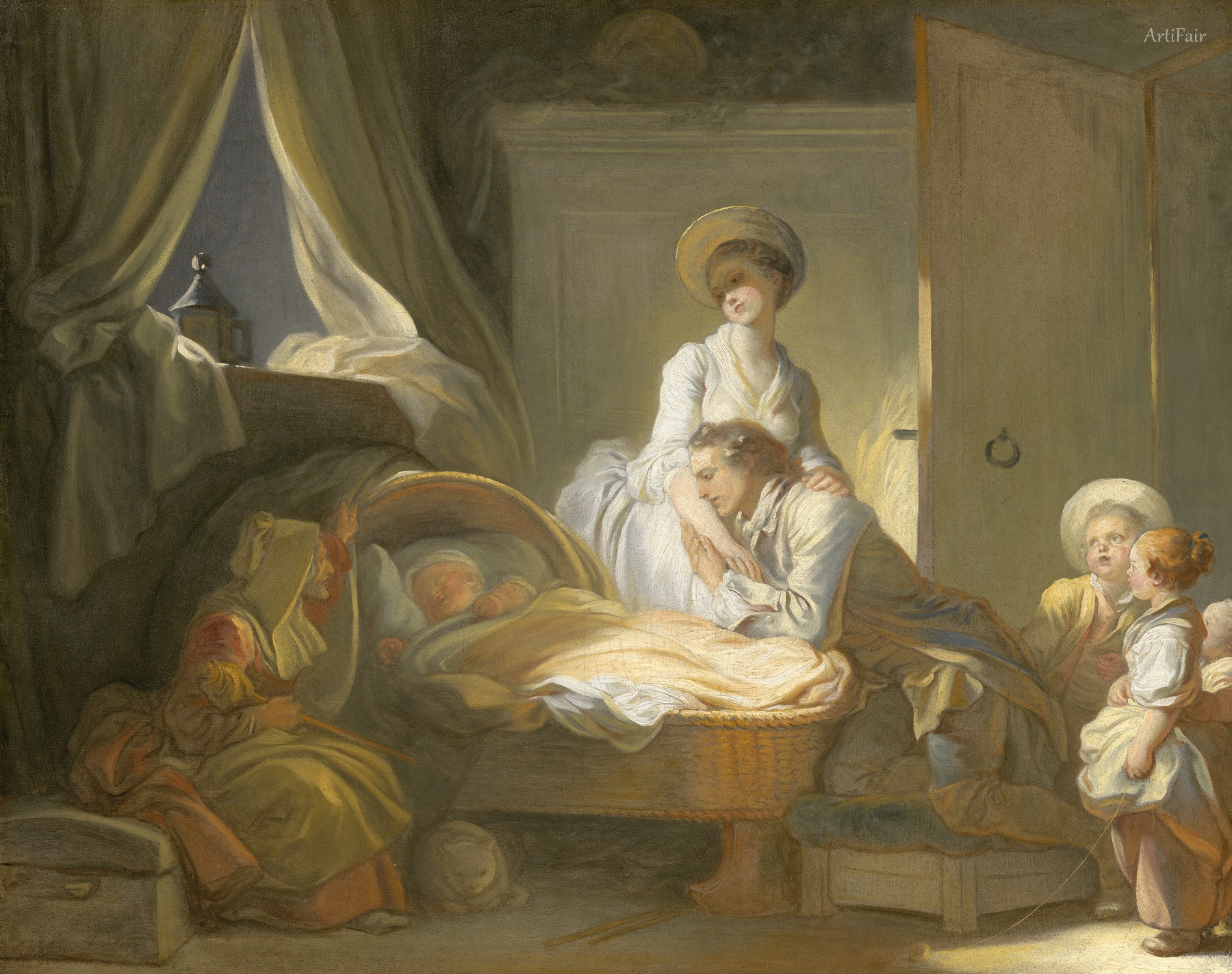
The Visit to the Nursery
Category:
Created:
1775
Likes:
0
Dimensions:
Download:
New users get 4 free credits. 2K costs 1 credit; 4K and Ultra HD are priced by resolution. Public domain artworks can be used commercially.
Dominant colors
Public domain download summary
This artwork is provided as a public domain image resource. The 2K file costs 1 credit for everyday creative work, while 4K and Ultra HD files are priced by resolution.
Art Appreciation
The Visit to the Nursery (La Visite à la nourrice) is an oil painting on canvas by Jean-Honoré Fragonard, made around 1775 and in the National Gallery of Art, Washington, since 1946 as part of the Samuel H. Kress Collection (accession 1946.7.7).
Fragonard is usually remembered for playful, mildly erotic subjects, but in the 1770s he also painted scenes of family life, and this is one of his most ambitious. A young couple and their older children have come to see their newest baby, asleep in a wicker cradle beside the old wet nurse who sits at the left. The father kneels and rests his head on the cradle while the mother, in a white dress and wide hat, leans over him; two children peer in at the open door on the right. The French Wikipedia article suggests the scene probably illustrates Jean-François de Saint-Lambert's tale Sara Th., and the Web Gallery of Art points to a close relationship with an engraving designed by Jean-Michel Moreau and published in 1776.
The canvas measures 73 × 92.1 cm. It was long identified with a picture owned by the tax farmer Jean François Leroy de Sennéville, one of Fragonard's main patrons, which was offered at his sale in April 1780 without finding a buyer and sold again in 1784. According to the English Wikipedia article, a painting that fits the old sale description more closely was rediscovered around 2009 in Estonia, so the Washington canvas's early history is now less certain.
The documented history of this canvas runs from the Burat family in Paris, who owned it by 1883 and lent it to exhibitions in 1907 and 1921, to Wildenstein & Co., which showed it in New York in 1939 and sold it to the Samuel H. Kress Foundation in 1942.