
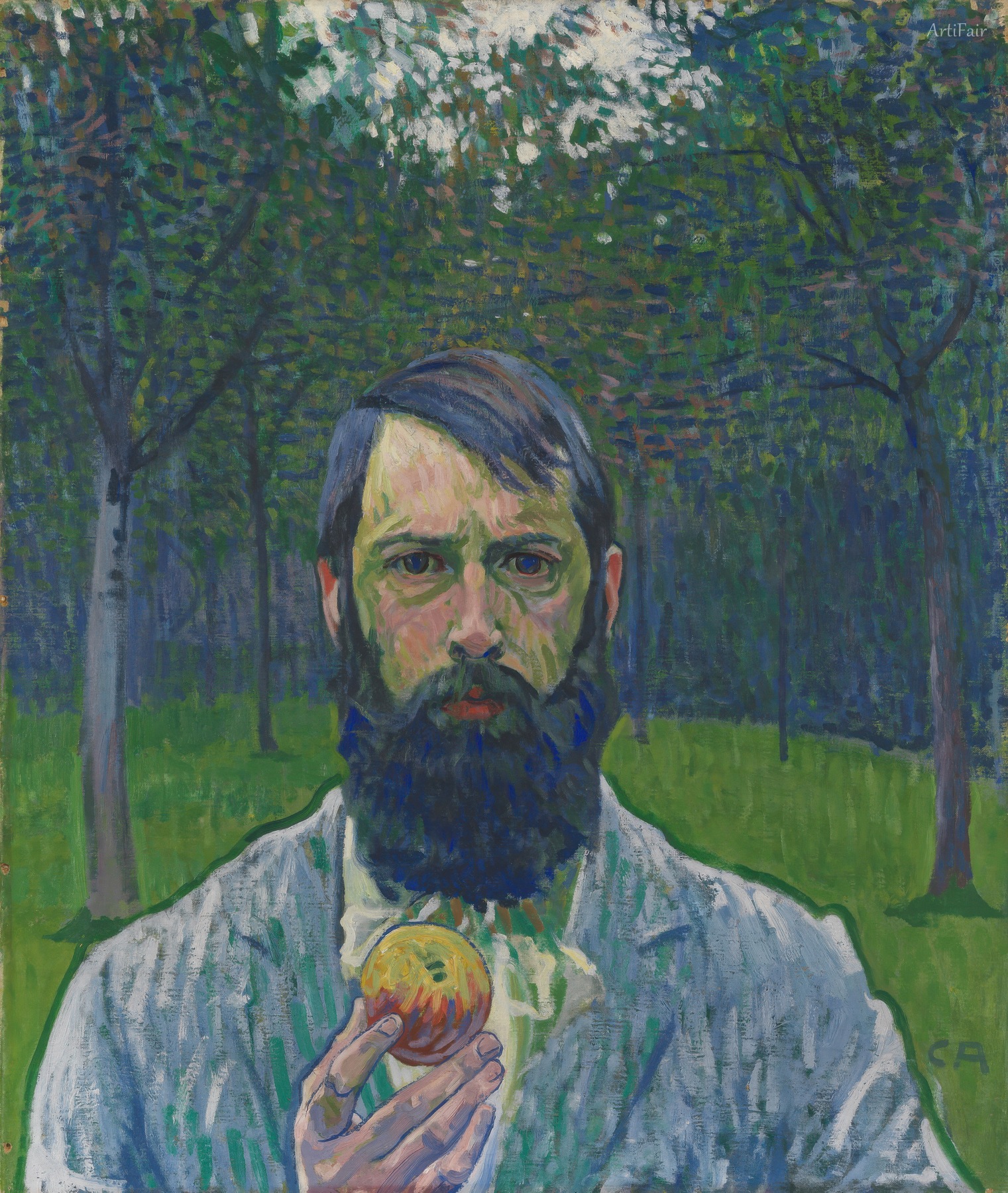
Self-Portrait with Apple
Category:
Created:
1901
Likes:
0
Dimensions:
Download:
New users get 4 free credits. 2K costs 1 credit; 4K and Ultra HD are priced by resolution. Public domain artworks can be used commercially.
Dominant colors
Public domain download summary
This artwork is provided as a public domain image resource. The 2K file costs 1 credit for everyday creative work, while 4K and Ultra HD files are priced by resolution.
Art Appreciation
Self-Portrait with Apple (Selbstbildnis mit Apfel) is an oil on canvas by Cuno Amiet, painted in 1901 and 1902; measuring 64.5 by 54 centimetres, it belongs to a private collection and has been on loan to the Kunstmuseum Solothurn since 2002.
Amiet shows himself as a bearded half-length figure pressed close to the lower edge of the picture, set beneath a canopy of fruit trees, one hand rising into view to hold an apple up into the light. He was an unusually prolific painter of his own likeness — around two hundred painted self-portraits from the years 1883 to 1961 are recorded — yet most of them test stylistic means rather than probe his psychology; here, by contrast, the Solothurn museum reads a convincing display of artistic self-confidence. The first reviewer already sensed this in 1902, writing of the man holding an apple that he 'thinks and wills', that an extraordinary will emanates from him and that he dominates the viewer without even looking at them.
In August 1902 Amiet travelled with his wife Anna to Dresden and went on to Berlin and Munich to study old masters and current art. The artist who impressed him most was Hans Thoma, whose self-portraits appear to have suggested this composition's low-set figure, its screen of fruit trees and the hand entering from below; the grave expression and symmetrically placed trees recall Ferdinand Hodler, while the frontal, iconic pose was a topos of symbolist portraiture already found among painters of the Pont-Aven circle. The light falling through the leaf canopy like a cupola and the ostentatious apple — a motif that recurs throughout Amiet's work — lend a sacral note.
The picture's early ownership was eventful: held by Oscar Miller-Sieber in Biberist until September 1910, it passed back through Amiet's hands to the Frankfurter Kunstverein in February 1911, then to the Frankfurt collectors Edgar Bolz and Harry Fuld, was auctioned at Galerie Jürg Stuker in Bern on 21 May 1953 (lot 4027) and shown at the Kunsthalle Bern in 1958 (no. 18) before entering the Solothurn museum as a loan.