
Truth, Time and History
Category:
Created:
Date unknown
Likes:
0
Dimensions:
Download:
New users get 4 free credits. 2K costs 1 credit; 4K and Ultra HD are priced by resolution. Public domain artworks can be used commercially.
Dominant colors
Public domain download summary
This artwork is provided as a public domain image resource. The 2K file costs 1 credit for everyday creative work, while 4K and Ultra HD files are priced by resolution.
Art Appreciation
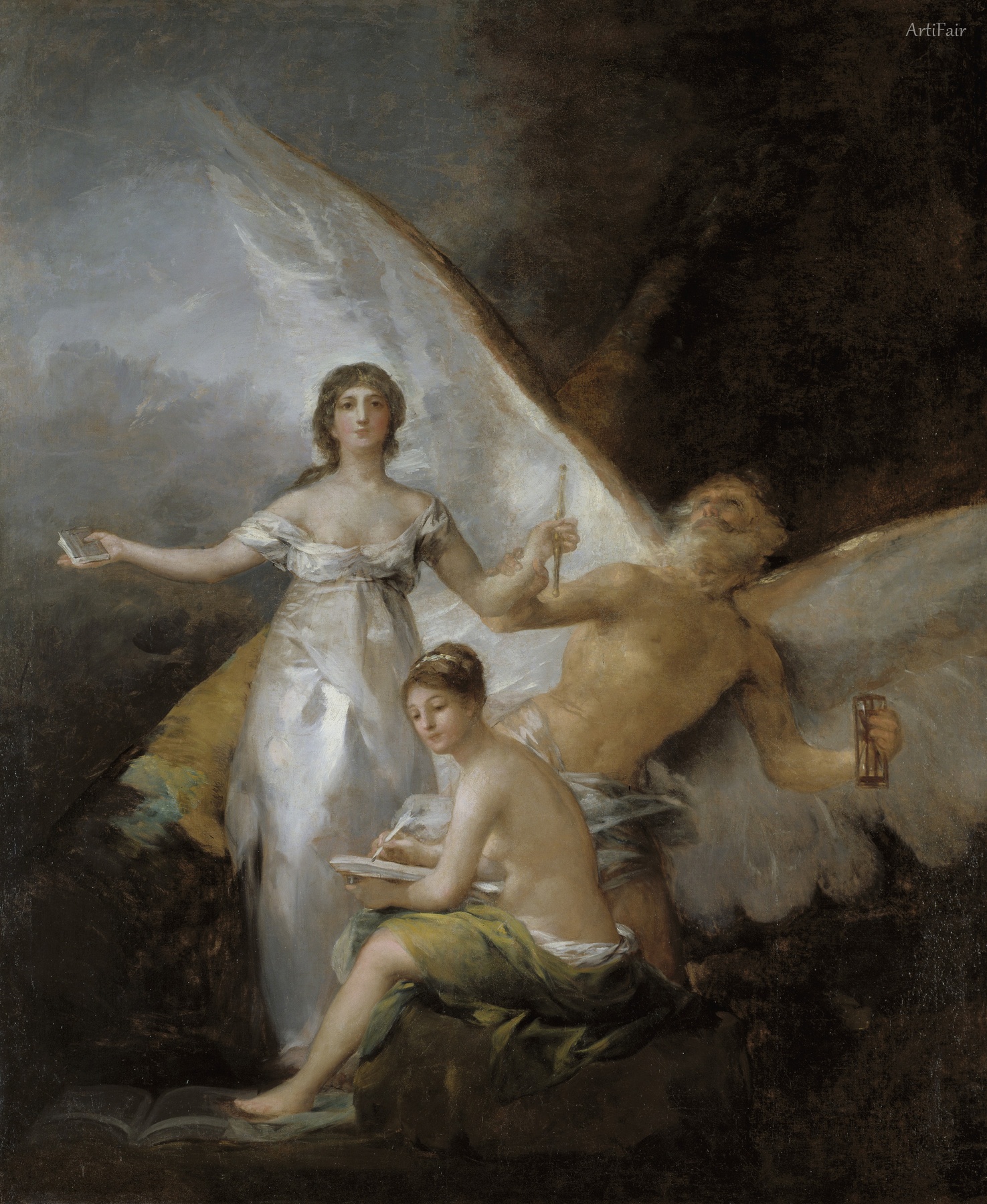
Truth, Time and History (La Verdad, el Tiempo y la Historia) is a large oil on canvas by Francisco Goya, usually dated 1804–1808, in the Nationalmuseum, Stockholm (NM 5593). It measures 294 × 244 cm and is also known as Spain, Time and History or Allegory of the Constitution of 1812.
Three allegorical figures fill the canvas. Winged, bearded Time, holding an hourglass, grips the arm of a young woman in a white satin gown who carries a sceptre and a small book; in front of them History sits half-nude on a rock, writing with a quill, an open volume lying at her feet. The light falls from the upper left onto the standing woman while the right side stays in shadow. Spanish commentators note the vigorous brushwork, which models the drapery and Time's feathers without fussing over detail.
The meaning of the central figure, and with it the date, is disputed. Martin S. Soria read her as Spain led by Time toward a brighter future and placed the picture around 1797, pointing to the influence of Cesare Ripa's Iconologia; Folke Nordström compared her to personifications of Philosophy. Eleanor Sayre linked the work to the liberal Constitution of Cádiz of 1812, an interpretation the Nationalmuseum follows: its catalogue describes the woman as both Truth and Spain, holding the new constitution. Dates proposed range from 1797 to 1812. Goya's related oil sketch, in which a nude Truth is threatened by owls and bats, is in the Museum of Fine Arts, Boston.
The painting may have been made with a companion allegory of Poetry, perhaps for Manuel Godoy's palace in Madrid, though this cannot be documented. The two were first recorded in 1867 in the collection of Juan Duncan Shaw, Austrian consul in Cádiz. Later owners included Luis de Navas in Madrid and the American collector Charles Deering; after Deering's death in 1927 it passed to E. & A. Silberman Galleries in New York, and the Nationalmuseum acquired it in 1961.