
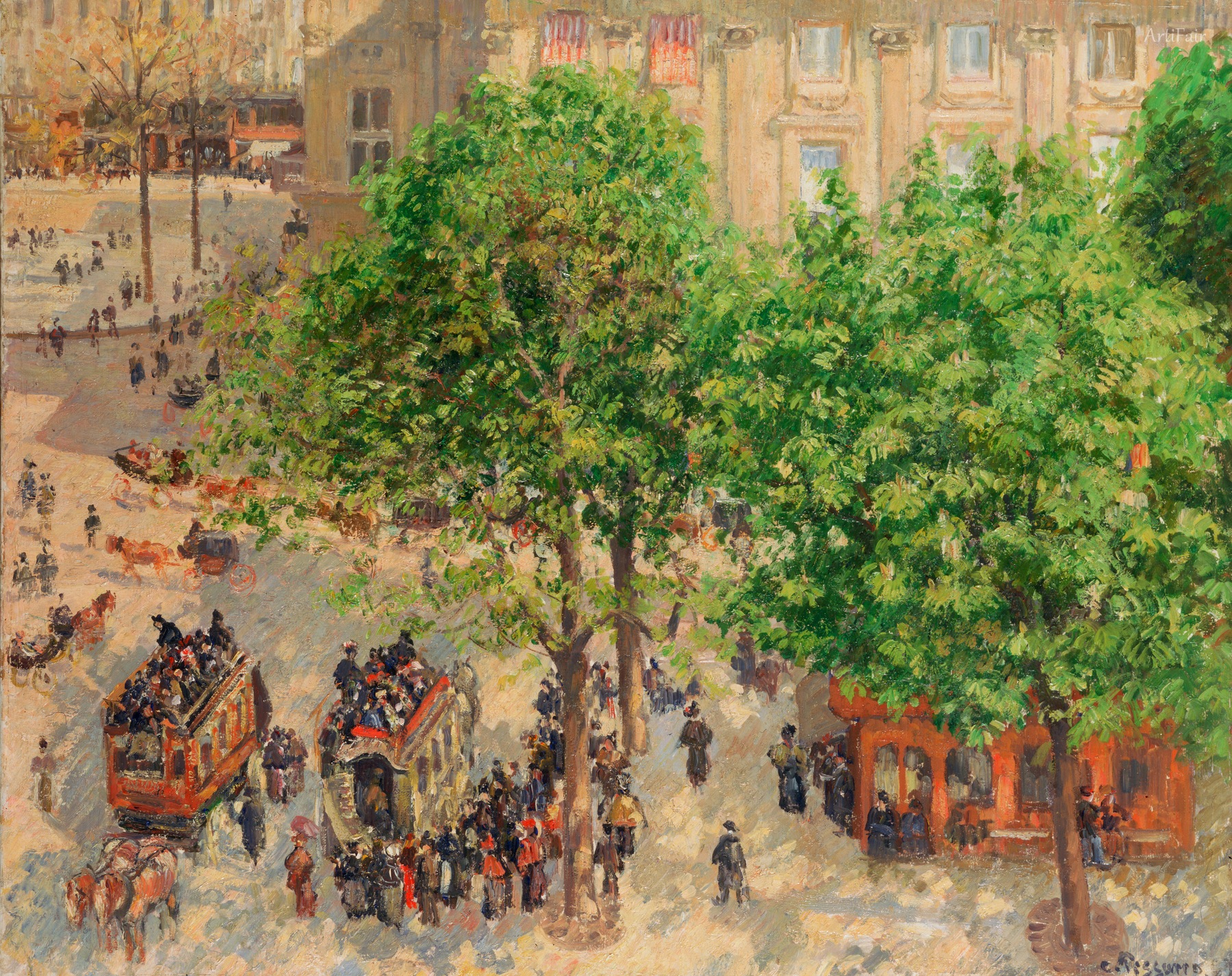
Place du Théâtre-Français, Spring
Category:
Created:
1898
Likes:
0
Dimensions:
Download:
New users get 4 free credits. 2K costs 1 credit; 4K and Ultra HD are priced by resolution. Public domain artworks can be used commercially.
Dominant colors
Public domain download summary
This artwork is provided as a public domain image resource. The 2K file costs 1 credit for everyday creative work, while 4K and Ultra HD files are priced by resolution.
Art Appreciation
Place du Théâtre-Français, Spring is an oil on canvas painted by Camille Pissarro in 1898, the last of his series of views over the square and the Avenue de l'Opéra from the Hôtel du Louvre; it is in the State Hermitage Museum, St Petersburg.
In December 1897 Pissarro wrote to his son Lucien that he had found a room at the Grand Hôtel du Louvre with a fine view of the Avenue de l'Opéra and the corner of the Place du Palais-Royal, adding that he was delighted to paint streets people called ugly but which were so silvery, luminous and alive. He began work there in January 1898 for a one-man show planned by his dealer Paul Durand-Ruel. In all he painted fifteen views from this vantage point. This canvas, signed and dated lower right, is thought to have been painted in early April 1898, although the authors of the Pissarro catalogue raisonné believe he reworked it in his studio at Éragny in April and May.
Almost every other picture in the series shows winter or the very start of spring, with bare trees and the view angled towards the avenue. Here the chestnuts in the foreground are in full green leaf, and Pissarro looks down on the square itself, today Place André-Malraux: passengers queue to board two horse-drawn omnibuses, a small pavilion serves as a waiting room, and the Palais-Royal, home of the Comédie-Française, closes the view. The foreground trees are built up in short, thick strokes, the distance in thinner, smoother paint.
The series was shown at Durand-Ruel's gallery from late May 1898. On 2 June the dealer sold this canvas for 4,000 francs to the Moscow industrialist Pyotr Shchukin; after his death in 1912 it passed to his brother Sergei Shchukin. Nationalised after the 1917 Revolution, it went to the State Museum of New Western Art and in 1930 to the Hermitage. It measures 65.5 by 81.5 cm.