
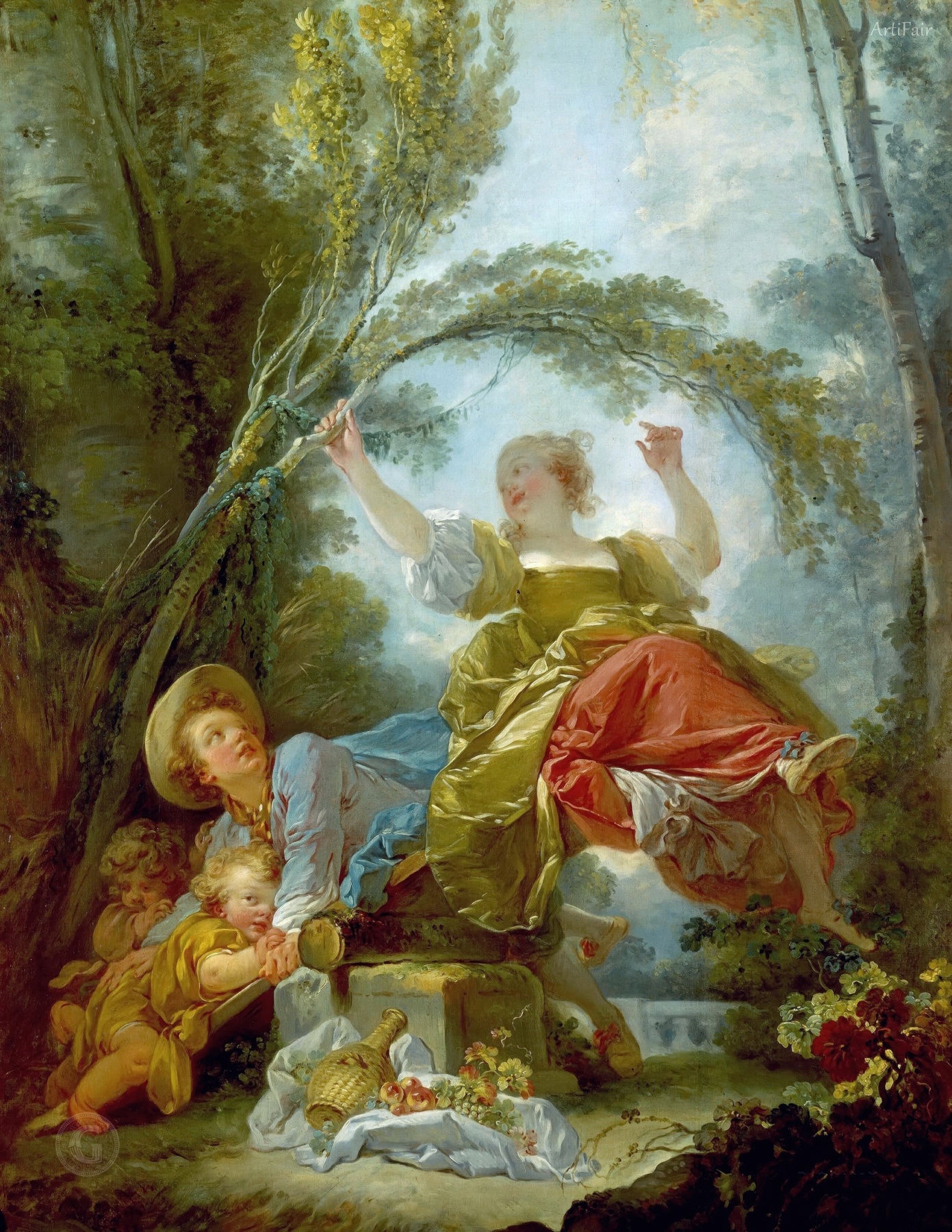
The See-Saw
Category:
Created:
1750
Likes:
0
Dimensions:
Download:
New users get 4 free credits. 2K costs 1 credit; 4K and Ultra HD are priced by resolution. Public domain artworks can be used commercially.
Dominant colors
Public domain download summary
This artwork is provided as a public domain image resource. The 2K file costs 1 credit for everyday creative work, while 4K and Ultra HD files are priced by resolution.
Art Appreciation
The See-Saw (La Bascule) is an oil painting on canvas by Jean-Honoré Fragonard, made around 1750–1752 early in his career and now in the Museo Nacional Thyssen-Bornemisza, Madrid (inv. 148).
The picture dates from before Fragonard's first journey to Italy, when he was a pupil in François Boucher's studio; he won the Prix de Rome in 1752, trained at the École royale des élèves protégés under Carle Van Loo from 1753 to 1756, and then spent the years 1756 to 1761 in Rome. Even at this early stage, the museum notes, the work already shows the subjects and handling that would later make him popular.
A girl in an olive-green bodice and red skirt is lifted into the air on a plank while a boy in a straw hat and two small children bear down on the other end. A wine flask, flowers and fruit lie on a white cloth in the foreground, and slender trees and leafy branches fill the canvas. The diagonal of the rising girl gives the scene its movement, and the brushwork is loose and the colours bright. The painting is the pendant to Blind Man's Buff in the Toledo Museum of Art; one reading is that the earlier picture is about courtship and the rocking see-saw hints at a relationship already consummated. It is regarded as an important forerunner of Fragonard's The Swing in the Wallace Collection.
Both pendants belonged to Baron Saint-Julien, at whose posthumous sale in 1784 they fetched 500 livres; two years later they sold for 852 livres at the Morel sale. Because the 1784 catalogue describes larger canvases, it has been suggested they were cut down at the top, and Jacques-Firmin Beauvarlet's engravings show more foliage and sky. Later owned by the Rothschilds in Vienna and Pregny, the pair was split on the American market, and Baron Hans Heinrich Thyssen-Bornemisza bought The See-Saw in 1956. The canvas measures 120 × 94.5 cm.