
The Call
Category:
Created:
1902
Likes:
0
Dimensions:
Download:
New users get 4 free credits. 2K costs 1 credit; 4K and Ultra HD are priced by resolution. Public domain artworks can be used commercially.
Dominant colors
Public domain download summary
This artwork is provided as a public domain image resource. The 2K file costs 1 credit for everyday creative work, while 4K and Ultra HD files are priced by resolution.
Art Appreciation
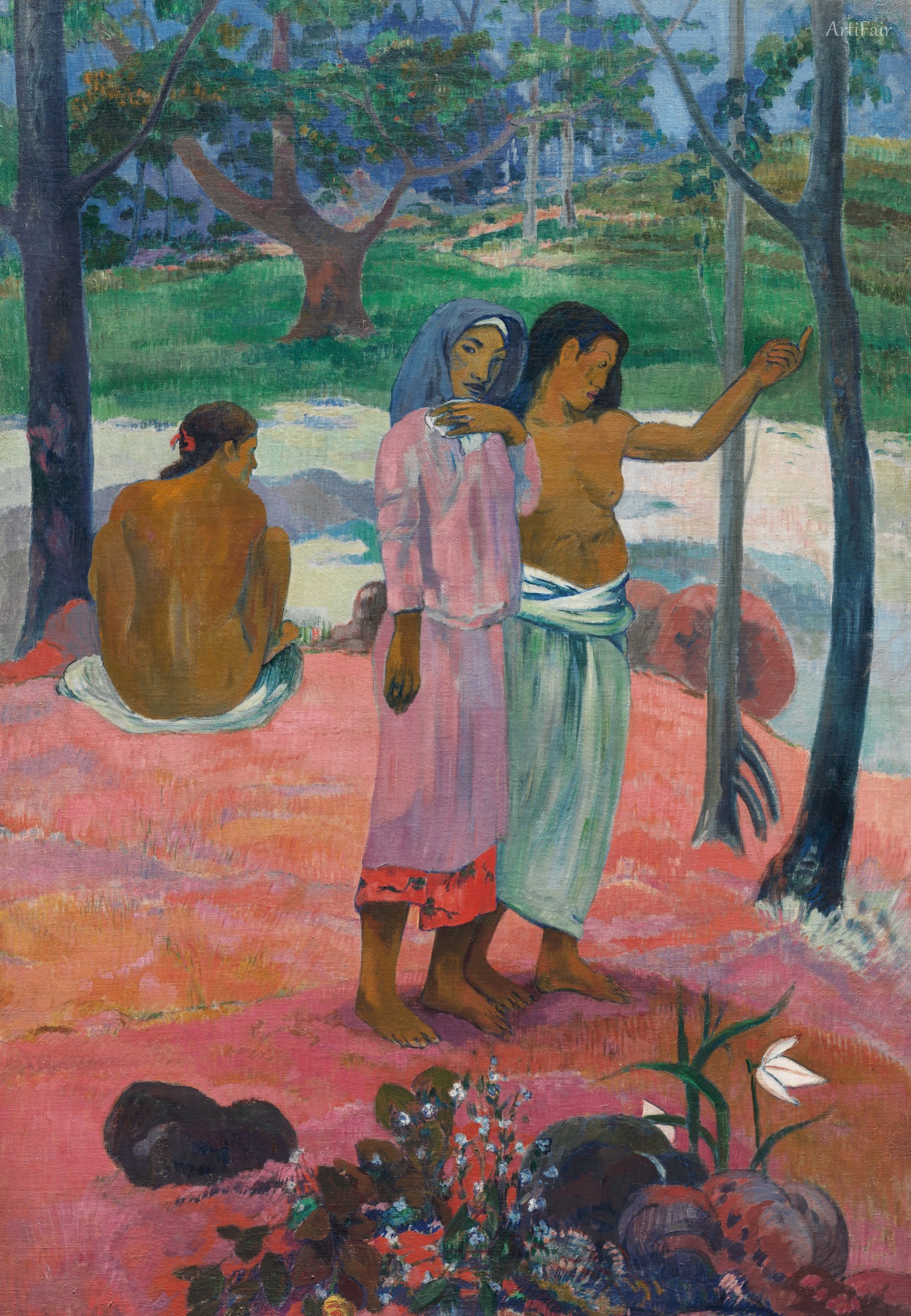
The Call (L'Appel) is an oil-on-canvas painting by Paul Gauguin from 1902, made in French Polynesia a year before his death and now in the Cleveland Museum of Art. It measures 131.3 by 89.5 cm and entered the museum in 1943 as a gift of the Hanna Fund.
Gauguin had left Tahiti in September 1901 and settled at Atuona on Hiva Oa in the Marquesas Islands, hoping to find new subjects there; Wikipedia places the making of The Call in the Marquesas. He sent twenty canvases to his dealer Ambroise Vollard the following April, and later work from these islands is often hard to tell apart from his Tahitian pictures. The Cleveland museum groups The Call with a series of late paintings in which he explored the mysteries of life and death, and presents it as an example of his aim of painting from memory and imagination rather than from direct observation.
Two women stand barefoot at the centre, as if on sacred ground. One wears a long pink dress and headscarf; the other, bare to the waist, stretches an arm towards someone outside the frame, perhaps answering a call from fate or destiny, in the museum's reading. A third woman sits with her back to us at the left, and the scene is set on pink earth between slender tree trunks, with flowers and stones along the bottom edge. Although Gauguin is known as one of the founders of modern art, he drew on ancient Greek, Roman and Egyptian sources: the pointing figure on the right was taken from the Parthenon frieze.
The painting passed from Vollard to Baron Wolf Kohner in Budapest, who owned it by 1912, and then to Wildenstein & Co., which sold it to Cleveland on 9 November 1943. It has since been lent to exhibitions including the 1955 Gauguin show in Edinburgh and at the Tate in London and the 1959 Gauguin exhibition at the Art Institute of Chicago and the Metropolitan Museum of Art.