
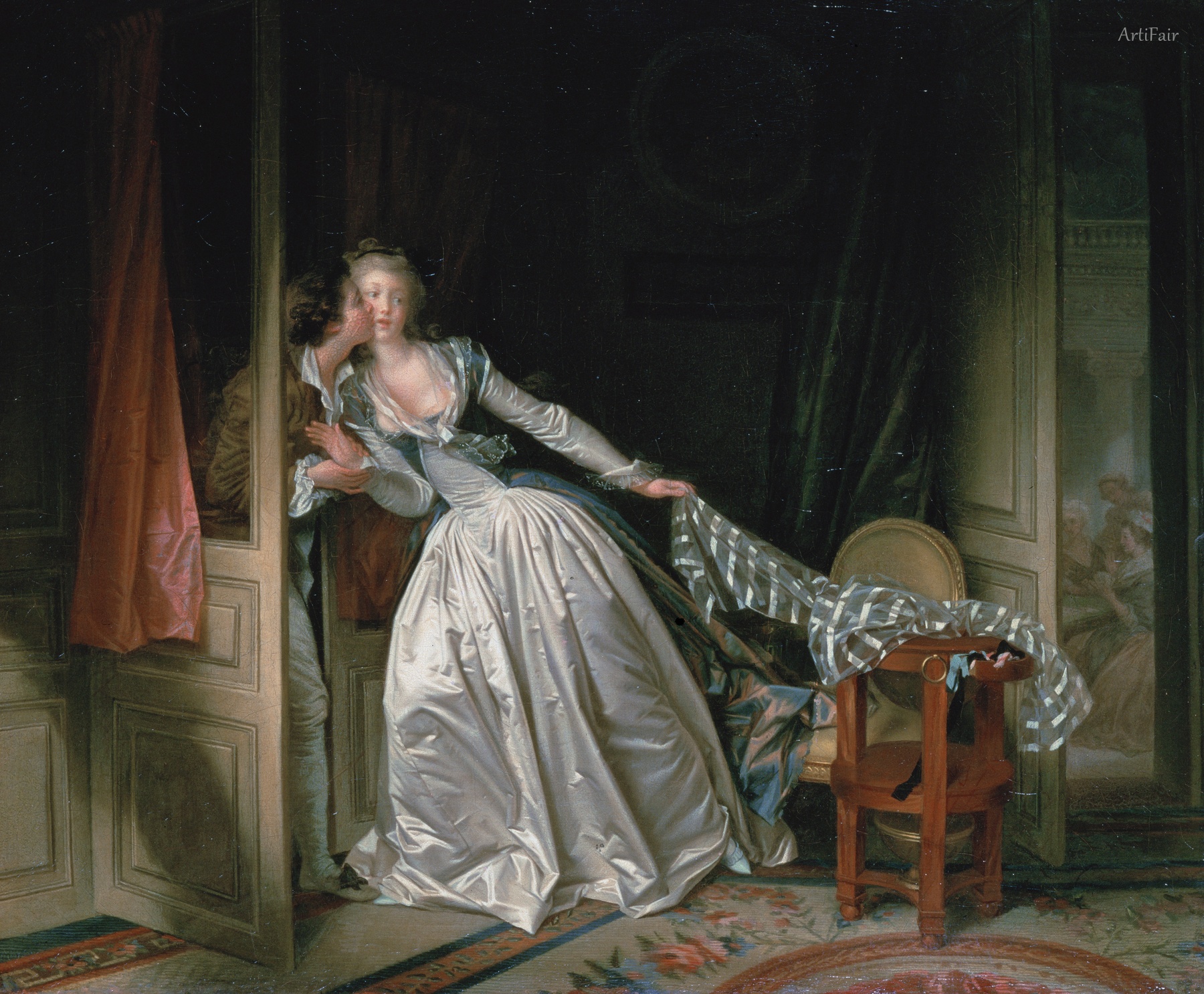
The Stolen Kiss
Category:
Created:
1780
Likes:
1
Dimensions:
Download:
New users get 4 free credits. 2K costs 1 credit; 4K and Ultra HD are priced by resolution. Public domain artworks can be used commercially.
Dominant colors
Public domain download summary
This artwork is provided as a public domain image resource. The 2K file costs 1 credit for everyday creative work, while 4K and Ultra HD files are priced by resolution.
Art Appreciation
The Stolen Kiss (Le Baiser à la dérobée) is an oil painting on canvas traditionally attributed to Jean-Honoré Fragonard, dated to the late 1780s and held by the State Hermitage Museum, Saint Petersburg; many scholars now see the hand of his pupil Marguerite Gérard in it.
The attribution to Fragonard rests on an engraving by Nicolas François Regnault, advertised in the Mercure de France in June 1788 as a companion to The Bolt. The smooth, enamel-like surface and the Dutch-style interior are, however, closer to the manner of Gérard, Fragonard's sister-in-law and apprentice, and the picture is variously catalogued as hers, as a joint work, or as Fragonard's. Hermitage curator Inna Nemilova based the late-1780s date on these technical and stylistic features.
The small canvas, about 45 × 55 cm, shows a young woman who has slipped away from her companions, still visible through a half-open door at the right, to be kissed by a young man leaning in from a side door. Her body, the long striped shawl in her hand and the table over which it falls form a strong diagonal, held in place by the vertical lines of the two doors. The sheen of her silk gown, the patterned carpet and the drapery show the attention to costly textures typical of such scenes of secret courtship, a favourite subject of pre-revolutionary French society.
By 1795 the painting was in the Royal Picture Gallery of Stanisław August Poniatowski, the last king of Poland, at the Łazienki Palace in Warsaw. The palace and its contents were sold to Tsar Alexander I in 1817, and in 1895 the picture was moved to the Hermitage. Poland asked for its return after 1918, but in 1922 it received instead the smaller Polish Woman, then attributed to Watteau, now in the National Museum in Warsaw.