
Henry Ford Hospital
Category:
Created:
1932
Likes:
0
Dimensions:
Download:
New users get 4 free credits. 2K costs 1 credit; 4K and Ultra HD are priced by resolution. Public domain artworks can be used commercially.
Dominant colors
Public domain download summary
This artwork is provided as a public domain image resource. The 2K file costs 1 credit for everyday creative work, while 4K and Ultra HD files are priced by resolution.
Art Appreciation
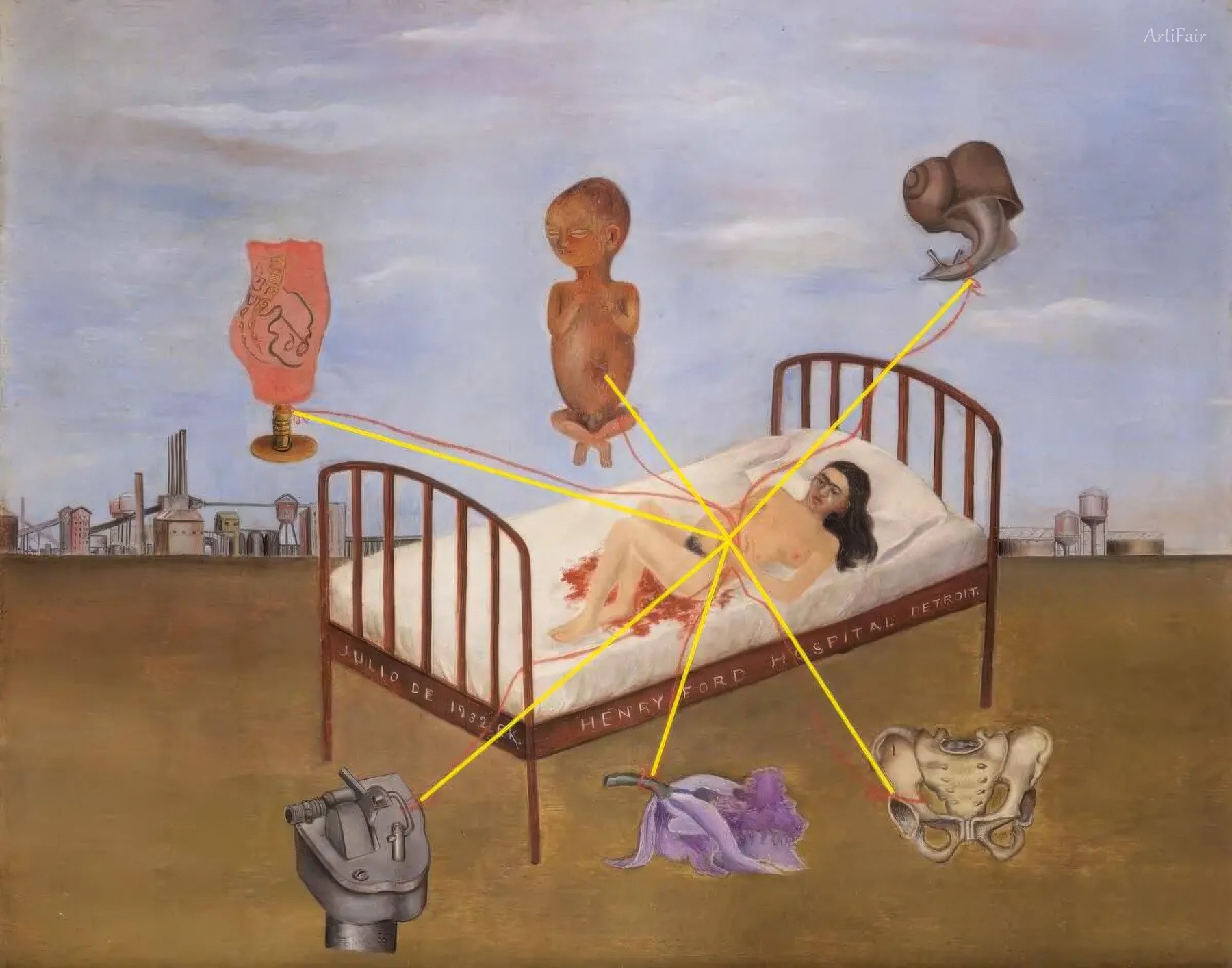
Henry Ford Hospital is a 1932 oil-on-metal painting by Frida Kahlo, made after the miscarriage she suffered in Detroit that July; it belongs to the Museo Dolores Olmedo in Mexico City. Kahlo and Diego Rivera were living in Detroit while he painted his Detroit Industry murals at the Detroit Institute of Arts, a commission funded by Edsel Ford. On the night of 4 July 1932 Kahlo, who was about three and a half months pregnant, lost the pregnancy and remained in hospital until 17 July; the picture she made afterward was first titled The Lost Desire and is also known as The Flying Bed (La cama volando).
In the painting Kahlo lies nude and weeping on a blood-stained hospital bed that floats in an empty landscape; the bed rail reads Henry Ford Hospital, and an industrial skyline — identified in the collection's catalogue as Ford's River Rouge complex — lines the horizon. Six red threads tether her body to floating objects: a male fetus, an anatomical model of the female reproductive organs, a snail, a grey machine resembling a piece of hospital equipment, a pelvic bone, and a lavender cattleya orchid that had been a gift from Rivera — the only orchid in her paintings. The thread reaching the fetus, the one line not tied in a bow, suggests an umbilical cord.
While in hospital Kahlo asked for medical illustrations of the fetus; doctors refused, and Rivera brought her anatomy textbooks instead. Direct depictions of pregnancy loss are rare in Western painting, and this small panel, 30.5 by 38 centimetres, is frequently cited by historians and in medical humanities as an image of reproductive grief. It was shown in her 1938 New York exhibition as Lost Desire and in Paris in 1939 as Le désir perdu.