
The Magpie
Category:
Created:
1868
Likes:
1
Dimensions:
Download:
New users get 4 free credits. 2K costs 1 credit; 4K and Ultra HD are priced by resolution. Public domain artworks can be used commercially.
Dominant colors
Public domain download summary
This artwork is provided as a public domain image resource. The 2K file costs 1 credit for everyday creative work, while 4K and Ultra HD files are priced by resolution.
Art Appreciation
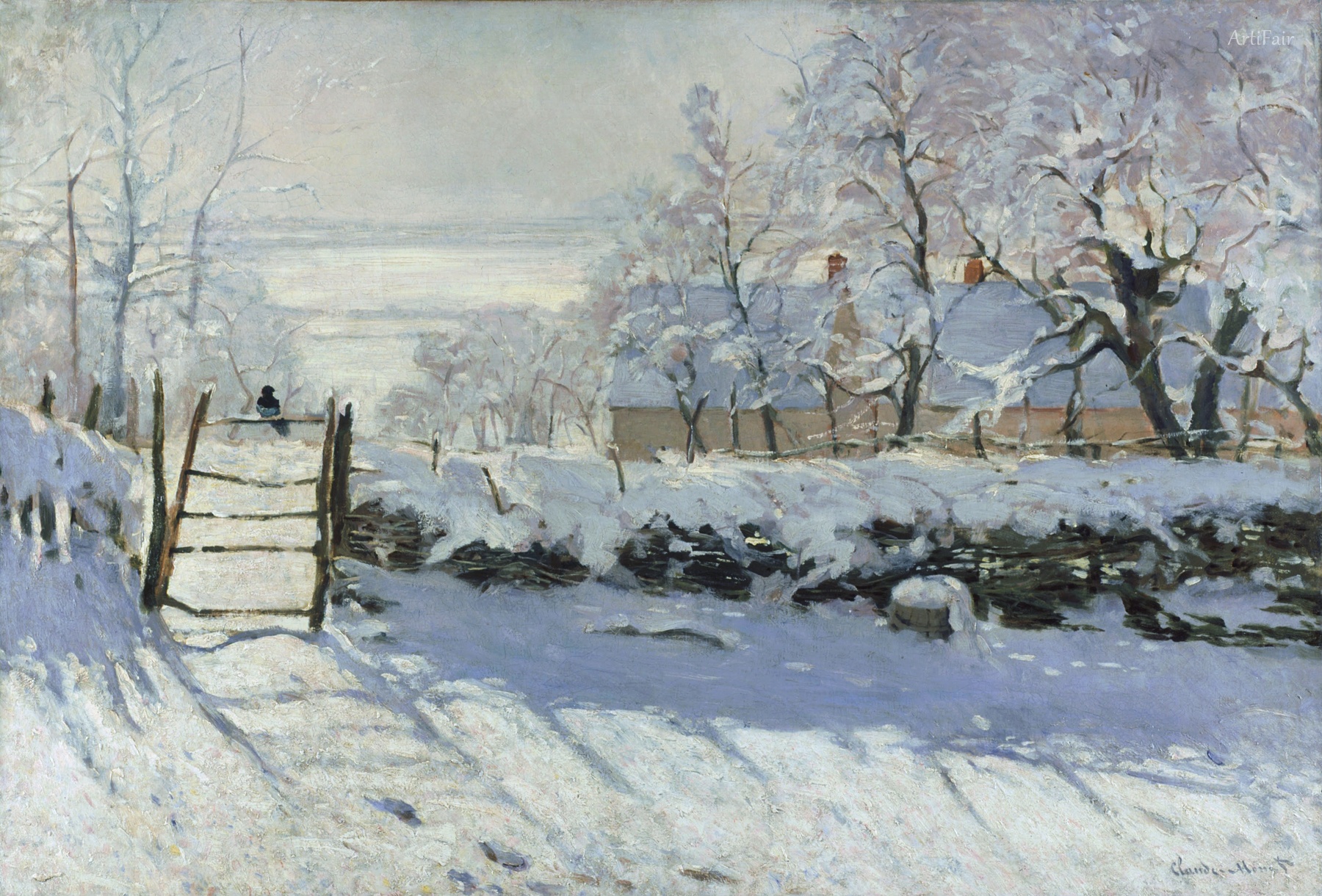
The Magpie (La Pie) is an oil on canvas painted by Claude Monet near Étretat in Normandy during the winter of 1868–69; it is in the Musée d'Orsay, Paris.
In late 1868 Monet's patron Louis-Joachim Gaudibert helped him rent a house at Étretat for his companion Camille Doncieux and their infant son Jean. Monet joined them there in October after a period of depression, and by December he was writing to Frédéric Bazille that he found the countryside perhaps even more charming in winter than in summer and preferred to work alone in nature, away from Paris. Among the canvases of that stay was this snowscape, one of about 140 winter landscapes he painted and the largest of them, at 89 by 130 cm.
There are no figures. A single black magpie sits on a gate in a wattle fence, and sunlight falling on fresh snow throws long shadows that Monet painted blue and violet rather than grey or black. The picture is an early example of his use of coloured shadows, an approach later associated with Impressionism and linked to the colour theories of Goethe and Chevreul. Behind the fence, house roofs and snow-laden trees fade into a hazy background, an effect of atmospheric perspective.
Monet sent The Magpie to the Salon of 1869 together with a seascape; both were rejected in April, a critic reporting that the jury found the painting too common and too coarse. Monet complained that the rejection had taken the bread from his mouth. The canvas remained in private hands, passing through the Carlander collection, the Durand-Ruel gallery and Guerlain, until the French state bought it in 1984 for the Musée d'Orsay, where it has become one of the most popular paintings in the collection.