
The Cornfield
Category:
Created:
1826
Likes:
0
Dimensions:
Download:
New users get 4 free credits. 2K costs 1 credit; 4K and Ultra HD are priced by resolution. Public domain artworks can be used commercially.
Dominant colors
Public domain download summary
This artwork is provided as a public domain image resource. The 2K file costs 1 credit for everyday creative work, while 4K and Ultra HD files are priced by resolution.
Art Appreciation
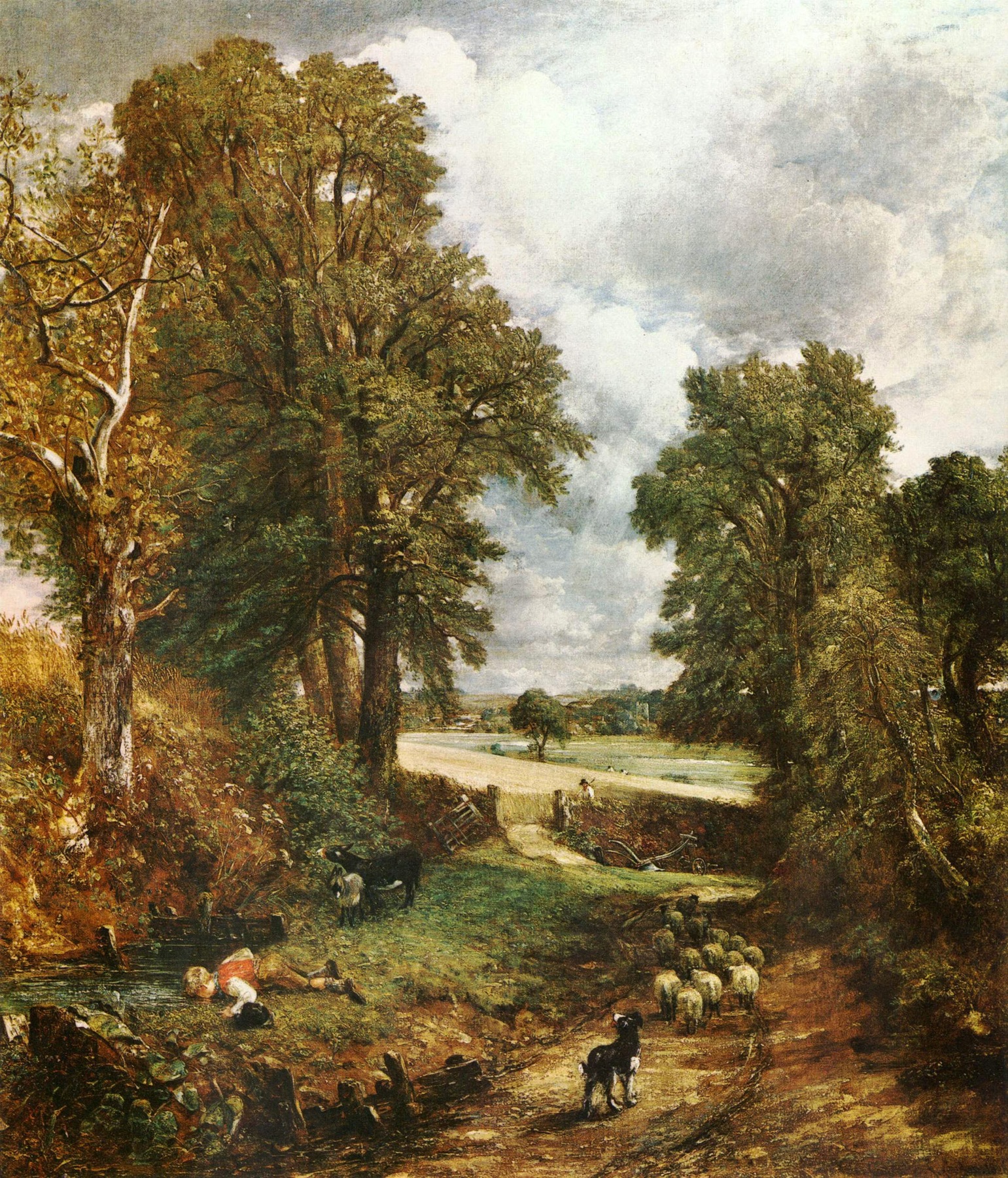
The Cornfield is an oil painting on canvas by John Constable, painted between January and March 1826 in his London studio, and held by the National Gallery, London, which received it in 1837 as the first of his works to enter the national collection.
The 143 × 122 cm picture shows a wooded lane in high summer, based on Fen Lane, the route Constable often walked as a schoolboy from his home village of East Bergholt to Dedham. In the left foreground a shepherd boy in a red waistcoat lies flat on the bank to drink from a pool, his hat beside him; a donkey and foal graze the verge, a dog is distracted from the flock of sheep moving down the lane, and an open gate leads to a field of tall wheat. Constable himself called the work The Drinking Boy. The distant village with its church tower was invented: his son Charles later said that view never existed.
Constable's first idea survives in a free oil sketch in the Indianapolis Museum of Art, followed by a study of the landscape alone now on loan to Birmingham; the drinking boy came from a sketch made about fifteen years earlier. On 1 March 1826 his friend the botanist Henry Phillips wrote listing the grasses and wild flowers that would bloom in such a lane in July. Constable told John Fisher he hoped the picture would sell, since it had a little more eye-salve than he usually gave, meaning picturesque details.
It was shown at the Royal Academy in 1826 and at the Paris Salon of 1827, and David Lucas engraved it for Constable's print series Various Subjects of Landscape. Despite praise it never sold. Shortly after the artist's death on 31 March 1837, 113 subscribers, among them Wordsworth, Faraday and Sir William Beechey, bought it from his estate for 300 guineas, gave it its present title and presented it to the Gallery.