
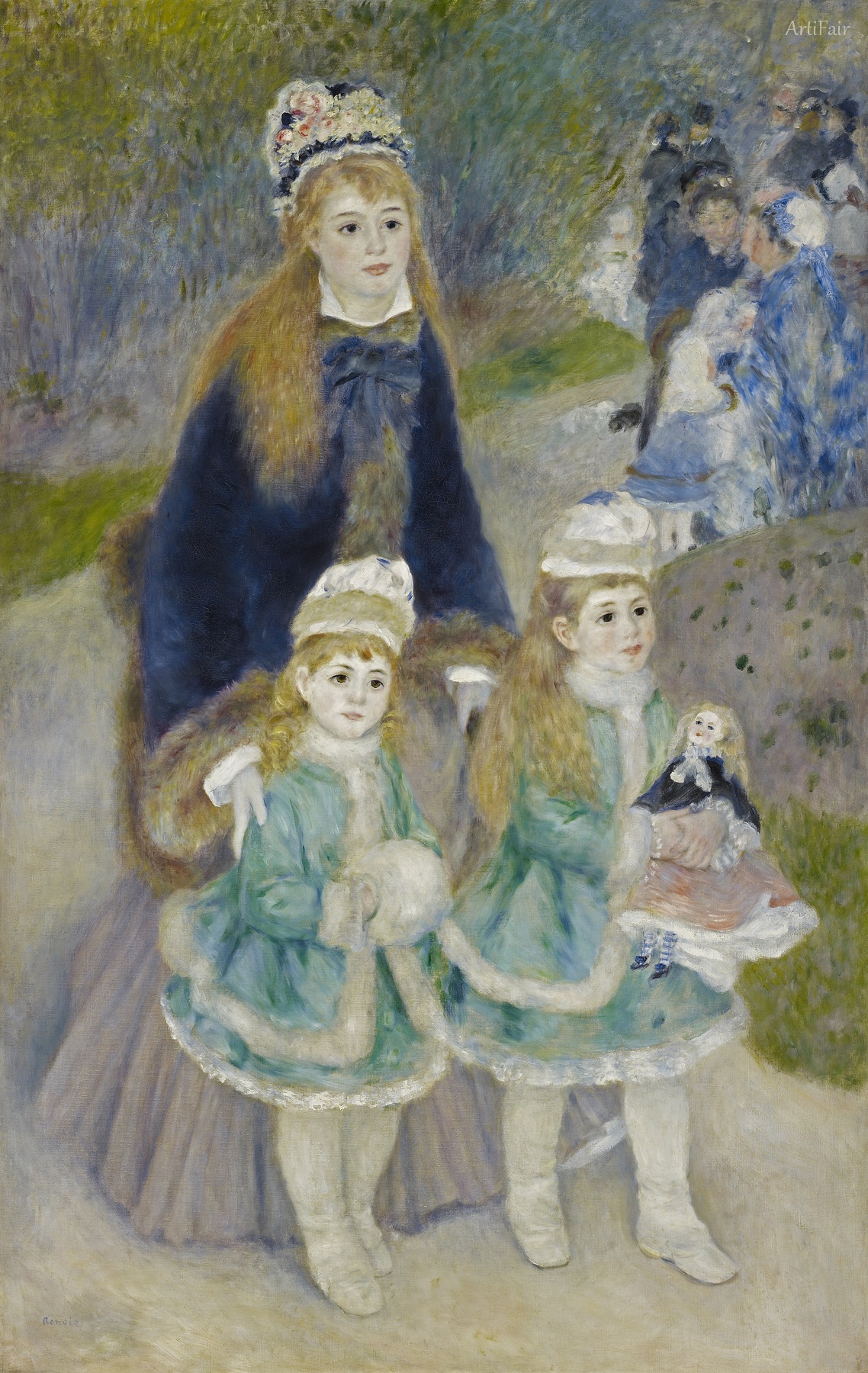
Mother and Children (La Promenade)
Category:
Created:
1875
Likes:
0
Dimensions:
Download:
New users get 4 free credits. 2K costs 1 credit; 4K and Ultra HD are priced by resolution. Public domain artworks can be used commercially.
Dominant colors
Public domain download summary
This artwork is provided as a public domain image resource. The 2K file costs 1 credit for everyday creative work, while 4K and Ultra HD files are priced by resolution.
Art Appreciation
Mother and Children, which Renoir himself exhibited as La Promenade, is a large oil on canvas painted by Pierre-Auguste Renoir in the winter of 1875–76; it has been in the Frick Collection, New York, since Henry Clay Frick acquired it in 1914.
At 170.2 × 108.3 cm, the canvas belongs to the group of near life-size figure paintings that Renoir attempted in the experimental decade of Impressionism. Its scale suggests a commissioned society portrait, but according to the Frick the evidence indicates that he hired professional models; French Wikipedia names Henriette Grossin as the model for the woman. Despite the familiar English title, the relationship between the figures is not documented: the Frick describes the young woman as perhaps a nanny or an older sister.
The scene is a well-kept Paris park on a cold day. The young woman wears a blue velvet jacket with wide sleeves trimmed with red fox, and steers two little girls in matching blue-green jackets edged with swansdown or white mink; the girl on the right carries a doll dressed as fashionably as she is. Farther up the path Renoir added eleven more figures and two dogs. The loose brushwork applied to a scene of modern Parisian life is characteristic of his Impressionist manner of these years.
Renoir sent seventeen paintings to the Second Impressionist Exhibition in April 1876, and La Promenade was the centrepiece of his display. To his dismay most critics ignored it, and those who wrote about it were unfavourable; one reviewer called the exhibition a cruel spectacle of works by lunatics, while another remarked that the eyes in Renoir's portraits seemed to jump off the canvas. The Frick later built its exhibition Renoir, Impressionism, and Full-Length Painting around the picture, which it calls the most significant Impressionist work in its permanent collection.