
The Triumph of Death
Category:
Created:
1562
Likes:
0
Dimensions:
Download:
New users get 4 free credits. 2K costs 1 credit; 4K and Ultra HD are priced by resolution. Public domain artworks can be used commercially.
Dominant colors
Public domain download summary
This artwork is provided as a public domain image resource. The 2K file costs 1 credit for everyday creative work, while 4K and Ultra HD files are priced by resolution.
Art Appreciation
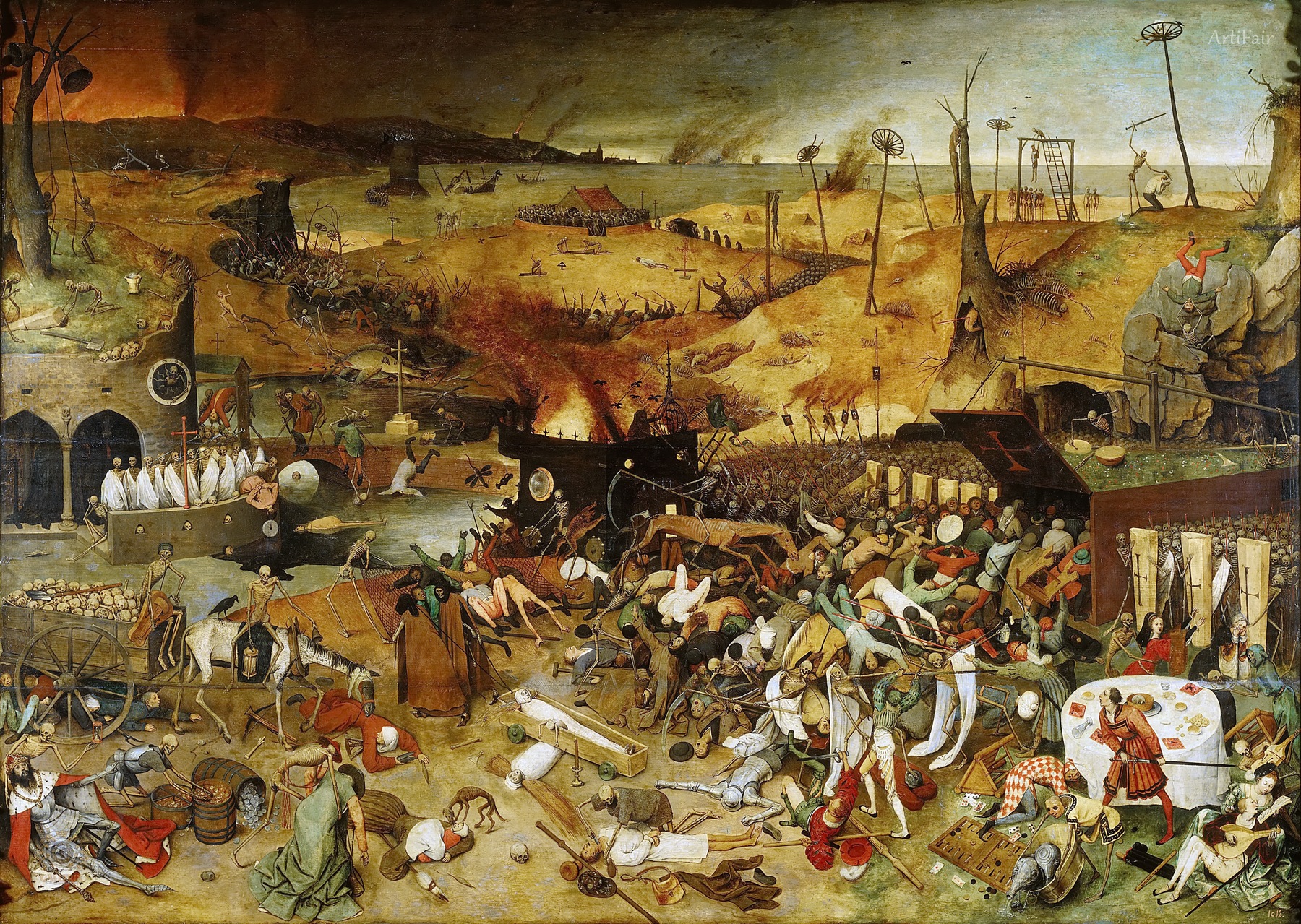
The Triumph of Death is an oil painting on oak panel by Pieter Bruegel the Elder, made around 1562; unsigned and undated, it has been in the Museo del Prado, Madrid, since 1827.
Bruegel combined two visual traditions here: the northern woodcuts of the Dance of Death and the Italian theme of the Triumph of Death, known from frescoes such as those in the Palazzo Sclafani in Palermo and the Camposanto in Pisa. Across a scorched, treeless panorama, with towns burning and shipwrecks on the sea, armies of skeletons attack the living. No one is spared: peasants and soldiers, nobles, a king and a cardinal are all taken. Skeletons ring a bell hung in a tree to announce the end of the world, drive people into a huge coffin-shaped trap marked with crosses, and kill with scythes, nets, the wheel, the gallows and the axe. A skeleton on a gaunt horse may allude to the Horsemen of the Apocalypse.
The foreground is full of pointed details. A dying king in armour reaches for his barrels of coins while a skeleton holds up an hourglass; a cardinal is led away by a skeleton wearing his red hat; a starving dog sniffs at a dead child. At lower right a banquet is broken up, a jester hides under the table among scattered cards and a backgammon board, and a young couple go on making music, unaware of the skeleton playing behind them. The scenes reflect the mid-sixteenth century, when the danger of plague was severe.
The painting was probably commissioned or bought by Vespasiano Gonzaga and appears in the 1637 estate inventory of his daughter Isabella. By 1745 it belonged to Queen Elisabeth Farnese of Spain at the palace of La Granja. Relatives of Bruegel made at least five copies. A restoration in the 2010s removed yellowed varnish and old overpaint. It measures 117 × 162 cm.