
Mariana
Category:
Created:
1851
Likes:
1
Dimensions:
Download:
New users get 4 free credits. 2K costs 1 credit; 4K and Ultra HD are priced by resolution. Public domain artworks can be used commercially.
Dominant colors
Public domain download summary
This artwork is provided as a public domain image resource. The 2K file costs 1 credit for everyday creative work, while 4K and Ultra HD files are priced by resolution.
Art Appreciation
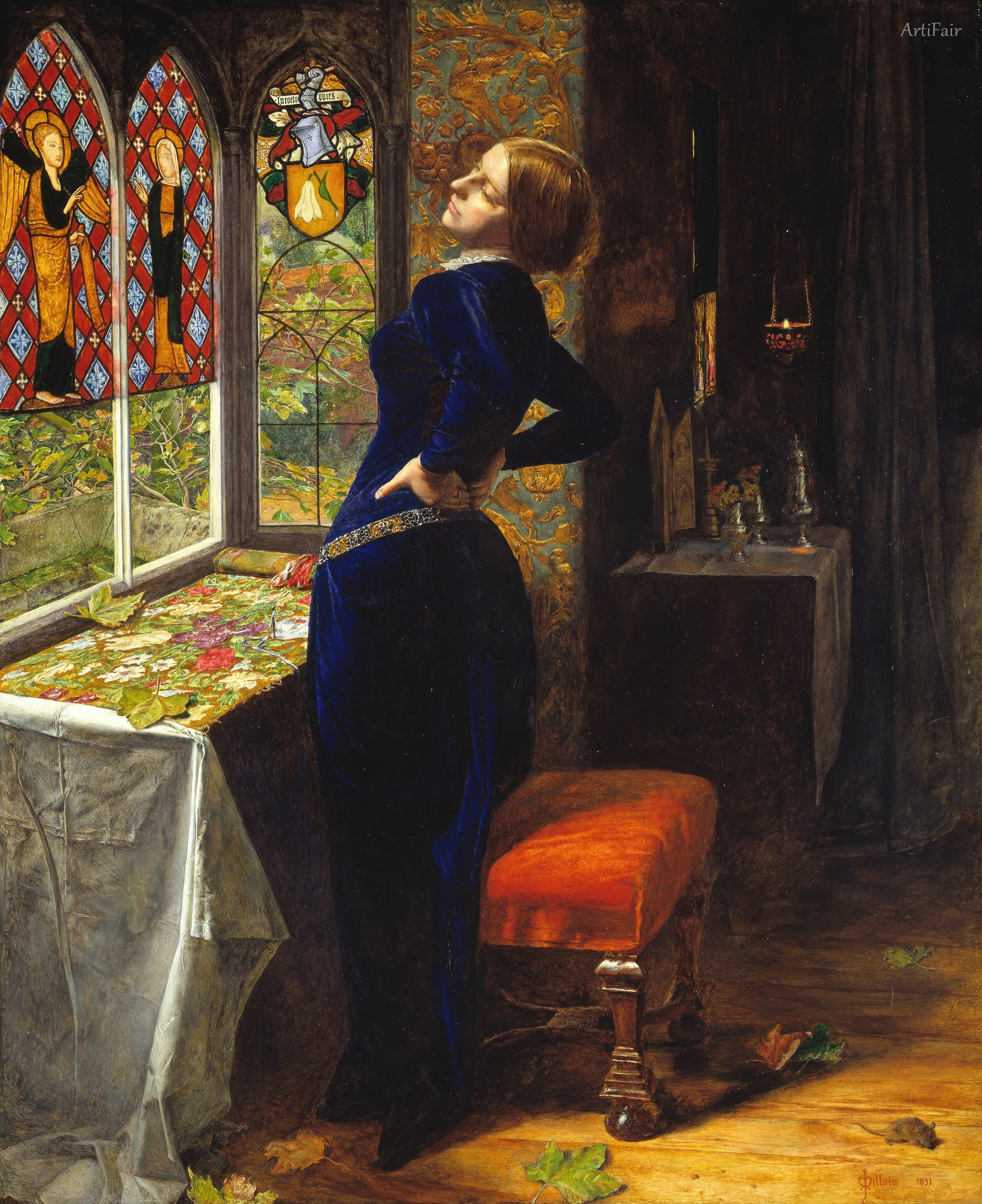
Mariana is an oil painting on a mahogany panel by John Everett Millais, shown at the Royal Academy in 1851 and held by Tate in London since 1999.
The subject comes from Shakespeare's Measure for Measure by way of Alfred Tennyson's 1830 poem 'Mariana'. Abandoned by her fiancé Angelo after her dowry was lost in a shipwreck, Mariana lives alone in a moated grange, still longing for him. At the Academy the picture was hung with lines from the poem: 'She only said, My life is dreary, He cometh not, she said'. Tennyson had been made Poet Laureate in November 1850, which gave the subject a certain topicality, and Millais may have meant the work as a companion to William Holman Hunt's Claudio and Isabella of 1850, another scene from the same play.
Mariana rises from her embroidery to stretch her back, her needle pushed hard into the cloth, while autumn leaves blown in from the garden lie on the table and floor as a sign of passing time. The stained glass shows the Annunciation, copied from a window in the chapel of Merton College, Oxford; the coat of arms beside it, with a snowdrop and the motto 'In coelo quies' (in Heaven there is rest), appears to be Millais's own invention. A mouse at lower right is taken straight from Tennyson's lines, and the small altar with a triptych may allude to his later poem 'Mariana in the South'.
Tate's technical study found the 59.7 by 49.5 cm panel thickly primed in white, with graphite underdrawing visible in infra-red; much of the paint is laid thinly in small hatches to exploit that bright ground, and the dress combines Prussian blue and ultramarine. John Ruskin singled out the white drapery on the table in his defence of the Pre-Raphaelites in May 1851. The painting belonged to the Makins family, whose collection was begun by Henry Francis Makins, a friend of Millais, and it was accepted in lieu of £4.2 million of inheritance tax on the estate of Roger Makins, 1st Baron Sherfield, before allocation to Tate.