
The Death of Marat
Category:
Created:
1793
Likes:
1
Dimensions:
Download:
New users get 4 free credits. 2K costs 1 credit; 4K and Ultra HD are priced by resolution. Public domain artworks can be used commercially.
Dominant colors
Public domain download summary
This artwork is provided as a public domain image resource. The 2K file costs 1 credit for everyday creative work, while 4K and Ultra HD files are priced by resolution.
Art Appreciation
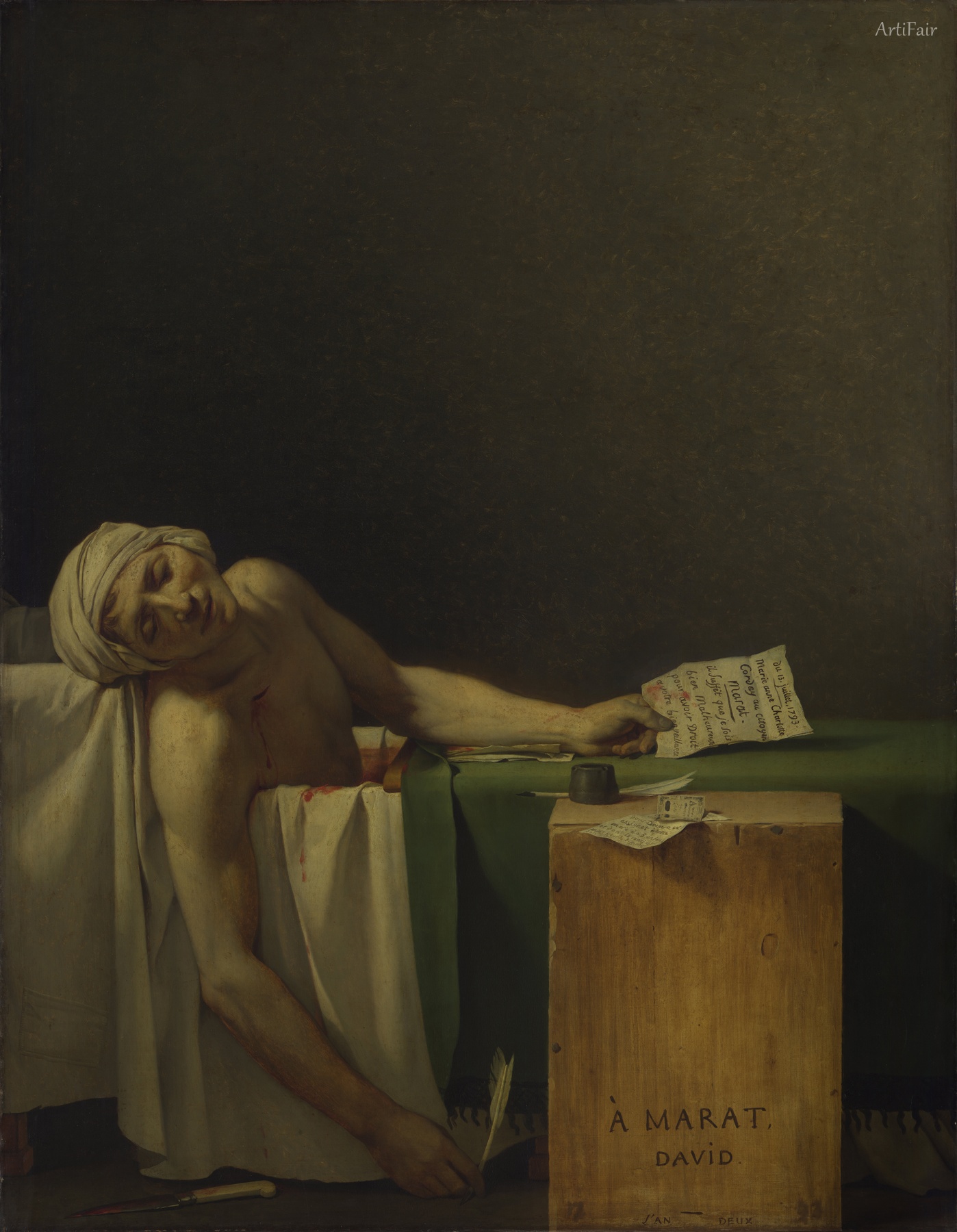
The Death of Marat (Marat assassiné) is an oil-on-canvas painting by Jacques-Louis David, completed in 1793 and measuring 165 × 128 cm; it belongs to the Royal Museums of Fine Arts of Belgium in Brussels (inv. 3260), while a studio replica hangs in the Louvre.
Jean-Paul Marat, a leader of the radical Montagnards, suffered from a skin disease that kept him in his bathtub for long hours, and he worked there. On 13 July 1793 he was stabbed to death in the bath by Charlotte Corday, a Girondin sympathiser who blamed him for the September Massacres. The next day the deputy Guirault asked David, himself a Montagnard, a member of the Committee of General Security and a personal acquaintance of Marat, to do for him what he had done for the murdered deputy Le Peletier. David announced the picture finished on 14 October and presented it to the National Convention on 14 November; it was hung in the assembly hall as a pair with his Le Peletier on its deathbed, on either side of the president's rostrum.
Against a dark, almost empty upper half, Marat slumps in the tub, his head wrapped in a white turban, a quill still in one hand and in the other a letter whose invented text, dated 13 July 1793 and signed by Corday, pleads for his kindness. The wooden crate serving as a desk carries the inscription À MARAT, DAVID, L'AN DEUX. The hanging arm has often been compared to Michelangelo's Pietà, and David bathed the body in soft light like that of a Christian martyr.
The two paintings were removed from the Convention in February 1795 and returned to David later that year. During his exile in Brussels his pupil Antoine-Jean Gros kept them hidden in Paris. After renewed praise from Baudelaire in 1845, the picture was bequeathed by Jules David-Chassagnol in 1886 and entered the Brussels museum in 1893. The art historian T. J. Clark has called it the first modernist painting.