
Nevermore
Category:
Created:
1897
Likes:
0
Dimensions:
Download:
New users get 4 free credits. 2K costs 1 credit; 4K and Ultra HD are priced by resolution. Public domain artworks can be used commercially.
Dominant colors
Public domain download summary
This artwork is provided as a public domain image resource. The 2K file costs 1 credit for everyday creative work, while 4K and Ultra HD files are priced by resolution.
Art Appreciation
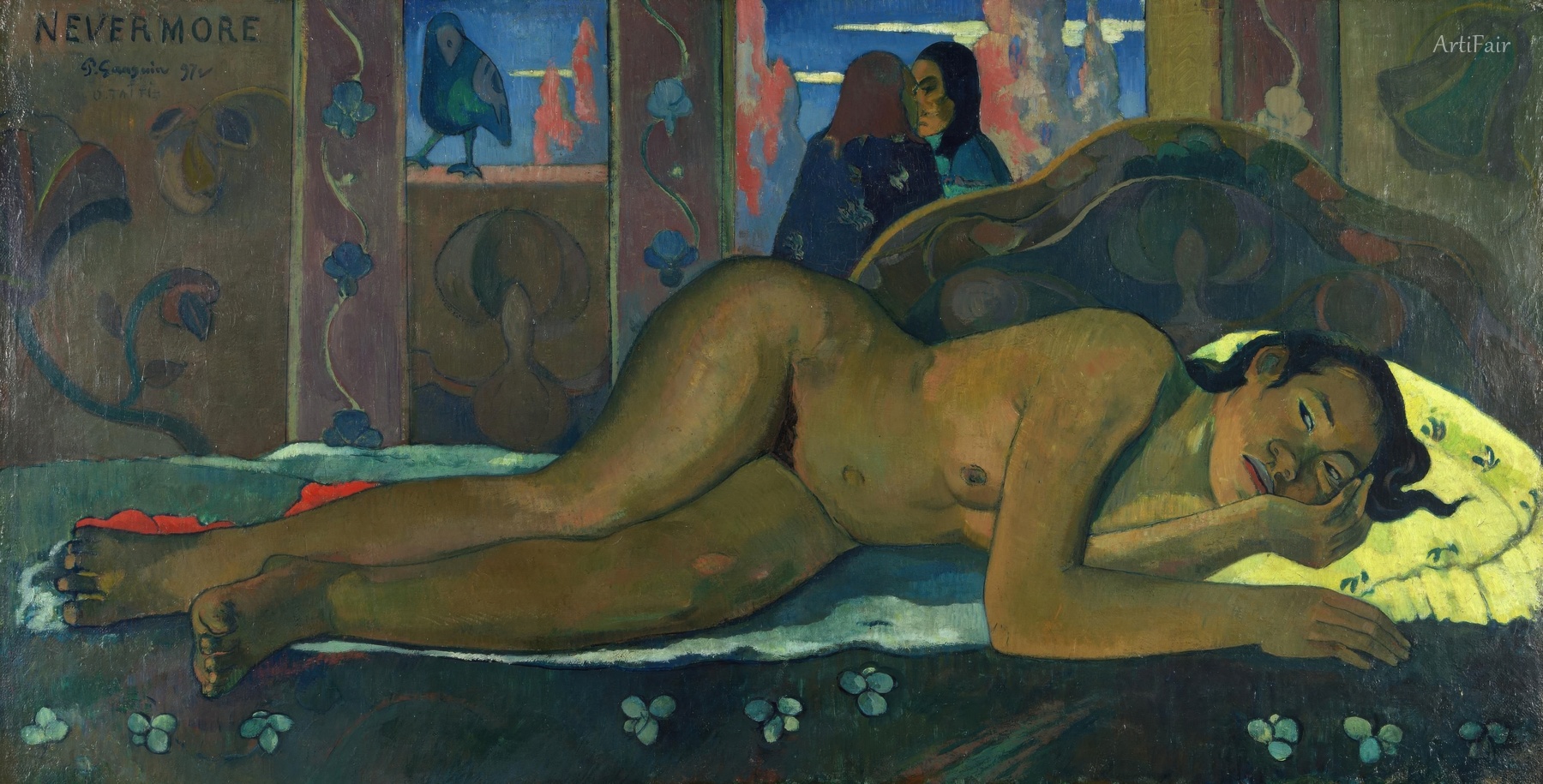
Nevermore is an oil on canvas painted by Paul Gauguin in Tahiti in February 1897, during his second and final stay on the island; measuring 60.5 × 116 cm, it is in the Courtauld Gallery, London, the gift of Samuel Courtauld in 1932.
The picture takes up the long European tradition of the reclining nude. A young Tahitian woman lies on a bed, her body echoed by the curves of the headboard, but she is not at rest: she seems anxiously aware of two figures talking behind her, whom the Courtauld suggests may be evil spirits, and of a dark bird perched on a ledge. She is sometimes identified as Pahura, Gauguin's companion, then about fifteen, and the museum points out that her youth and Gauguin's position as a European colonist taking teenage 'wives' are now the most disturbing aspects of the image. Pahura had recently lost the couple's newborn child when the work was painted.
The word Nevermore, lettered at the upper left, and the bird recall Edgar Allan Poe's poem The Raven, in which a raven answers a grieving man's every question with that single word. Gauguin wrote to Daniel de Monfreid that he had wanted a simple nude to suggest a certain barbaric luxury of former times, that the whole was deliberately sombre and sad, and that the bird was not Poe's raven but the bird of the devil keeping watch. The sense of loss has also been read as Gauguin's disillusion at the erosion of Tahitian culture. X-rays show that it was painted over another picture.
Gauguin sent the canvas to Monfreid in Paris in 1897, and in 1898 the composer Frederick Delius bought it from him for 500 francs; Gauguin wondered whether the title had prompted the purchase. Around 1922 it passed through the Goupil Gallery to Herbert Coleman of Manchester, and Samuel Courtauld bought it before July 1924. It was shown at Gauguin's retrospective at the 1906 Salon d'Automne, and in 2010 an Art Fund poll voted it Britain's most romantic painting.