
The Potato Eaters
Category:
Created:
1885
Likes:
0
Dimensions:
Download:
New users get 4 free credits. 2K costs 1 credit; 4K and Ultra HD are priced by resolution. Public domain artworks can be used commercially.
Dominant colors
Public domain download summary
This artwork is provided as a public domain image resource. The 2K file costs 1 credit for everyday creative work, while 4K and Ultra HD files are priced by resolution.
Art Appreciation
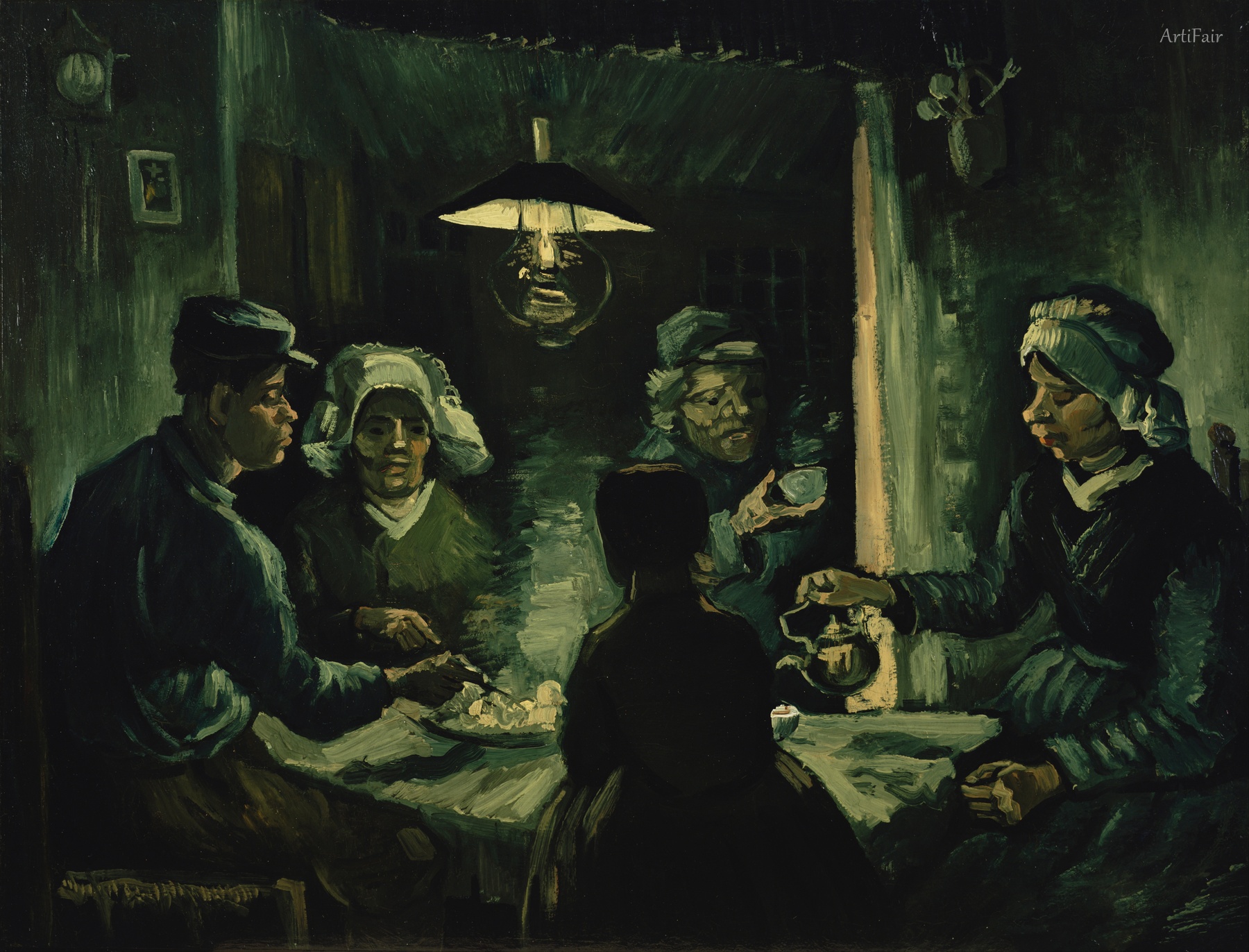
The Potato Eaters is an oil painting on canvas by Vincent van Gogh, made in Nuenen in the Netherlands in April and May 1885 and now in the Van Gogh Museum, Amsterdam (Vincent van Gogh Foundation). It measures 82 × 114 cm.
Van Gogh was living with his parents in Nuenen, a village of farmers, labourers and weavers, and had spent March and early April making studies for it. He saw this canvas as a showpiece: by choosing a difficult multi-figure composition he wanted to prove that he was becoming a real figure painter. He worked on it from 13 April until early May, adding small touches later that year. Before starting he also made a lithograph of the composition, drawn from memory in a single day, and an earlier oil sketch is in the Kröller-Müller Museum in Otterlo.
Five members of a peasant family share a meal of potatoes by the light of a single oil lamp. Van Gogh gave them coarse faces and bony hands, and wrote to his brother Theo that he wanted to show that they had tilled the earth with the same hands they were putting in the dish, and so had honestly earned their food. He painted them in earth colours, which he compared to a dusty potato, unpeeled. A peasant family at table with a figure seen from behind in the centre also appears in a painting by Jozef Israëls of the Hague School, which Van Gogh admired.
The picture was sent to Theo in Paris at the beginning of May 1885. Its dark colouring and faulty anatomy drew criticism, most painfully from his friend Anthon van Rappard, yet in 1887 Van Gogh still told his sister Willemien it was the best thing he had done. It stayed in the family, passed to the Vincent van Gogh Foundation in 1962 and has been in the museum since it opened in 1973. In April 1991 it was among twenty paintings stolen from the museum and recovered within the hour.