
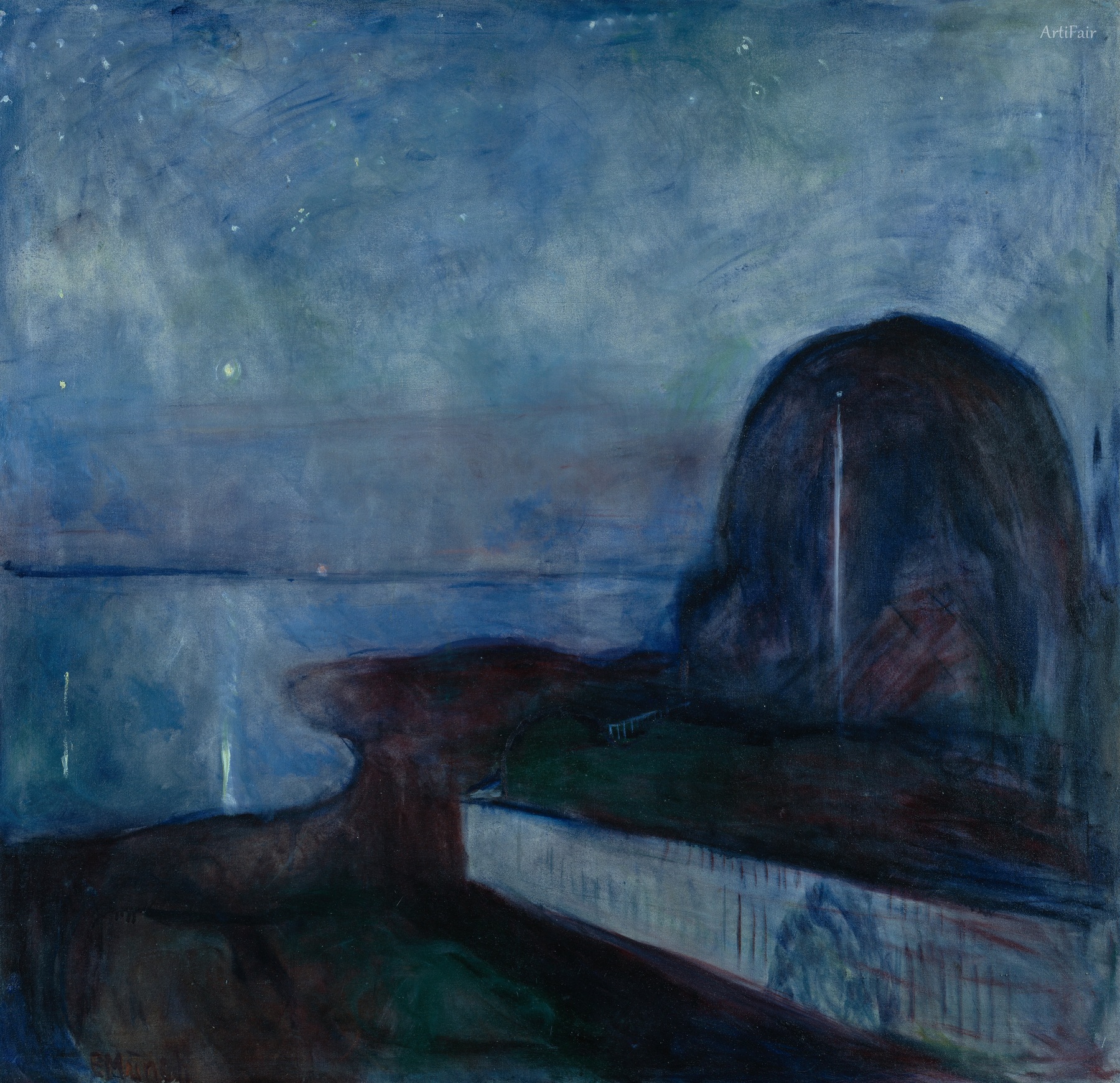
Starry Night
Category:
Created:
1893
Likes:
0
Dimensions:
Download:
New users get 4 free credits. 2K costs 1 credit; 4K and Ultra HD are priced by resolution. Public domain artworks can be used commercially.
Dominant colors
Public domain download summary
This artwork is provided as a public domain image resource. The 2K file costs 1 credit for everyday creative work, while 4K and Ultra HD files are priced by resolution.
Art Appreciation
Starry Night (Stjernenatt) is an oil painting on canvas by Edvard Munch, made in 1893 and now in the J. Paul Getty Museum in Los Angeles (accession number 84.PA.681); it measures 135.6 × 140 cm.
The view is of the shore at Åsgårdstrand, a small resort on the Oslofjord south of Kristiania (now Oslo), where Munch spent his summers from the late 1880s and where he later bought a house. According to Getty, he painted it from his room at the Grand Hotel, looking over a place he associated with falling in love for the first time. In the same year he painted a second, smaller version of the scene, now in the Von der Heydt-Museum in Wuppertal; his later paintings with this title, from 1900–1901 and 1922–1924, show other places.
The nearly square canvas divides along a diagonal. At upper left a blue and green night sky with scattered stars meets the water, where the light of a star leaves a thin vertical reflection. At lower right a dark rounded mass, standing for a clump of linden trees, rises above the horizon, and a pale fence cuts in from the corner. A soft, rounded shape on the fence may be the shadow of two lovers, a theme that runs through Munch's work, although the couple themselves are not shown. The curving shoreline carries on into the trees.
The Getty notes that Munch was after the feelings the night aroused rather than its picturesque side. The paint is thick in some areas and so thin elsewhere that bare canvas shows through, and in places watery passages have run downward. Munch himself compared human souls to planets: like stars meeting in the dark, they shine brightly for a moment and then vanish.