
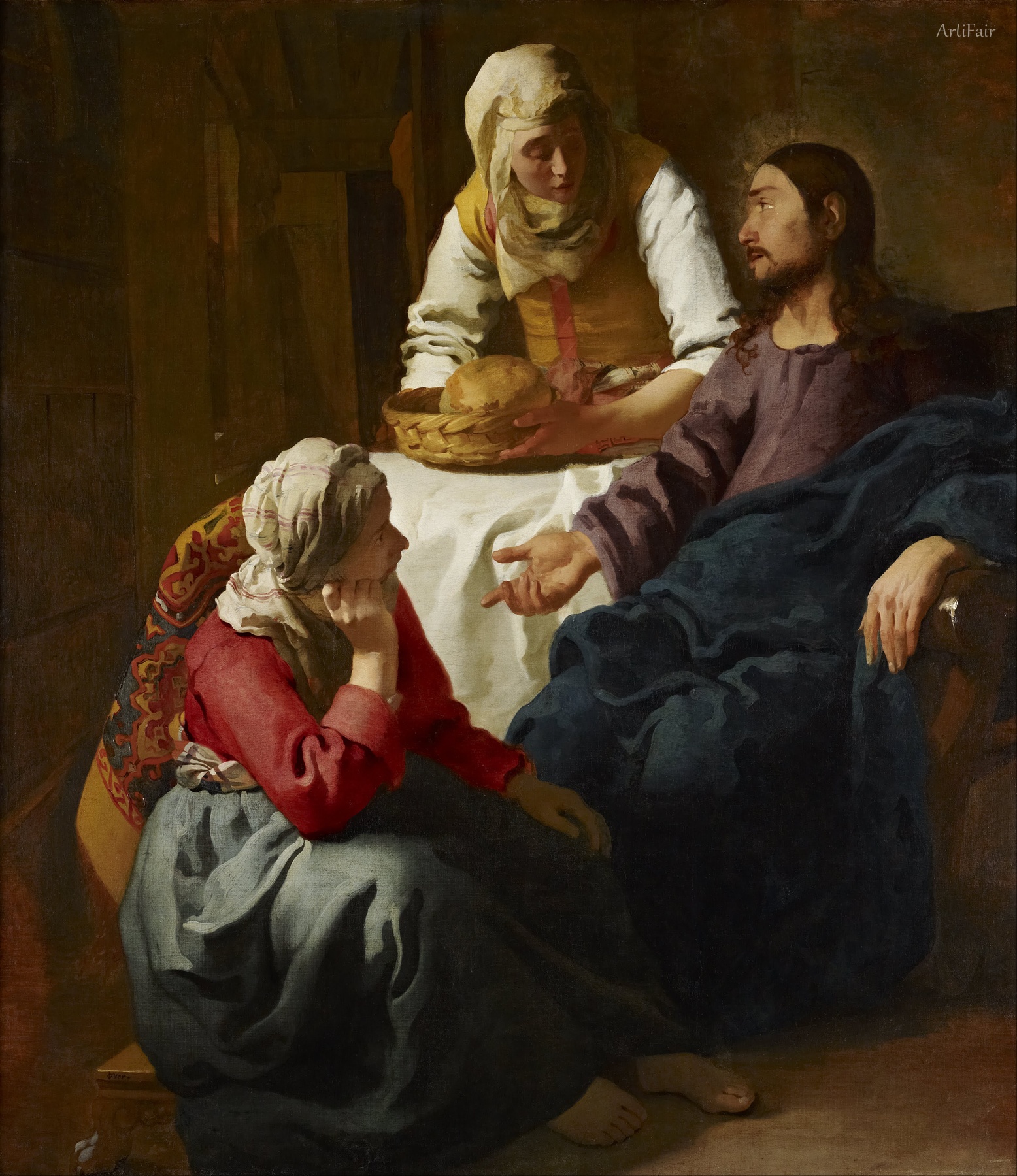
Christ in the House of Martha and Mary
Category:
Created:
1656
Likes:
1
Dimensions:
Download:
New users get 4 free credits. 2K costs 1 credit; 4K and Ultra HD are priced by resolution. Public domain artworks can be used commercially.
Dominant colors
Public domain download summary
This artwork is provided as a public domain image resource. The 2K file costs 1 credit for everyday creative work, while 4K and Ultra HD files are priced by resolution.
Art Appreciation
Christ in the House of Martha and Mary is an oil painting on canvas by Johannes Vermeer, made around 1654–1656, and held by the Scottish National Gallery in Edinburgh, to which it was given in 1927.
At about 160 × 142 cm it is the largest painting by Vermeer and one of the very few with an overt religious subject. It illustrates the brief episode in the Gospel of Luke in which Jesus visits the sisters at Bethany: Mary sits at his feet listening, while Martha, busy with serving, complains that she has been left to do the work, and Christ answers that Mary has chosen the better part. In Vermeer's day the story was read as a contrast between the active and the contemplative life, a point on which Catholics and Protestants differed; Vermeer gives the two sisters equal weight, and all three figures are bound together in one group.
The picture belongs to the painter's earliest phase, before the domestic interiors for which he is known. The pose of Christ follows Italian models, and art historians most often point to a painting of the subject by the Flemish artist Erasmus Quellinus, a former assistant of Rubens, now in Valenciennes. The handling is broad and quick, with summary treatment of Martha's bread basket compared with the minute textures of his later work. Instead of his usual ultramarine, Christ's robe is painted with a mixture of smalt, indigo and lead white. The canvas is signed IVMeer on the bench at lower left. Its religious theme has been linked to Vermeer's ties with Delft's Catholic community through his mother-in-law, Maria Thins, though its patron is unknown.
Nothing is known of the painting's early history. It surfaced with the Abbot family in Bristol around 1880, passed through the London trade, and in 1901 was bought by William Allan Coats of Scotland, whose sons presented it to the national collection.