
Springtime
Category:
Created:
1872
Likes:
2
Dimensions:
Download:
New users get 4 free credits. 2K costs 1 credit; 4K and Ultra HD are priced by resolution. Public domain artworks can be used commercially.
Dominant colors
Public domain download summary
This artwork is provided as a public domain image resource. The 2K file costs 1 credit for everyday creative work, while 4K and Ultra HD files are priced by resolution.
Art Appreciation
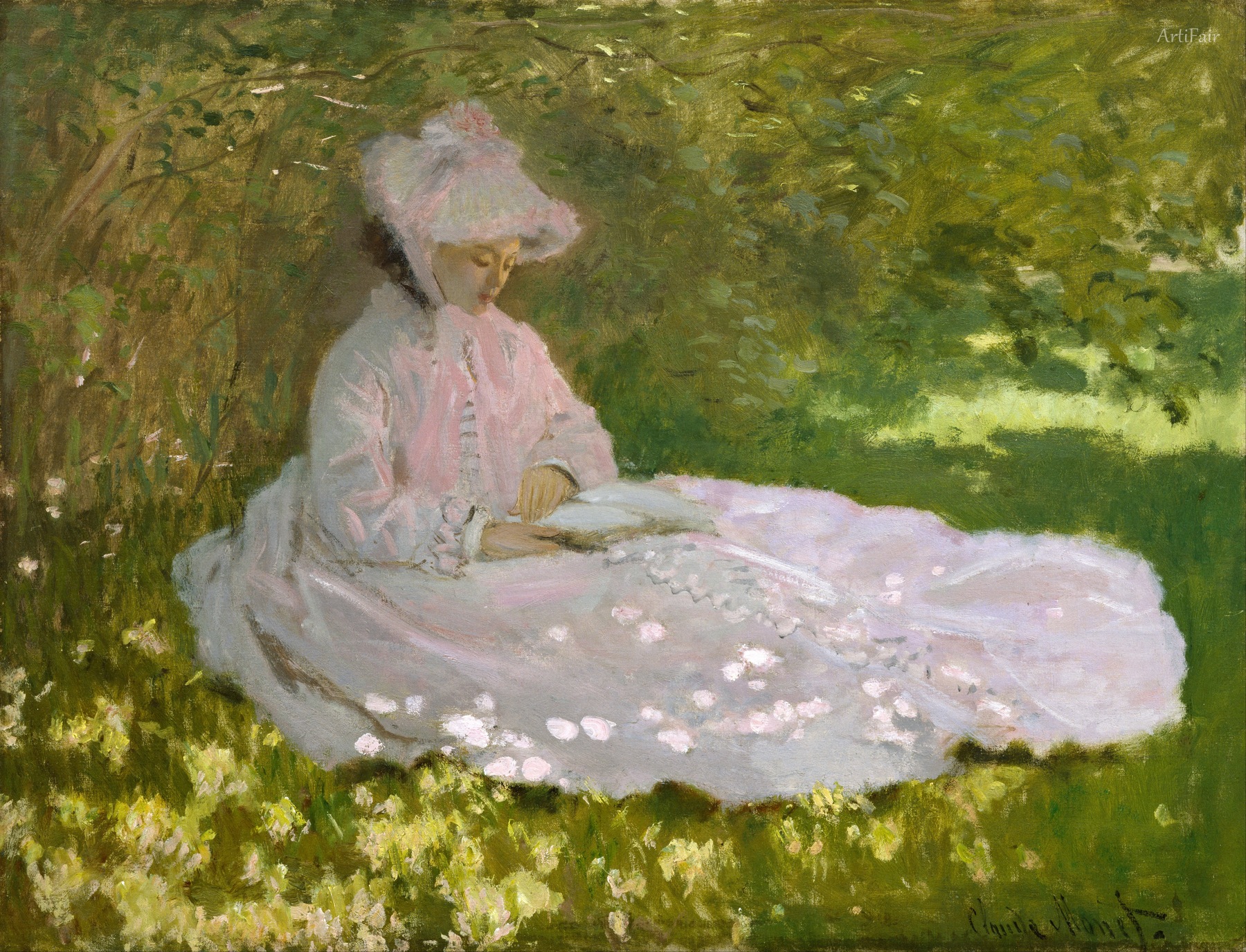
Springtime, also called The Reader, is an oil-on-canvas painting by Claude Monet from 1872, showing a young woman reading in the shade of a garden; it belongs to the Walters Art Museum in Baltimore (accession number 37.11).
Monet returned to France in 1871 after spending the Franco-Prussian War years in England and the Netherlands, and at the very end of that year settled with his family in Argenteuil, a town on the Seine northwest of Paris with a rail link to the capital. He painted this canvas in his garden there the following spring. The sitter is usually identified as his wife, Camille Doncieux, who modelled for many of his figure paintings of the 1860s and 1870s, although the French Wikipedia notes the identification is not documented. In the early 1870s Monet often painted his garden with Camille and their son Jean.
The canvas measures 50 by 65.5 cm. According to the Walters, Monet cared less about a likeness than about how separate, unblended dabs of colour could suggest bright sunlight filtering through leaves. Face and hands are handled lightly, while the dress and the grass in the foreground carry the scattered patches of light. Reviewing the 1876 exhibition, Émile Zola singled out a portrait of a woman in white seated in the shade of foliage, her dress sprinkled with spots of light like large drops.
The painting appeared at the second Impressionist exhibition at Durand-Ruel's gallery in 1876 under the more generic title Woman Reading, and again at the Monet-Rodin exhibition at the Galerie Georges Petit in 1889. Its early ownership is not fully clear: it passed through the hands of the dealer Paul Durand-Ruel and the collector Ernest Hoschedé, and belonged to Mary Cassatt in 1889. Henry Walters bought it in 1903, with George A. Lucas acting as his agent, and it came to the museum with his bequest in 1931.