
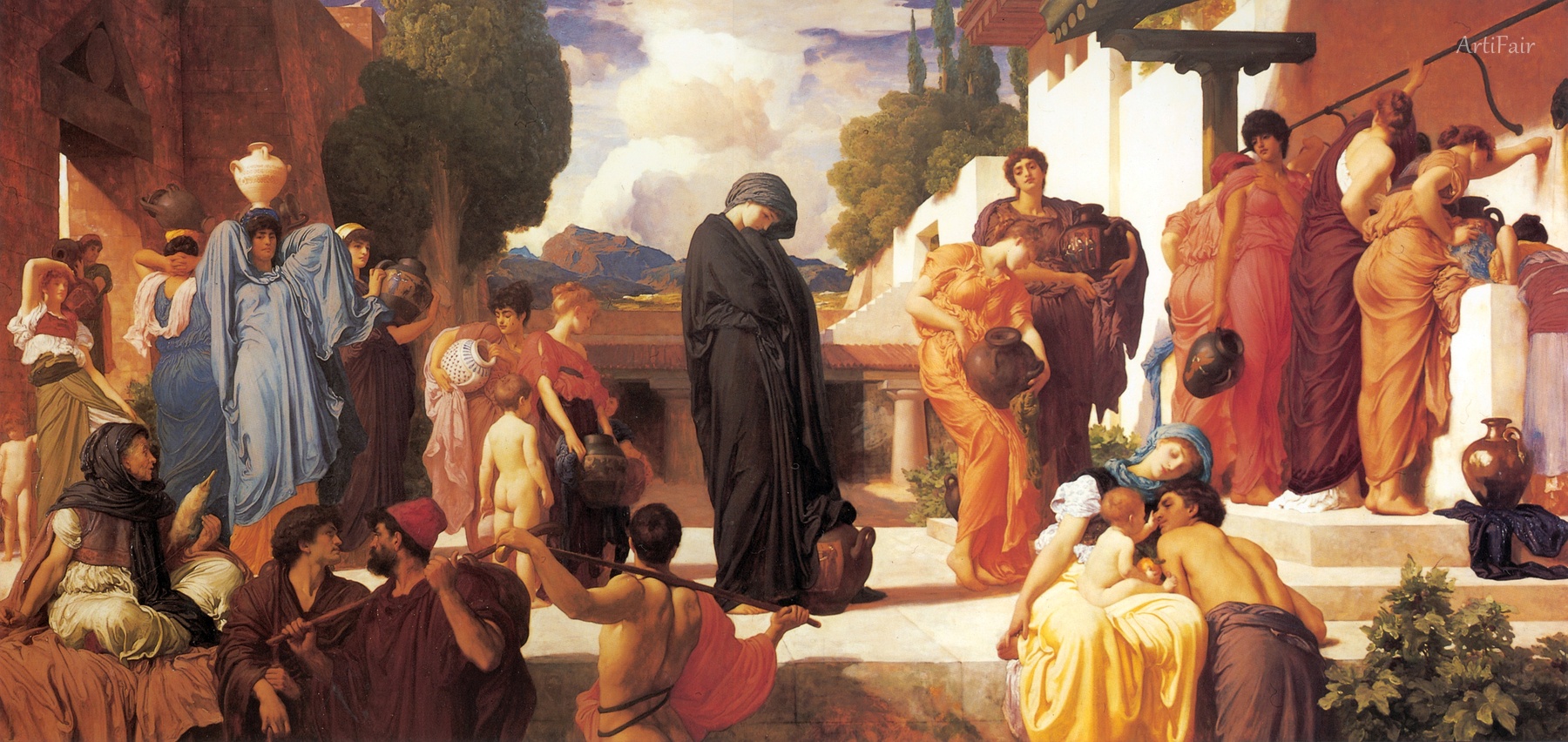
Captive Andromache
Category:
Created:
1886
Likes:
0
Dimensions:
Download:
New users get 4 free credits. 2K costs 1 credit; 4K and Ultra HD are priced by resolution. Public domain artworks can be used commercially.
Dominant colors
Public domain download summary
This artwork is provided as a public domain image resource. The 2K file costs 1 credit for everyday creative work, while 4K and Ultra HD files are priced by resolution.
Art Appreciation
Captive Andromache is an oil on canvas by Frederic Leighton, painted around 1886–1888 and owned by Manchester Art Gallery (accession 1889.2); at 197 × 407 cm it was the largest painting of his late career.
The subject comes loosely from Homer's Iliad, in which Hector, foreseeing his own death, pictures his wife Andromache in Argos as a slave, toiling at another woman's loom or carrying water from a foreign well. After the fall of Troy, Andromache was given as a prize of war to Neoptolemus, son of Achilles. When the painting was shown at the Royal Academy in 1888, the catalogue printed lines from Elizabeth Barrett Browning's translation in which bystanders mark her tears and say: 'This is she, The wife of that same Hector that fought best Of all the Trojans.'
Leighton sets the scene as a long frieze, a format that recalls the reliefs on ancient sarcophagi. Women in blue, green and violet drapery approach from the left and others in peach, rose and wine-red stand on the steps at the right, drawing water at a rectangular fountain. In the middle, alone, stands Andromache, wrapped in a black cloak, waiting her turn and looking down at a young family by the fountain, a mother holding a child who reaches up to the father. An old woman spinning at the lower left watches her. Tracings in the Royal Academy show that Leighton first posed Andromache frontally and included more figures; he later turned her into profile and thinned the crowd, which sharpens her isolation. Around sixty preparatory drawings are known, including nude and drapery studies, twenty-five of them at Leighton House in London.
Manchester City Council bought the painting from the artist in 1889 for £4,000. It reached a wide public through reproductions, including a photogravure in a portfolio of paintings shown at the 1889 Exposition Universelle in Paris and an engraving by Charles Roberts issued as a supplement to The Graphic in 1891.