
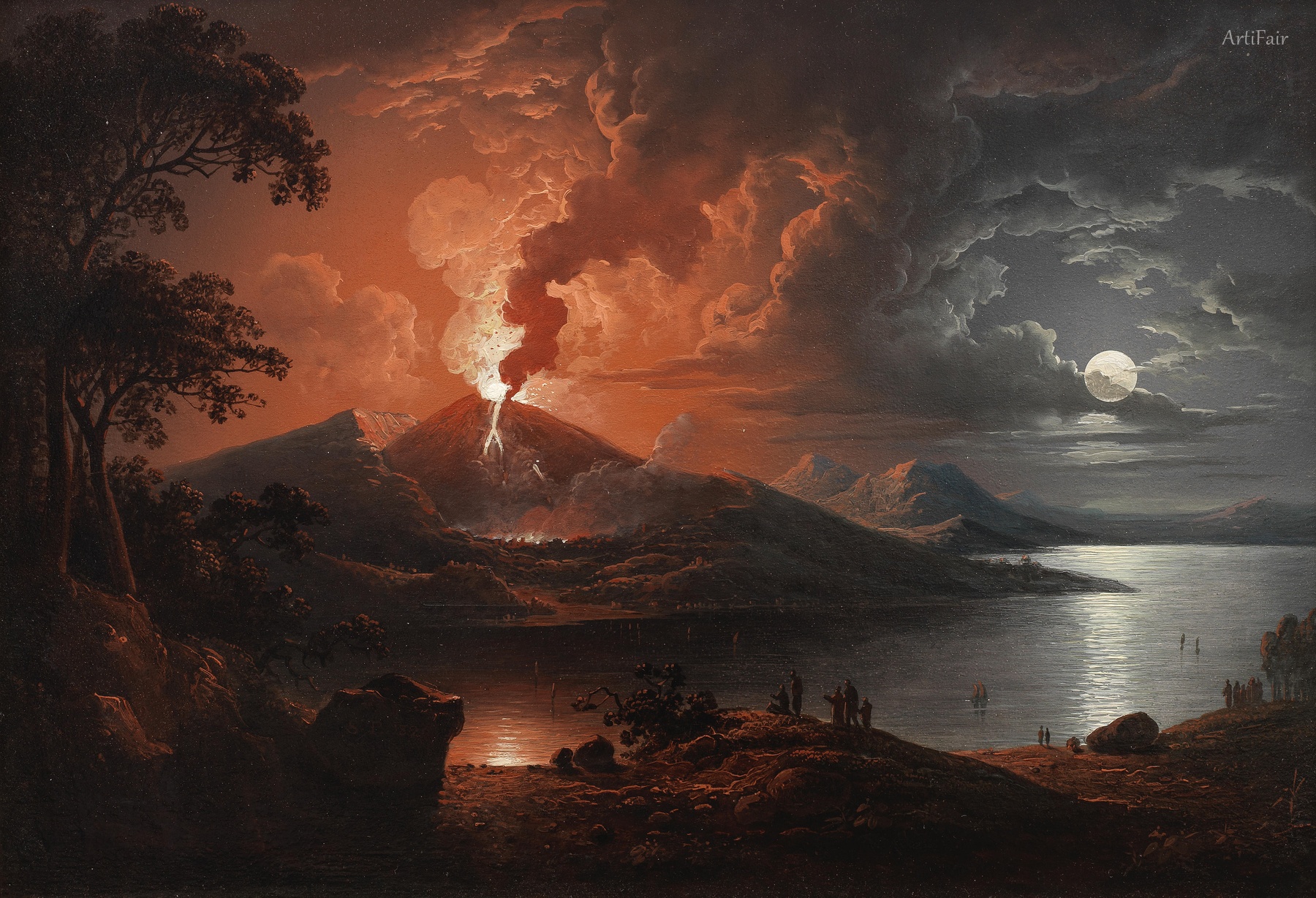
Vesuvius Erupting by Moonlight
Category:
Created:
Date unknown
Likes:
0
Dimensions:
Download:
New users get 4 free credits. 2K costs 1 credit; 4K and Ultra HD are priced by resolution. Public domain artworks can be used commercially.
Dominant colors
Public domain download summary
This artwork is provided as a public domain image resource. The 2K file costs 1 credit for everyday creative work, while 4K and Ultra HD files are priced by resolution.
Art Appreciation
Vesuvius Erupting by Moonlight is a small oil painting on panel by the English landscape painter Sebastian Pether, signed with his initials and dated S. P. 1825 on a rock at the lower left. It measures 28 by 40.2 cm and was sold at Bonhams in London in July 2022 for £20,400 including premium.
Pether, who died at Battersea in 1844 (sources give his birth year as 1790 or 1793), specialised in moonlight, sunset and firelight scenes. He trained under his father Abraham Pether, and with his brother Henry the three were known as the Moonlight Pethers. Despite steady output he exhibited little, had only one real patron, John Fleming Leicester, and sold most of his work through dealers for low prices, leaving his large family in poverty at his death. His paintings and his brother's are often confused, although Henry usually signed his work.
The picture sets two light sources against each other, a device at the heart of Pether's art. On the left the volcano throws up a column of fire and smoke, with lightning in the cloud and molten lava glowing on its slopes, staining the sky red. On the right a full moon breaks through dark clouds and lays a silver path across the water of the bay. Tall trees and a large rock frame the dark foreground, where small figures stand on the shore watching the eruption.
Vesuvius was a recurring subject for Pether. The Nelson-Atkins Museum of Art in Kansas City owns another moonlit eruption signed and dated 1825, with the moon on the left, and the museum notes that Pether travelled to Naples to paint the volcano, which was active in the late 1700s and early 1800s. Christie's has also recorded a variant on canvas, dated 1824 with a query.