
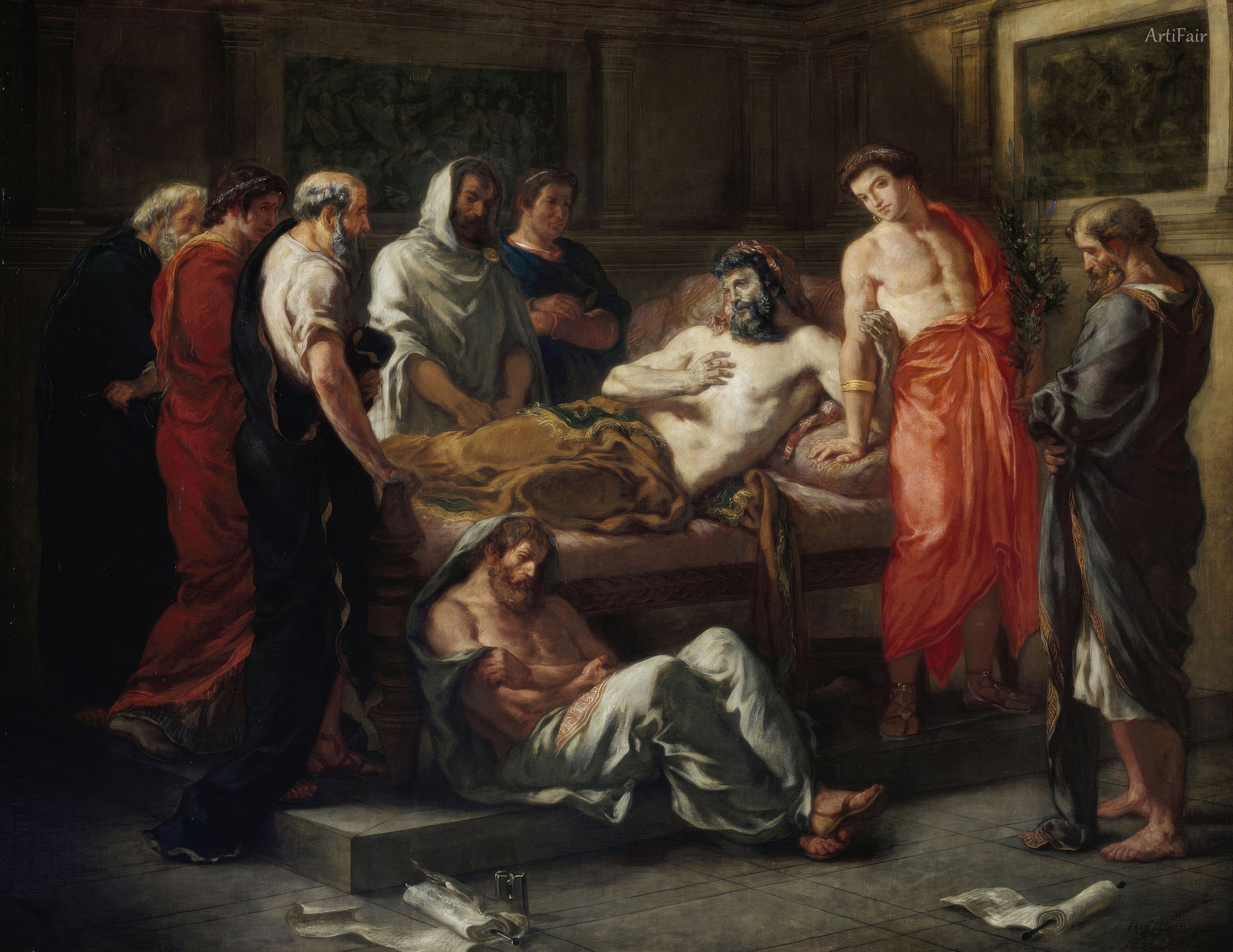
Last Words of the Emperor Marcus Aurelius
Category:
Created:
1844
Likes:
0
Dimensions:
Download:
New users get 4 free credits. 2K costs 1 credit; 4K and Ultra HD are priced by resolution. Public domain artworks can be used commercially.
Dominant colors
Public domain download summary
This artwork is provided as a public domain image resource. The 2K file costs 1 credit for everyday creative work, while 4K and Ultra HD files are priced by resolution.
Art Appreciation
Last Words of the Emperor Marcus Aurelius (Dernières paroles de l'empereur Marc Aurèle) is an oil painting on canvas by Eugène Delacroix, dated 1844 and held by the Musée des Beaux-Arts de Lyon (Inv. A 2928); it measures 260.6 × 336.3 cm.
Delacroix had admired the Stoic emperor since childhood, read his Meditations, and thought of the subject as early as 1824–1825. The canvas was begun in May 1843; his pupil and assistant Louis de Planet laid in the composition and the first glazes following Delacroix's instructions, and Delacroix took it up again in January 1844 and finished it that autumn. It belongs to a period in the 1840s when the leader of French Romanticism turned to austere classical themes, and it follows the deathbed scene as established by Poussin and later David.
The scene, taken from the historian Herodian, shows the old, sick emperor commending his son Commodus to his friends, Stoic philosophers like himself. Marcus Aurelius grips the arm of the young man, who stands in a bright red robe holding a laurel branch and seems eager to pull away, while the sombre advisers, heads bowed, crowd into the shadows around the bed. The Salon booklet of 1845 noted that Commodus's perverse inclinations had already shown themselves, and that the gloom of the listeners revealed how vain the recommendation was. The Lyon museum observes that it is the youth in red who brings life and movement to the scene.
Shown at the Salon of 1845, the painting met a cool reception from most critics; Baudelaire, however, called it splendid, magnificent, sublime and misunderstood, and praised its colour. It was also shown at the Exposition Universelle of 1855. The French state bought it on 19 May 1858 for 4,000 francs and sent it to Lyon in 1860, where it remains on long-term loan from the Centre national des arts plastiques.