
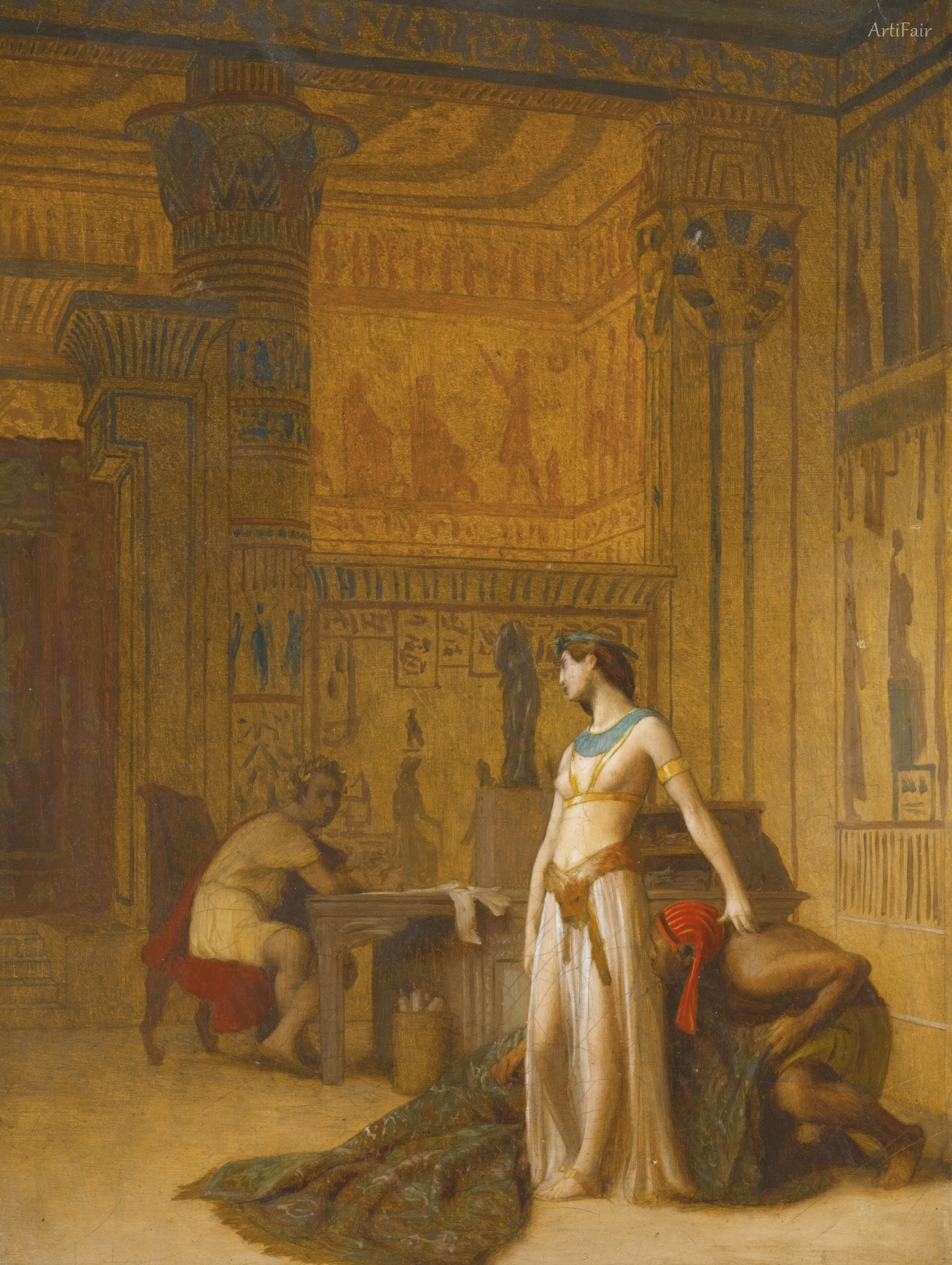
Cleopatra and Caesar (oil study)
Category:
Created:
1878
Likes:
0
Dimensions:
Download:
New users get 4 free credits. 2K costs 1 credit; 4K and Ultra HD are priced by resolution. Public domain artworks can be used commercially.
Dominant colors
Public domain download summary
This artwork is provided as a public domain image resource. The 2K file costs 1 credit for everyday creative work, while 4K and Ultra HD files are priced by resolution.
Art Appreciation
This Cleopatra and Caesar is a small preparatory oil study on canvas by Jean-Léon Gérôme, made around 1866 for his large Salon painting of the same subject; it is catalogued in Gerald Ackerman's catalogue raisonné as no. 159.2 and measures 31 × 23 cm.
The large picture was commissioned by the courtesan La Païva for her new mansion on the Champs-Élysées. She refused it on delivery, and it was bought by Gérôme's father-in-law, the dealer Adolphe Goupil, then shown at the Salon of 1866 and at the Royal Academy in London in 1871. Gérôme worked towards it through several drawings and two known oil studies. In the earliest ideas, including a drawing in the Musée Georges-Garret at Vesoul, Caesar rushes forward to lift Cleopatra from the floor. This study belongs to a later stage: Cleopatra now stands, and Caesar stays seated alone at his desk, as in a drawing once owned by Ackerman. In the finished canvas he raises his hands in surprise and four secretaries are added.
The subject comes from Plutarch's Life of Caesar. In 47 BC the young queen, driven from Alexandria by her brother's faction, had herself smuggled into the palace by her friend Apollodorus the Sicilian, wrapped in a bundle. Plutarch's word was later translated as 'carpet', and Gérôme's composition helped fix the image of Cleopatra rising from a rug. The temple interior is copied from a plate of the small temple at Deir el-Medina in the Description de l'Égypte, which Gérôme reversed in the final painting; Cleopatra's split skirt and Apollodorus's headdress are the painter's invention.
According to Galerie Heim, the study belonged to Gérôme's son-in-law, the painter Aimé Morot, and passed through a collection in Rouen and the Schweitzer Gallery in New York in 1970; Ackerman confirmed its authenticity.