
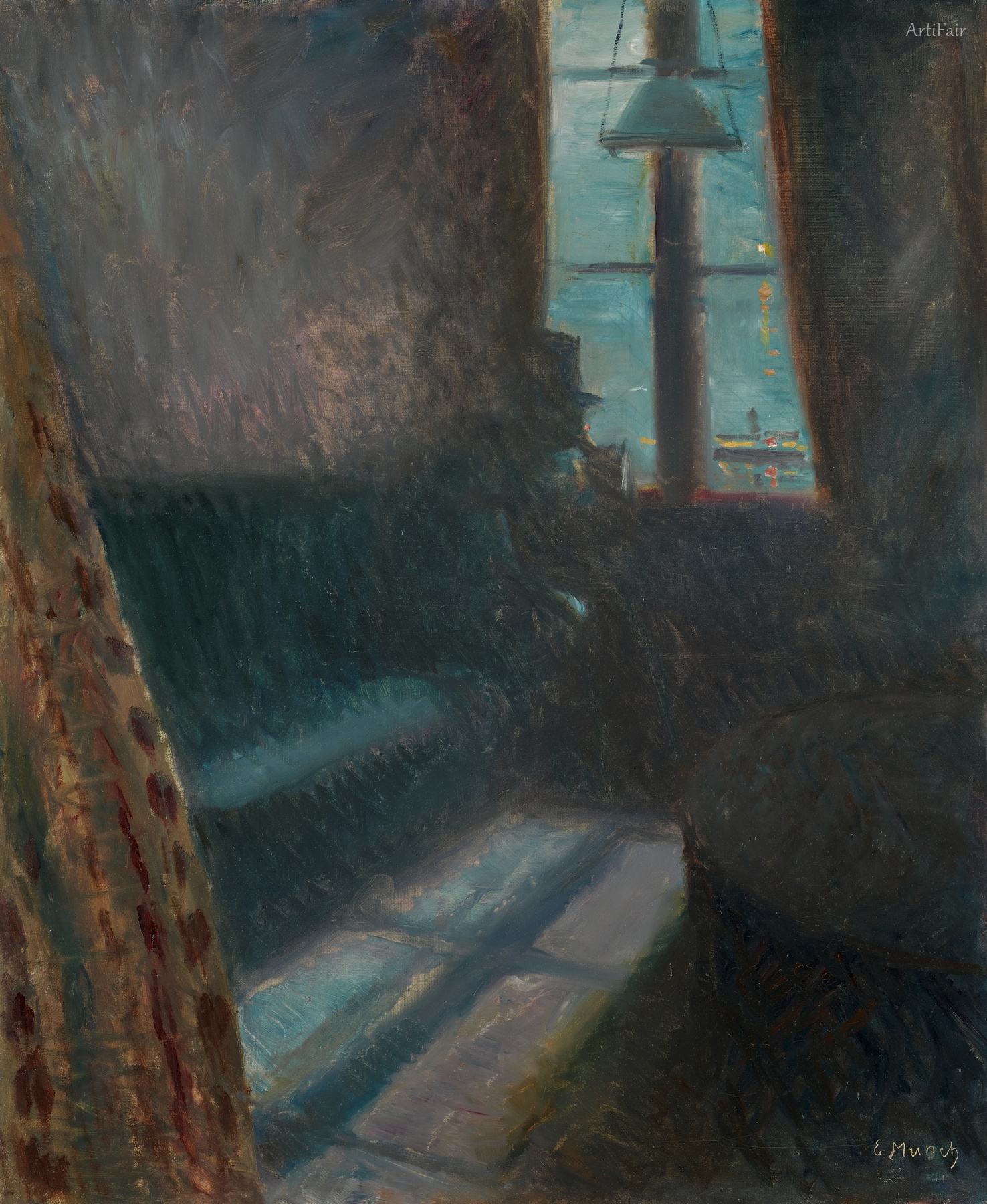
Night in Saint-Cloud
Category:
Created:
1890
Likes:
0
Dimensions:
Download:
New users get 4 free credits. 2K costs 1 credit; 4K and Ultra HD are priced by resolution. Public domain artworks can be used commercially.
Dominant colors
Public domain download summary
This artwork is provided as a public domain image resource. The 2K file costs 1 credit for everyday creative work, while 4K and Ultra HD files are priced by resolution.
Art Appreciation
Night in Saint-Cloud is an oil painting on canvas by Edvard Munch, made in 1890 and held by the National Museum of Art, Architecture and Design in Oslo (NG.M.01111); it measures 64.5 × 54 cm and is signed E Munch at lower right.
Munch spent 1889–91 in France on a Norwegian state grant. When cholera broke out in Paris in December 1889 he moved to Saint-Cloud on the outskirts of the city and rented rooms above a café overlooking the Seine. His father had died a month before the move, and the painting has often been read as a response to that loss. It shows his own darkened room late at night: a curtain at the left edge, a sofa and an unlit hanging lamp, and moonlight from the river casting the cross-shaped shadow of the window frame on the floor. A man in a top hat sits at the window, almost lost in the gloom; the model may have been the Danish poet Emanuel Goldstein, a close friend in those months.
The picture belongs to the period of Munch's so-called Saint-Cloud manifesto, in which he declared that he would no longer paint interiors with people reading and women knitting, but living people who breathe, feel, love and suffer. Art historians such as Hans Dieter Huber treat it as a key work in his turn from naturalism to symbolism. Munch reportedly also called it Symphony in Blue, which has suggested a debt to Whistler's nocturnes.
It was first shown, simply titled Night, among ten Munch paintings at the National Annual Autumn Exhibition in Kristiania in 1890, where the critic Andreas Aubert called it the finest thing Munch had done in years. The doctor and geologist Fredrik Arentz bought it there, and Munch borrowed it back for most of his exhibitions in the 1890s. Orders for four copies followed. The National Gallery bought the original from Arentz's heirs in 1917.