
The King's Wife (Te Arii Vahine)
Category:
Created:
1896
Likes:
0
Dimensions:
Download:
New users get 4 free credits. 2K costs 1 credit; 4K and Ultra HD are priced by resolution. Public domain artworks can be used commercially.
Dominant colors
Public domain download summary
This artwork is provided as a public domain image resource. The 2K file costs 1 credit for everyday creative work, while 4K and Ultra HD files are priced by resolution.
Art Appreciation
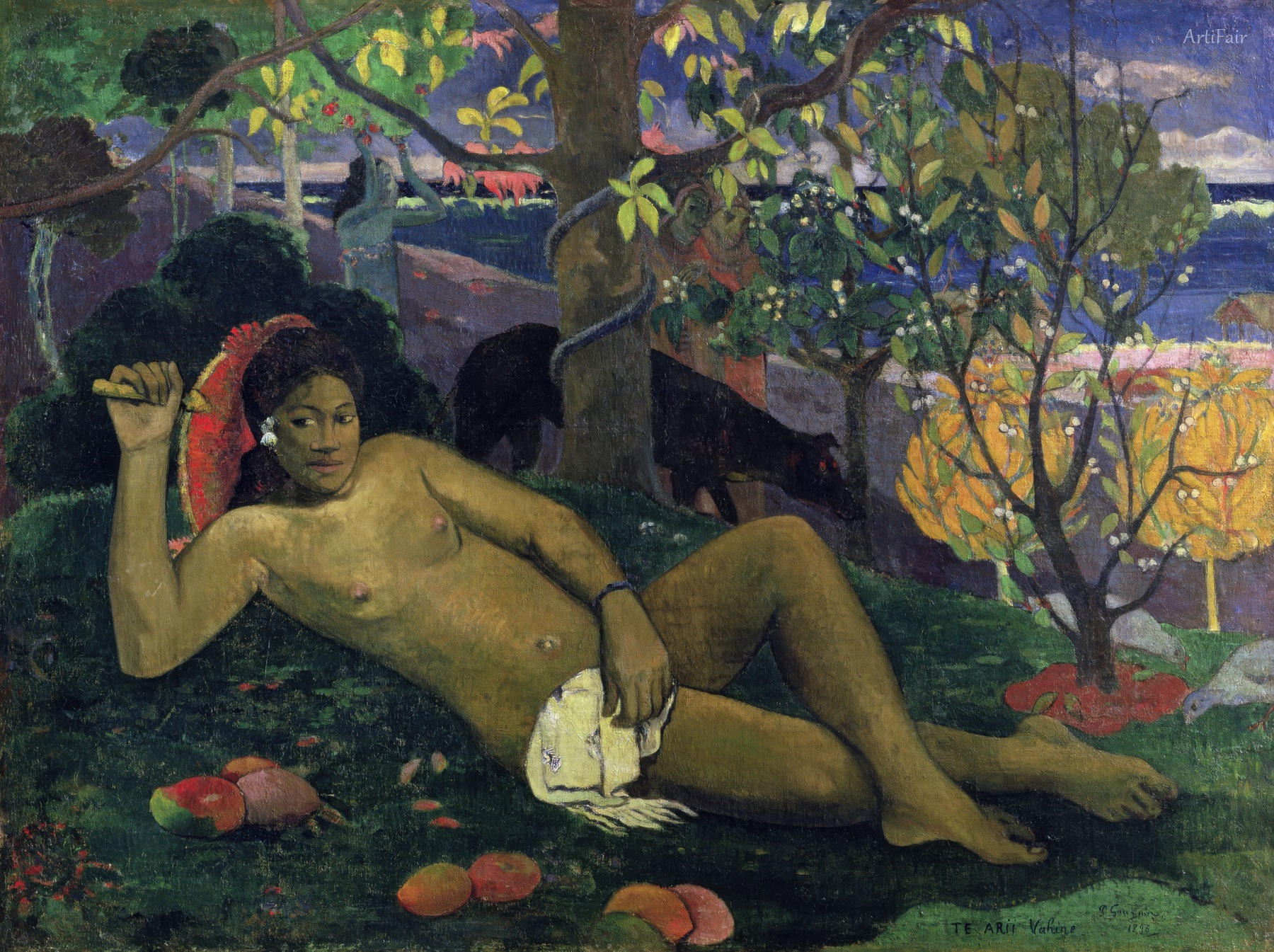
The King's Wife (Te arii vahine), also known as The Queen or Woman with Mangoes, is an oil-on-canvas painting by Paul Gauguin, made in Tahiti in early 1896 and now in the Pushkin State Museum of Fine Arts, Moscow. It measures 97 by 130 cm and bears the Tahitian title and the signature and date P. Gauguin 1896 at lower right.
The Pushkin Museum counts it among the most important works of Gauguin's second Tahitian period. In April 1896 he described it to his friend Daniel de Monfreid: a naked queen lying on a green carpet, a servant picking fruit, two old men by a large tree discussing the tree of knowledge, the seashore beyond, trees in flower, a dog on guard and two doves on the right. He judged that he had never made anything with so solemn a resonance of colour, and expected it to provoke an even louder outcry than his unsold canvases already had.
The pose openly takes up Édouard Manet's Olympia, which Gauguin had copied and whose photograph he took to Tahiti, and the museum also points to Titian's Venus of Urbino; the scholar Richard Brettell proposed a reclining figure from the reliefs of Borobudur in Java as another source. The model has been identified as Gauguin's young Tahitian companion. According to the art historian M. A. Bessonova, the red fan in her hand was, in Tahitian tradition, both a sign of royal lineage and an instrument of seduction, and she lies beneath the tree of knowledge of good and evil.
Monfreid kept the canvas until August 1903, when Gustave Fayet bought it for 1,100 francs; Monfreid's letter announcing the sale came back marked deceased, as Gauguin had died earlier that year. Shown in Stockholm in 1898 as Black Madonna and at the 1906 Salon d'Automne as Woman with Mangoes, it caught the eye of the Moscow collector Sergei Shchukin, who bought it from Fayet in May 1908 for 30,000 francs. Nationalised after the revolution, it hung from 1923 in the State Museum of New Western Art, where it received its present title, and moved to the Pushkin Museum in 1948.