
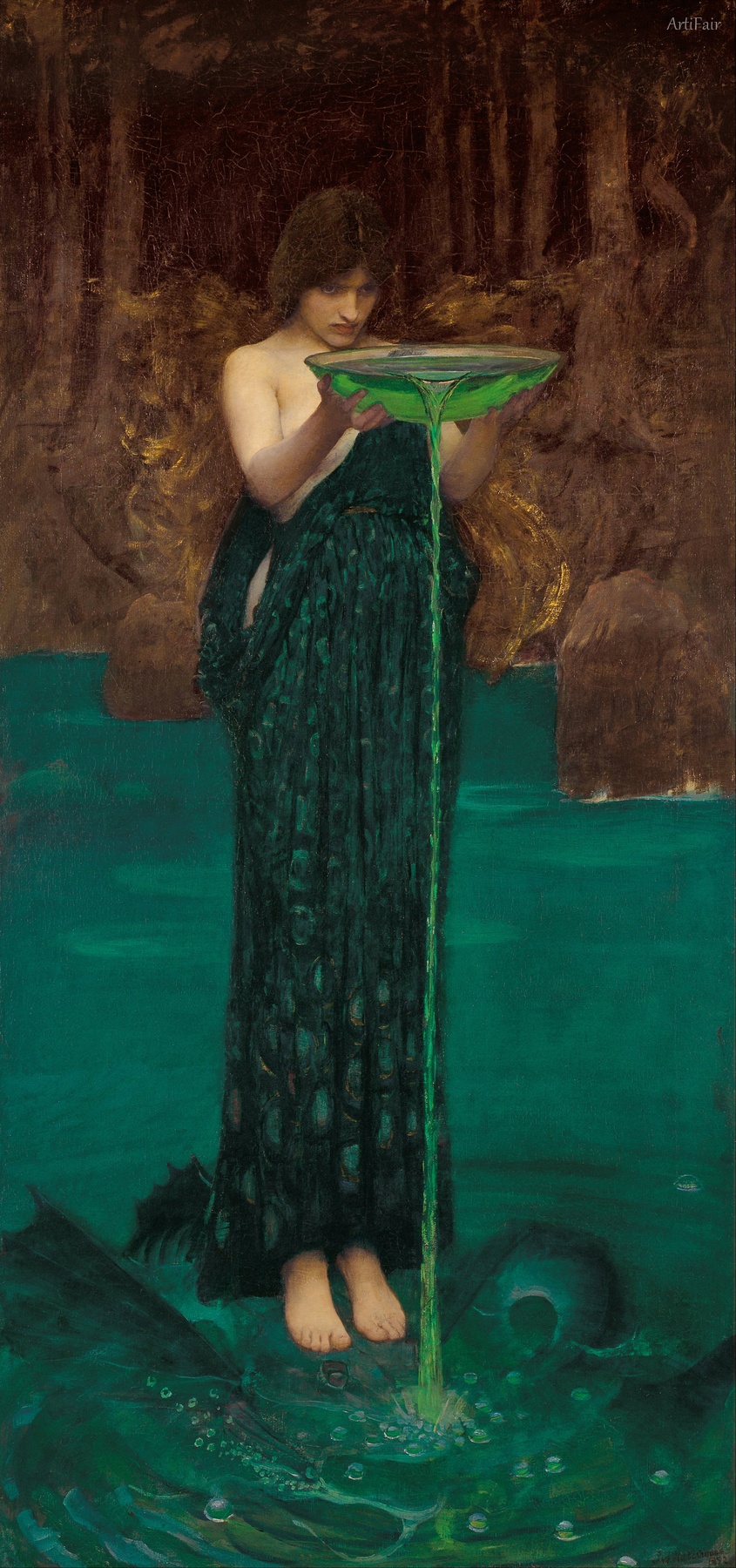
Circe Invidiosa
Category:
Created:
1892
Likes:
3
Dimensions:
Download:
New users get 4 free credits. 2K costs 1 credit; 4K and Ultra HD are priced by resolution. Public domain artworks can be used commercially.
Dominant colors
Public domain download summary
This artwork is provided as a public domain image resource. The 2K file costs 1 credit for everyday creative work, while 4K and Ultra HD files are priced by resolution.
Art Appreciation
Circe Invidiosa (Envious Circe) is an oil painting on canvas by John William Waterhouse, signed and dated 1892, in the collection of the Art Gallery of South Australia, Adelaide.
The subject comes from Book XIV of Ovid's Metamorphoses. The enchantress Circe tries and fails to draw the sea-god Glaucus away from the nymph Scylla, and in jealous revenge she poisons the cove where Scylla bathes, turning her rival into a sea monster. It was Waterhouse's second picture of Circe, following Circe Offering the Cup to Ulysses of 1891; he returned to her a third time in The Sorceress of 1911.
On a tall, narrow canvas measuring 180.7 by 87.4 cm, Circe stands barefoot above the water, head bowed, tipping a shallow bowl so that a thin stream of bright green liquid falls into the sea. Her gown is patterned with rounded, feather-like motifs, and beneath her feet the dark shapes of the monster already churn in the bubbling water: the transformation is under way, but Scylla herself is shown neither as nymph nor as beast. The writer Anthony Hobson linked the picture's air of menace to its deep greens and blues, and Gleeson White compared its colours to stained glass or jewels. Critics have discussed it in relation to the late nineteenth-century femme fatale, though some writers argue that Waterhouse's Circe is closer to a tragic figure who regrets what she is doing.
After it was exhibited at the Royal Academy in London, the painting was bought in 1892 with a South Australian Government grant, on the advice of a committee made up of Frederic Leighton, Edward Poynter and Hubert von Herkomer, and shipped to Adelaide on the S.S. Orient from Southampton in February 1893. The gallery had already become the first public institution to acquire a Waterhouse when it bought The Favourites of the Emperor Honorius in 1883. The new arrival had a mixed reception: the Daily Telegraph wrote in 1893 that it repels rather than attracts the average sightseer. The gallery now counts it among the most loved and reproduced works in its collection.