
Luncheon of the Boating Party
Category:
Created:
1881
Likes:
0
Dimensions:
Download:
New users get 4 free credits. 2K costs 1 credit; 4K and Ultra HD are priced by resolution. Public domain artworks can be used commercially.
Dominant colors
Public domain download summary
This artwork is provided as a public domain image resource. The 2K file costs 1 credit for everyday creative work, while 4K and Ultra HD files are priced by resolution.
Art Appreciation
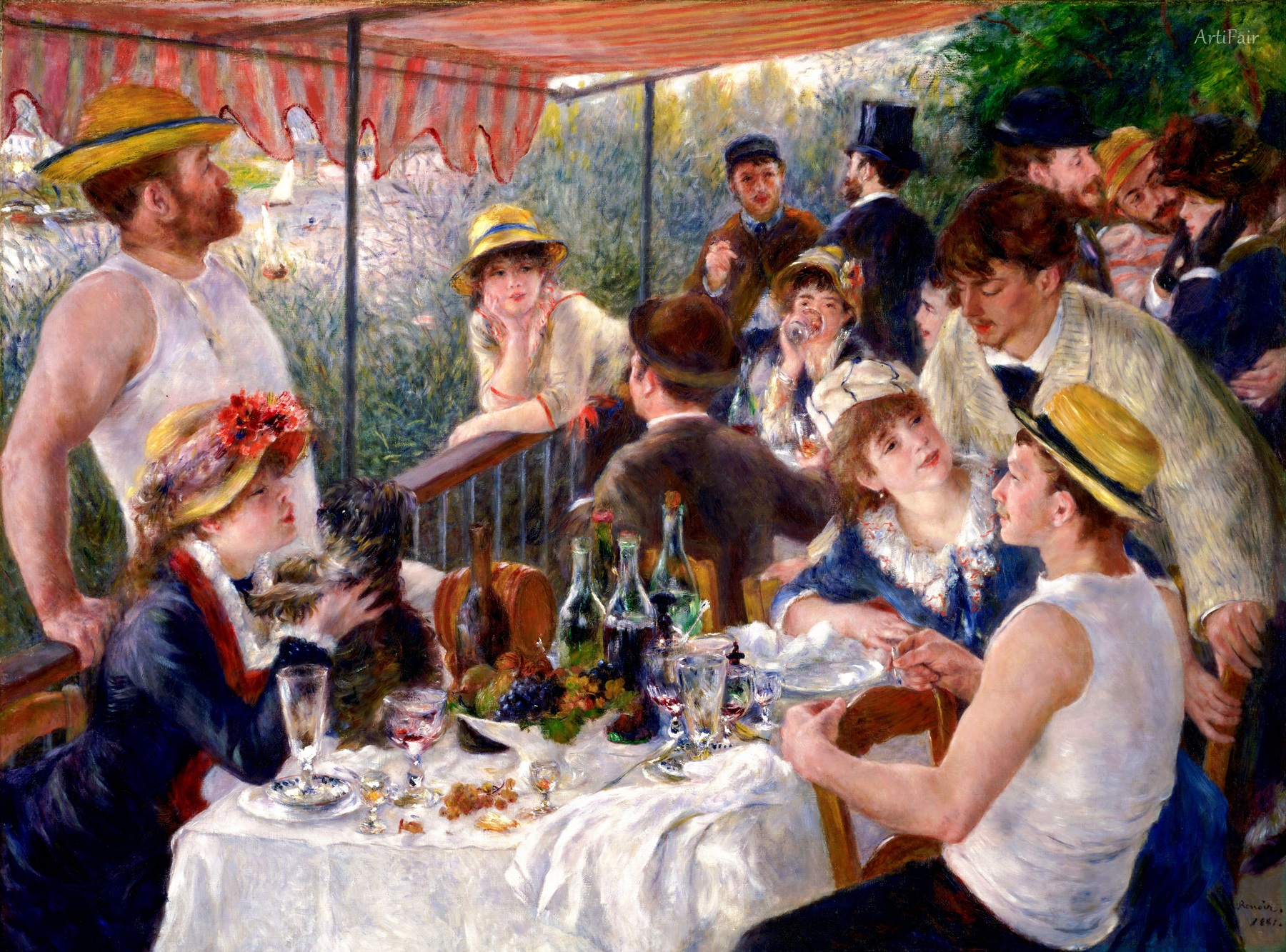
Luncheon of the Boating Party (Le Déjeuner des canotiers) is an oil-on-canvas painting by Pierre-Auguste Renoir, made in 1880–1881 and now in The Phillips Collection, Washington, D.C. It measures 130.2 by 175.6 cm and shows a group of Renoir's friends relaxing on the balcony of the Maison Fournaise, a restaurant on the Seine at Chatou.
Renoir began the picture in late summer 1880 and finished it in the winter of 1881, working on the terrace of the Fournaise, where he often stayed. It brings figure painting, still life and landscape together in one composition, and is thought to reflect his admiration for Veronese's Wedding Feast at Cana in the Louvre. The diagonal railing divides a crowded half from an almost empty one. The sitters, identified by Julius Meier-Graefe in 1912, include Aline Charigot, the seamstress Renoir later married, playing with a small dog at lower left; the painter and patron Gustave Caillebotte sitting astride a chair at lower right with the model Angèle and the journalist Adrien Maggiolo; the proprietor's children Alphonse and Alphonsine Fournaise by the railing; the actress Ellen Andrée drinking from a glass; Charles Ephrussi in a top hat talking with Jules Laforgue; and the actress Jeanne Samary at upper right with Eugène Pierre Lestringuez and Paul Lhote.
Shown at the Seventh Impressionist Exhibition in 1882, it was named the best painting in the show by three critics. Armand Silvestre called it one of the best things Renoir had painted, while Albert Wolff of Le Figaro remarked that Renoir would have had a very pretty picture if he had learned to draw.
The dealer Paul Durand-Ruel bought it from the artist. Duncan Phillips, who had pursued it for about a decade, acquired it from Durand-Ruel's son in 1923 for $125,000 and wrote that his gallery would possess one of the greatest paintings in the world. It went on view there in December 1923, and Phillips later concluded it was the only major Renoir he needed. The painting also features prominently in the film Amélie (2001), which compares its heroine to the woman with the glass.