
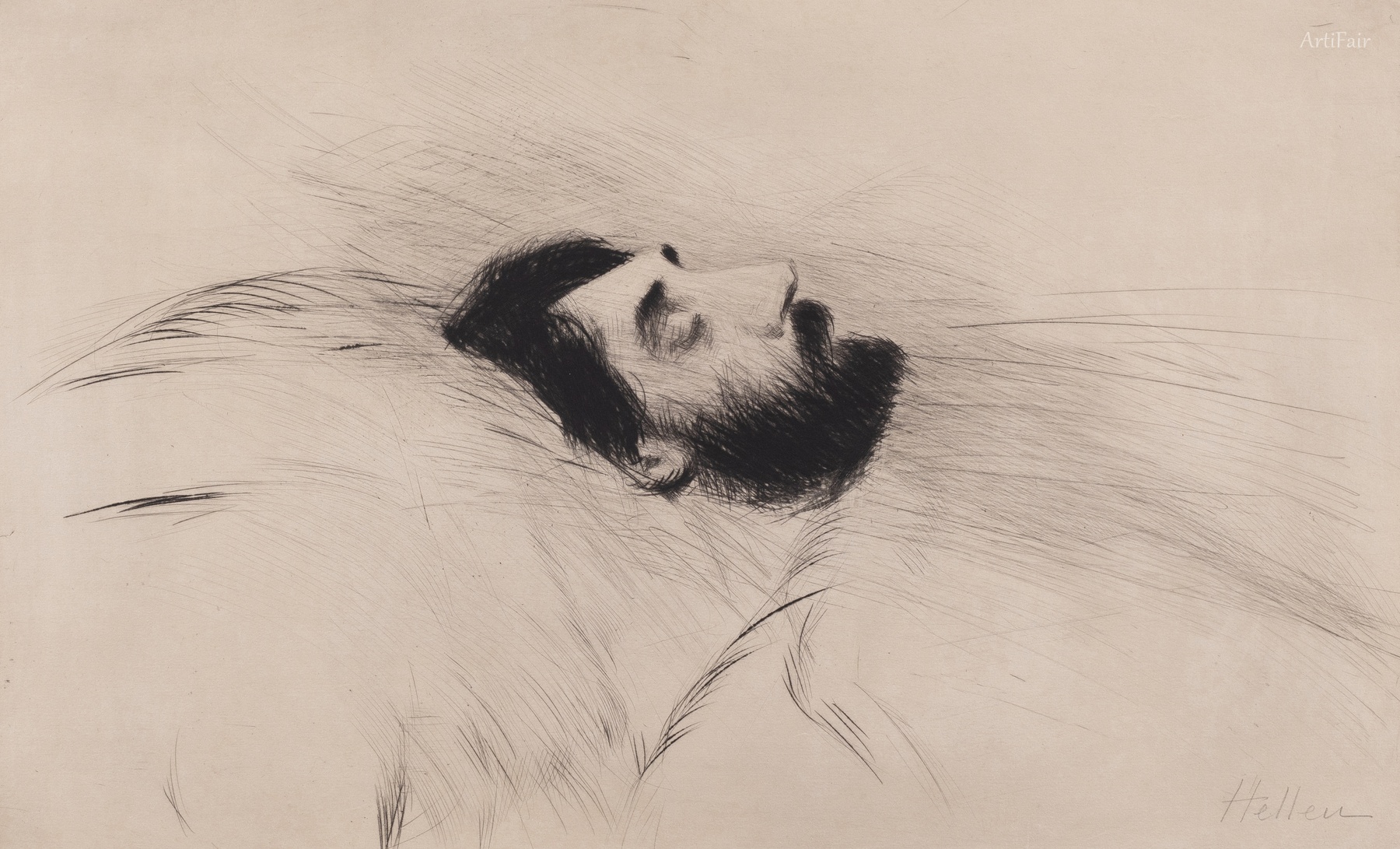
Proust on His Deathbed
Category:
Created:
1922
Likes:
0
Dimensions:
Download:
New users get 4 free credits. 2K costs 1 credit; 4K and Ultra HD are priced by resolution. Public domain artworks can be used commercially.
Dominant colors
Public domain download summary
This artwork is provided as a public domain image resource. The 2K file costs 1 credit for everyday creative work, while 4K and Ultra HD files are priced by resolution.
Art Appreciation
Proust on His Deathbed is a drypoint by Paul César Helleu, made on 19 November 1922, the day after the novelist Marcel Proust died in Paris; impressions are held by the Bibliothèque nationale de France and the Musée Bonnat-Helleu in Bayonne.
Helleu had learned drypoint, drawing with a sharp point directly on a copper plate, after meeting James Tissot in London in 1885, and became a virtuoso of the technique, producing more than 2,000 prints. Through Robert de Montesquiou he met Proust, according to Sotheby's in 1895, and the two became friends, seeing each other at Cabourg in 1907 and 1912. Helleu is regarded as the principal model for Elstir, the painter in In Search of Lost Time. In 1920 he wrote to Proust that he had always wanted to engrave his head, but that the writer no longer came to see him.
The chance came only after Proust's death. At the request of his brother, Professor Robert Proust, Helleu came to the bedroom on the Sunday afternoon. Proust's housekeeper Céleste Albaret later recalled that the light reflecting on the copper plate troubled him, but that he refused to have the shutters opened for fear the air would affect the body. To the dealer René Gimpel, Helleu said he had drawn Proust as a dead man, admired his thick black beard and newly rounded forehead, yet felt he had failed because, working by electric light, he could see only the copper. The print shows the head in profile sunk in the pillow, with the bedding suggested by a few sweeping strokes. Man Ray also photographed Proust on his deathbed.
Impressions are rare. According to Albaret only two or three proofs were pulled, none for sale; Helleu's daughter recalled him scraping the plate with his foot to destroy it, after which two more proofs were printed from the damaged copper. The president of the Friends of Paul-César Helleu estimates about five impressions, while a sheet sold at Christie's is inscribed 'tiré à 10'. The Bayonne impression came in 2009 as a bequest from the artist's daughter Paulette Howard-Johnston.