
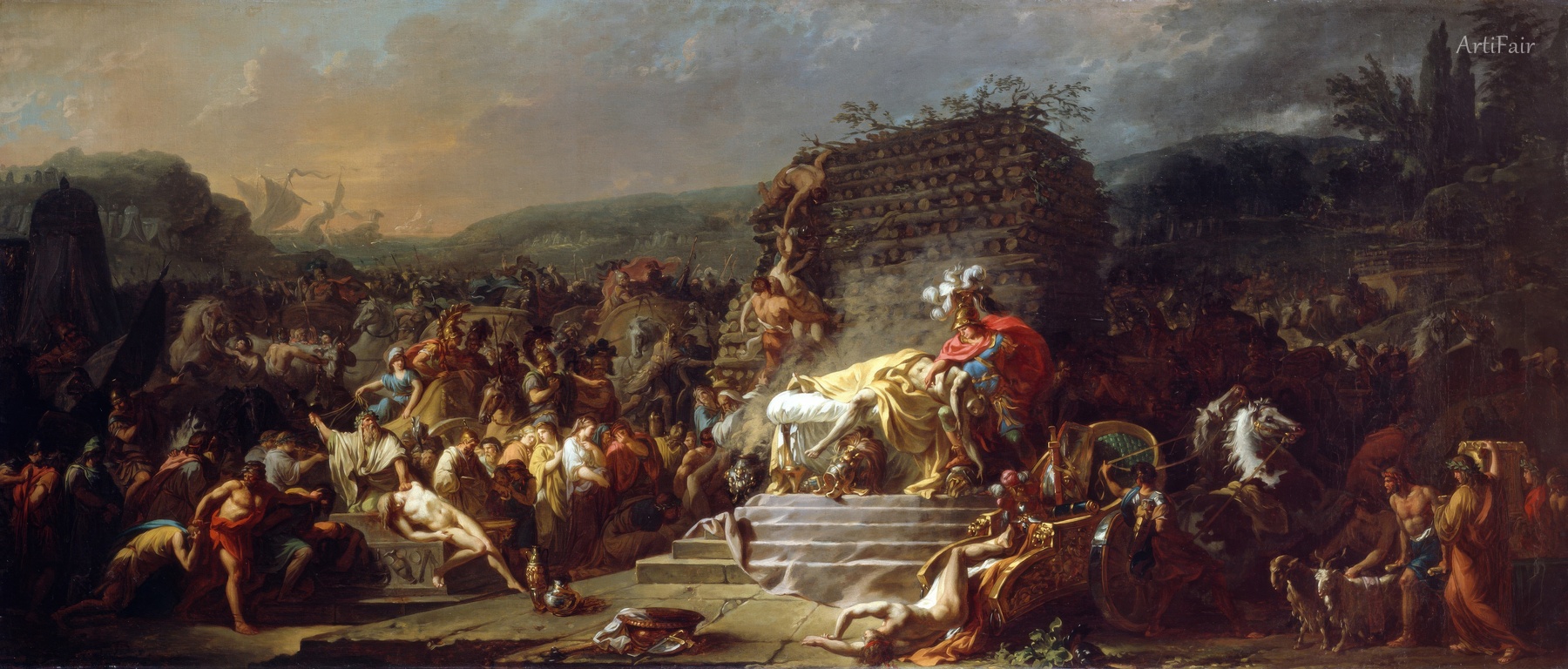
The Funeral of Patroclus
Category:
Created:
1778
Likes:
1
Dimensions:
Download:
New users get 4 free credits. 2K costs 1 credit; 4K and Ultra HD are priced by resolution. Public domain artworks can be used commercially.
Dominant colors
Public domain download summary
This artwork is provided as a public domain image resource. The 2K file costs 1 credit for everyday creative work, while 4K and Ultra HD files are priced by resolution.
Art Appreciation
The Funeral of Patroclus is an oil sketch on canvas by Jacques-Louis David, dated 1778 and signed 'J.L. David f. Roma 1779', painted while he was a student at the French Academy in Rome; it belongs to the National Gallery of Ireland, Dublin.
David won the Prix de Rome in 1774, which allowed him several years of study in Rome. There he copied ancient statues, sarcophagi and reliefs, in a period when Winckelmann's ideas had made antiquity the model for a new classicism. This broad panoramic composition, 94 × 218 cm, was conceived in an ambitious grand manner, and the French Wikipedia article notes that it still keeps Baroque and older French traits alongside its classical subject. A preparatory drawing of 1774 is in the Louvre.
The scene comes from the last books of Homer's Iliad and is set in the Greek camp. At the centre Achilles, in a red cloak, mourns his friend Patroclus, whose body lies on a bier in front of a tall funeral pyre. Patroclus had been killed by the Trojan prince Hector, whose corpse appears at the right beside the chariot to which Achilles had it tied. On the left are the twelve Trojan captives whom Achilles sacrificed at the funeral, and further episodes fill the background.
The picture was exhibited at the Palazzo Mancini in Rome in September 1778, where it was well received, and was then sent to Paris so that the academicians could judge David's progress; it was shown at the Salon of 1781. David sold it in 1782 to Abraham Fontanel. It later passed through collections in Naples, dropped out of sight, and reappeared on the London market; the National Gallery of Ireland bought it from the Heim Gallery in 1973 through the Shaw Fund.