
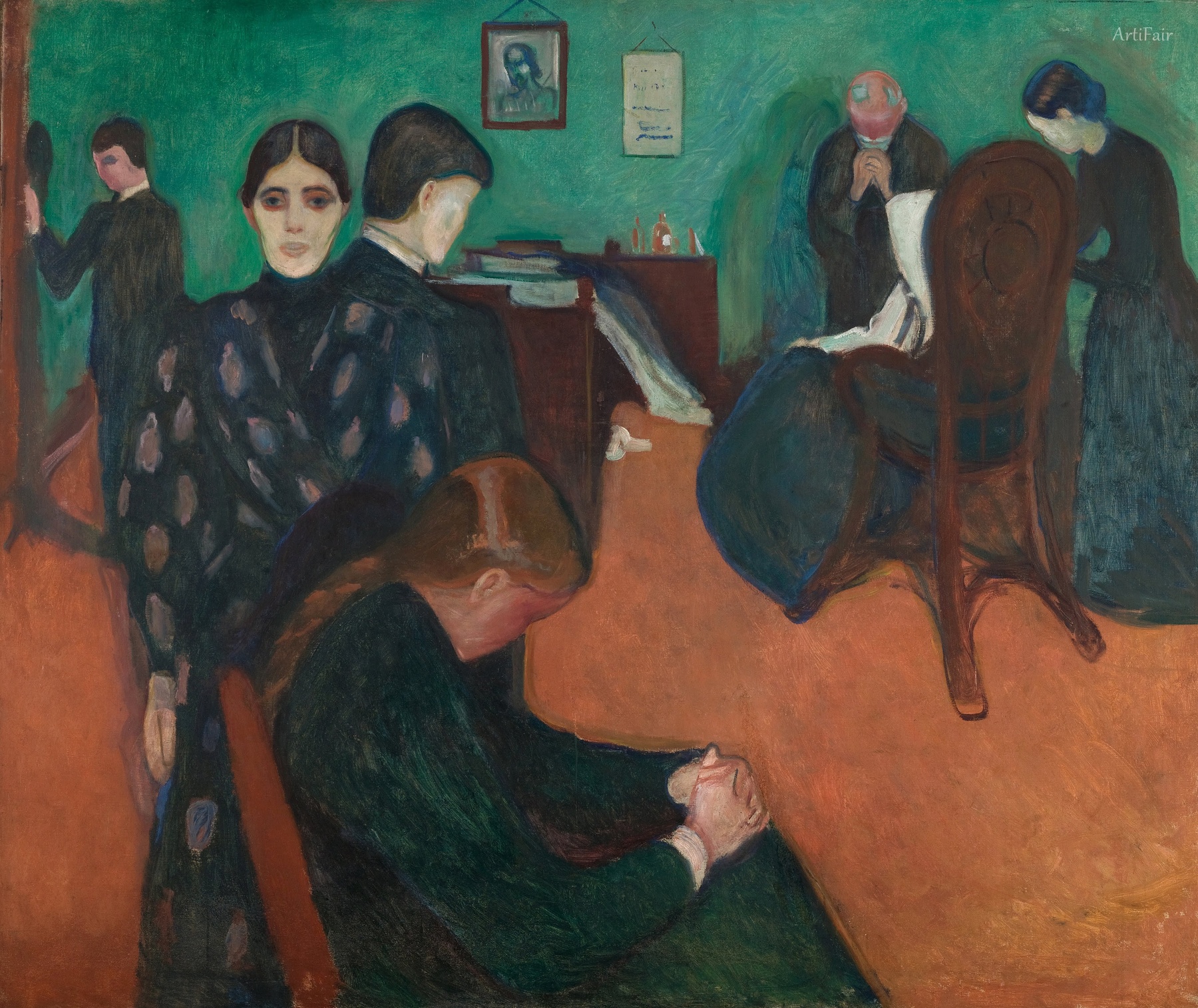
Death in the Sickroom
Category:
Created:
1893
Likes:
0
Dimensions:
Download:
New users get 4 free credits. 2K costs 1 credit; 4K and Ultra HD are priced by resolution. Public domain artworks can be used commercially.
Dominant colors
Public domain download summary
This artwork is provided as a public domain image resource. The 2K file costs 1 credit for everyday creative work, while 4K and Ultra HD files are priced by resolution.
Art Appreciation
Death in the Sickroom is an oil painting on canvas by Edvard Munch, made in 1893 and held by MUNCH, the Munch Museum in Oslo (MM.M.00418, catalogue raisonné Woll M 330); it measures 134 × 160 cm.
The painting returns to the death of Munch's elder sister Sophie, who died of tuberculosis in 1877 at the age of fifteen; their mother had died of the same disease in 1868. Munch began the motif in Berlin in 1893 and painted two large versions that year: this one in oils and another in tempera and crayon, now in the National Museum in Oslo, which the collector Olaf Schou gave to the National Gallery in 1910. Many sketches and a pastel survive, and in 1896 he made a lithograph of the subject.
Sophie herself is barely visible. A high-backed wicker chair hides her, leaving the eye to rest on the relatives. In the foreground are Munch's sisters Laura and Inger and the painter himself, turned away; at the back their father Christian bows his head over folded hands beside the aunt, Karen Bjølstad, while his brother Andreas stands near the door. The family members appear at the ages they had reached by 1893, not in 1877, and the father had in fact died in 1889, so the scene mixes different moments in time. Compared with the flatter tempera version, the saturated oil paint and dark shadows here anchor the figures more firmly in the room.
Munch first showed the motif, under the title A Death, on 5 December 1893 in Berlin, at the entrance to a cycle he called Study for a Series: Love, the forerunner of the Frieze of Life, which also included The Scream, Madonna and Vampire. Reactions were mixed: one critic praised it in the Frankfurter Zeitung, while others complained that one could not even tell whether the dead person was a man or a woman. When the Frieze was shown at the Berlin Secession in 1902, Death in the Sickroom was placed on a wall given over entirely to the theme of death.