
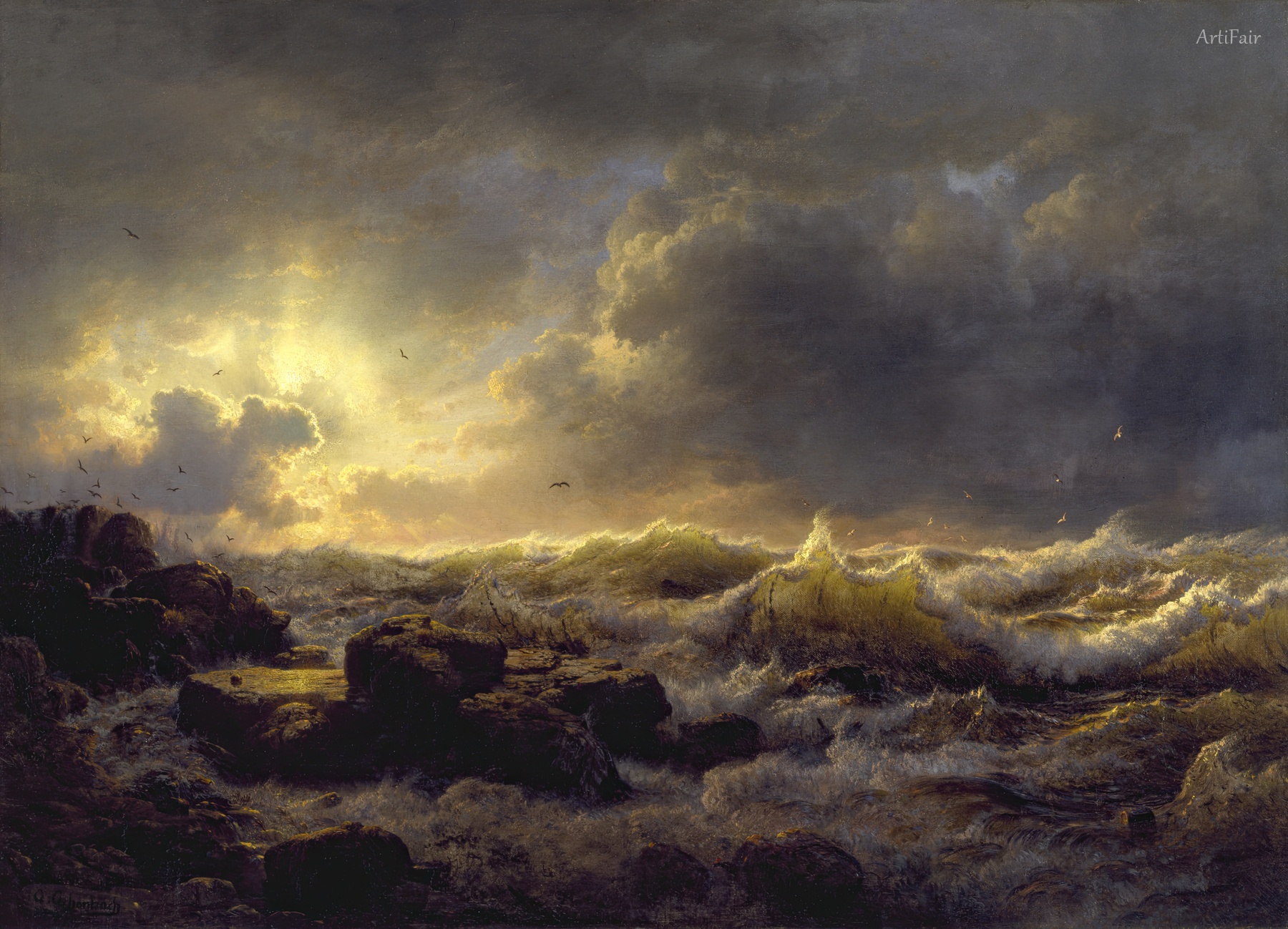
Clearing Up, Coast of Sicily
Category:
Created:
1847
Likes:
0
Dimensions:
Download:
New users get 4 free credits. 2K costs 1 credit; 4K and Ultra HD are priced by resolution. Public domain artworks can be used commercially.
Dominant colors
Public domain download summary
This artwork is provided as a public domain image resource. The 2K file costs 1 credit for everyday creative work, while 4K and Ultra HD files are priced by resolution.
Art Appreciation
Clearing Up, Coast of Sicily (Es klart auf, Küste von Sizilien) is an oil on canvas painted in 1847 by the German landscape and marine painter Andreas Achenbach; it belongs to the Walters Art Museum in Baltimore (accession 37.116).
Achenbach (1815–1910) trained at the Düsseldorf Academy, studying landscape with Johann Wilhelm Schirmer, and is counted among the founders of the Düsseldorf school. He travelled widely in Scandinavia and Italy, often with his brother Oswald, also a landscape painter; the two were nicknamed the 'Alpha and Omega' of landscape after their initials. In 1846 he returned to Düsseldorf to take over the family brewery and inn, and the following year he produced this Sicilian coast scene, signed 'A. Achenbach' and dated 1847 at lower left. The Walters describes him as a specialist in the sublime mode of landscape, in which human beings are dwarfed by the force of nature.
On a canvas of 82.5 by 116.1 cm, evening light breaks through a heavy storm sky at the left and catches the crests of waves pounding a rocky shore, while gulls battle the wind. People are absent. The museum points out the few traces of them that remain — a spar wedged among the rocks, a wooden keg drifting at the right and a tattered American flag on the foreground rocks, barely visible — which together suggest a shipwreck just out of sight.
The painting reached America early. From 1849 to 1857 it was with the Düsseldorf Gallery in New York, run by John Godfrey Boker, and then with the Cosmopolitan Art Association of Sandusky, Ohio, until 1862. William T. Walters bought it at the John Wolfe sale in New York in 1882; his son Henry Walters inherited it in 1894 and bequeathed it to the museum in 1931. It was lent to the exhibition Art and the Empire City: New York, 1825–1861 at the Metropolitan Museum of Art in 2000–2001.