
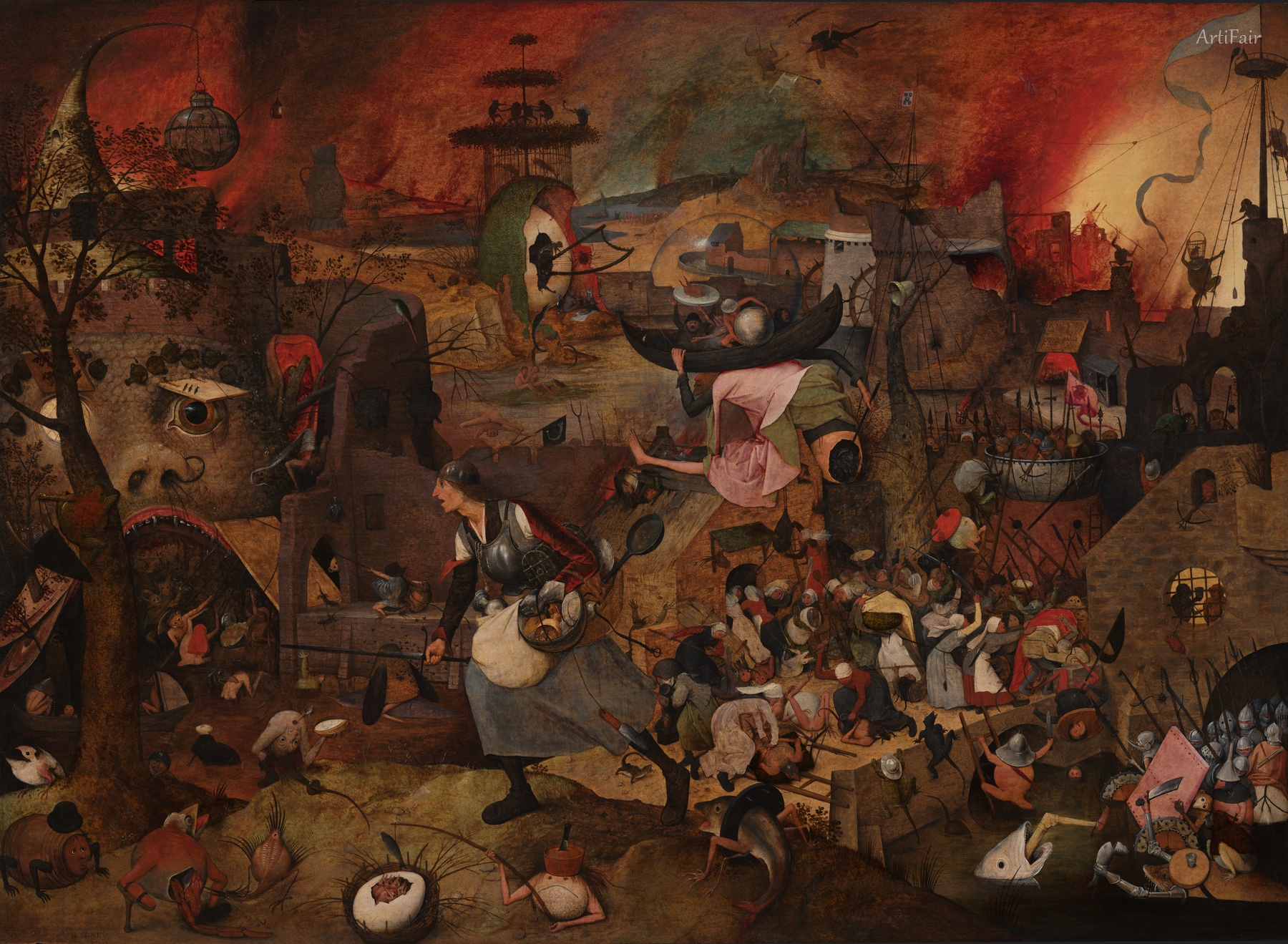
Dull Gret
Category:
Created:
1563
Likes:
0
Dimensions:
Download:
New users get 4 free credits. 2K costs 1 credit; 4K and Ultra HD are priced by resolution. Public domain artworks can be used commercially.
Dominant colors
Public domain download summary
This artwork is provided as a public domain image resource. The 2K file costs 1 credit for everyday creative work, while 4K and Ultra HD files are priced by resolution.
Art Appreciation
Dull Gret (Dulle Griet, also called Mad Meg) is an oil painting on panel by Pieter Bruegel the Elder, dated 1563, in the Museum Mayer van den Bergh in Antwerp. It measures about 117.4 by 162 cm.
The date was long uncertain: the signature had become illegible, and the picture was usually placed in 1561 or 1562 because it is so close in composition and style to The Fall of the Rebel Angels and The Triumph of Death. A restoration completed in 2018 revealed the year 1563, shortly after Bruegel had settled in Brussels. Like those two panels, it draws heavily on the demon-filled imagery of Hieronymus Bosch, and it is thought to have been intended for a series.
The title figure comes from Flemish folklore, where Griet was a scornful name for a shrewish woman and dulle could mean both mad and foolish. Wearing a breastplate, a mailed glove and a metal cap over peasant dress, she strides towards the gaping mouth of Hell with a sword in her right hand and her arms loaded with a chest, baskets and plundered goods, while a band of smaller women fights demons and loots a house behind her. Karel van Mander, writing in 1604, linked the picture to a proverb about plundering in front of Hell. Interpretations differ: it has been read as mockery of aggressive women, as a satire on greed, and as an allegory of the madness and folly of the age.
Pigment analysis by scientists at Ghent University found that Bruegel used inexpensive smalt rather than ultramarine for Griet's blue robe, alongside vermilion and copper resinate. The panel entered the collection of Emperor Rudolf II, was taken by Swedish troops in 1648 and resurfaced in Stockholm in 1800. Fritz Mayer van den Bergh bought it cheaply at a Cologne auction in 1897 and identified its author a few days later.