
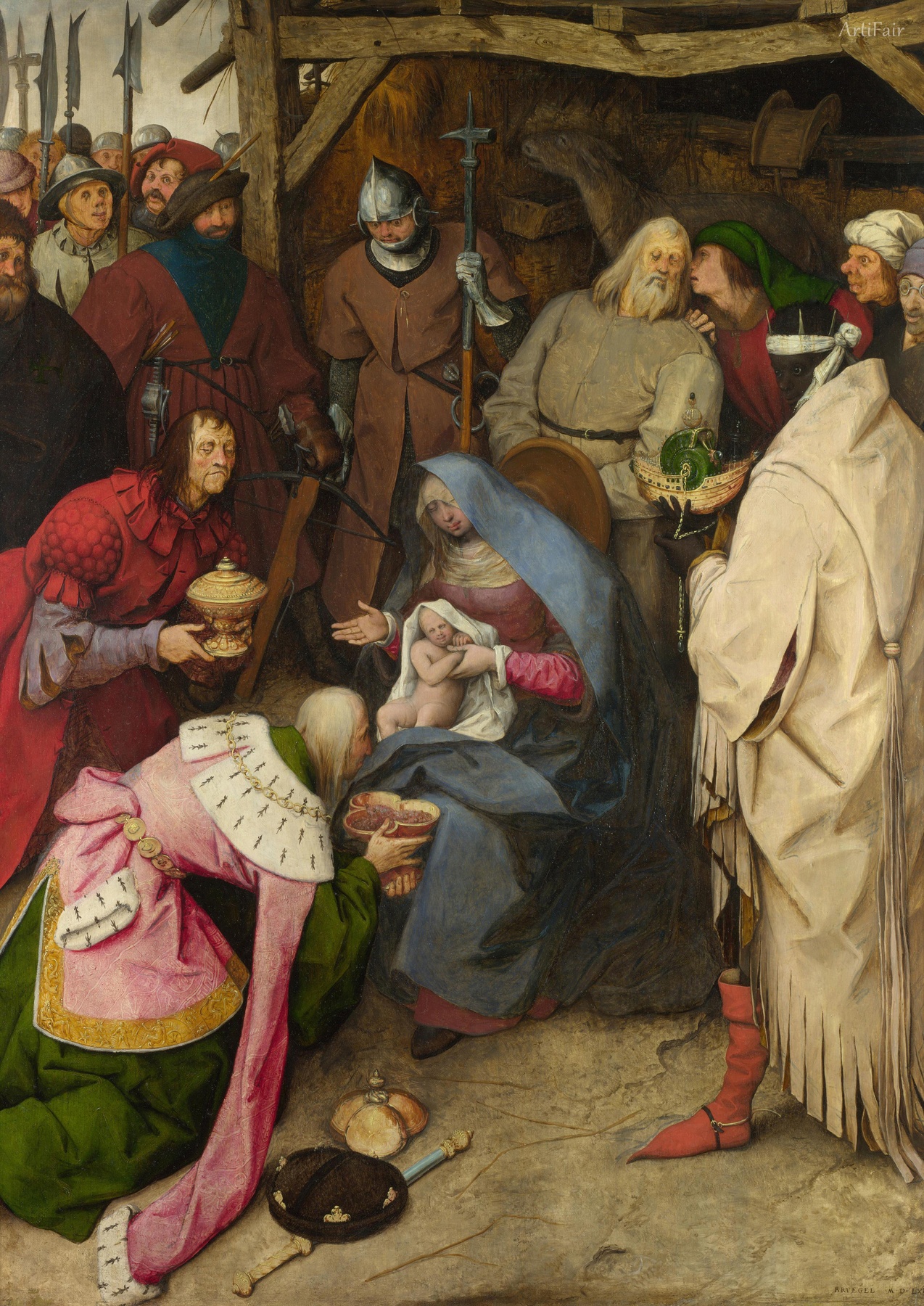
The Adoration of the Kings
Category:
Created:
1564
Likes:
0
Dimensions:
Download:
New users get 4 free credits. 2K costs 1 credit; 4K and Ultra HD are priced by resolution. Public domain artworks can be used commercially.
Dominant colors
Public domain download summary
This artwork is provided as a public domain image resource. The 2K file costs 1 credit for everyday creative work, while 4K and Ultra HD files are priced by resolution.
Art Appreciation
The Adoration of the Kings is an oil painting on oak panel by Pieter Bruegel the Elder, signed and dated 1564 at the lower right, in the National Gallery, London (NG3556). It is one of very few Bruegel paintings in an upright format, and among his small number of religious pictures.
Painted in Brussels in the tense years before the Eighty Years' War, it marked a departure for Bruegel as his first composition made up almost entirely of large figures, a grouping borrowed from Italian mannerists such as Parmigianino. His main source was the Adoration triptych by Hieronymus Bosch now in the Prado, with details taken from Jan Gossaert. The upright shape and rich colour suggest an altarpiece, perhaps for the collector Nicolaes Jonghelinck, but the patron is not known.
The Virgin sits before a ruined stable with the naked Christ Child on her lap, wrapped in a white cloth that resembles a shroud. The aged Caspar kneels in pink and ermine, Melchior bows at the left, and Balthasar stands at the right in a long white robe and red pointed boots, holding myrrh in a gold ship built around a nautilus shell. Behind Joseph crowd armed soldiers and gaping onlookers; the profile of the man speaking to Joseph echoes the donkey in the stable. Faces are elongated and close to caricature, and the crowding creates a claustrophobic mood that the museum relates to the soldiers who would later crucify Christ. Bruegel worked very fast: brushstrokes of the priming and the underdrawing show through, and he misspelled his signature and had to correct it. Reds and pinks have faded and the once-blue sky now looks grey.
The painting was bought by Archduke Ernst of Austria in 1594 and later belonged to the Habsburg collections. After passing to private owners in Vienna, it was smuggled out of Austria after the First World War by the dealer Guido Arnot and sold to the National Gallery for £15,000 in 1920, with help from the Art Fund and Arthur Serena.