
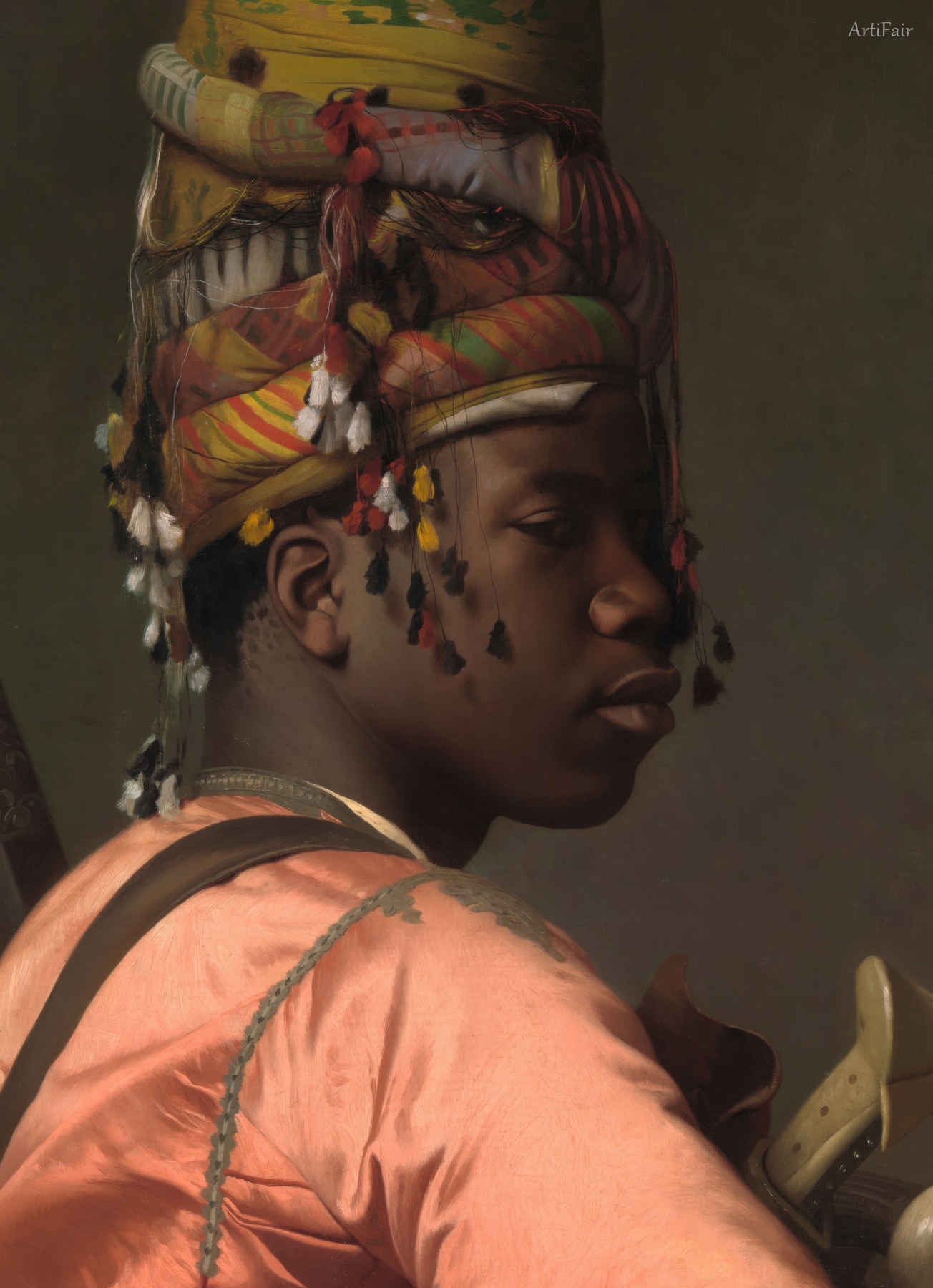
Black Bashi-Bazouk
Category:
Created:
1869
Likes:
2
Dimensions:
Download:
New users get 4 free credits. 2K costs 1 credit; 4K and Ultra HD are priced by resolution. Public domain artworks can be used commercially.
Dominant colors
Public domain download summary
This artwork is provided as a public domain image resource. The 2K file costs 1 credit for everyday creative work, while 4K and Ultra HD files are priced by resolution.
Art Appreciation
Bashi-Bazouk, also catalogued as Black Bashi-Bazouk, is an oil-on-canvas painting by Jean-Léon Gérôme, made in 1868–69 and now in the Metropolitan Museum of Art, New York.
Gérôme painted it in Paris after returning from a twelve-week journey to the Near East in early 1868, at a time when he was at the height of his career. Rather than working from a soldier in the field, he dressed a studio model in textiles and accessories he had brought back from the trip. The canvas measures 80.6 × 66 cm. The Met owns a second, much smaller Bashi-Bazouk from the same years (26 × 21.6 cm), showing a different sitter in a green cloak.
Bashi-bazouks were irregular troops of the Ottoman army, unpaid or poorly paid, who fought for plunder and were notorious for brutality and indiscipline. Having no uniform, they wore whatever they could find, and the mismatched cloths wound into this man's tall turban, hung with coloured tassels, allude to that habit. The Met renders Gérôme's Turkish title as 'headless'. The figure is seen from behind, head turned in profile, with a strap across his back and ivory-hilted weapons at his side. Both the Met and Wikipedia point to the contrast between the soldiers' fierce reputation and the sitter's exquisite silk tunic and dignified bearing, and to Gérôme's virtuoso rendering of textures.
The painting was bought directly from the artist by the Paris publisher and dealer Adolphe Goupil, passed through the hands of the New York dealer Samuel Putnam Avery and a series of private collections on the American East Coast, and was given to the Met by Mrs. Charles Wrightsman in 2008. In 2012 the museum chose it for the cover of the first new edition of its guidebook in nearly thirty years, and in 2020 the critic Sebastian Smee wrote in The Washington Post that it was one of the most beautiful paintings he knew.