
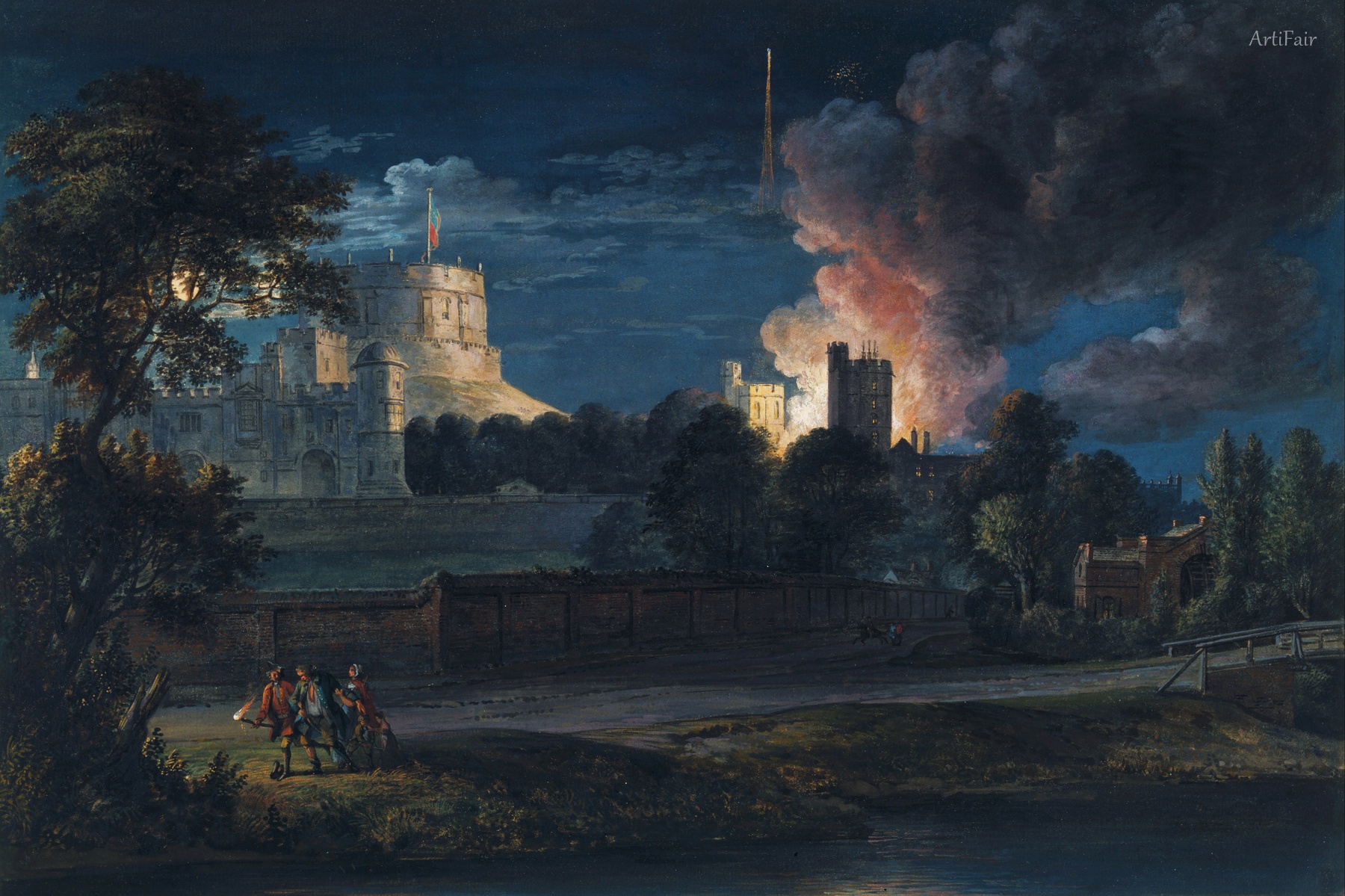
Windsor Castle from Datchet Lane on a Rejoicing Night
Category:
Created:
1768
Likes:
0
Dimensions:
Download:
New users get 4 free credits. 2K costs 1 credit; 4K and Ultra HD are priced by resolution. Public domain artworks can be used commercially.
Dominant colors
Public domain download summary
This artwork is provided as a public domain image resource. The 2K file costs 1 credit for everyday creative work, while 4K and Ultra HD files are priced by resolution.
Art Appreciation
Windsor Castle from Datchet Lane on a Rejoicing Night is a gouache with touches of gold paint on paper by Paul Sandby, signed and dated 1768, in the Royal Collection (RCIN 914584). It measures 309 by 459 mm and shows the castle by night during a public celebration.
Sandby, trained as a military draughtsman and employed on the Military Survey of Scotland, spent long periods at Windsor after his brother Thomas's patron, the Duke of Cumberland, became Ranger of Windsor Great Park, and drew the castle and its surroundings from the 1750s onwards. 1768 was a significant year for him: he became chief drawing master at the Royal Military Academy, Woolwich, and was one of the founder members of the Royal Academy.
A bonfire burns in the castle's Middle Ward, its glow shining through the windows of the Winchester Tower, while a full moon hangs over the Star Buildings, where the Royal Library is now housed. On Datchet Lane a drunken reveller, one stocking loose and his tricorn hat at his feet, straddles a makeshift hobby-horse as a torchbearer, a woman and two children lead him home. The Engine House at right was designed by Sir John Vanbrugh in 1718 to pump water up to the castle. Sandby rearranged the topography: the viewpoint is about half a mile (800 m) from the north front, yet the castle is drawn far larger than it would appear.
Because dated works by Sandby are uncommon, the Royal Collection suggests he was recording a real event. Candidates in 1768 include George III's 30th birthday on 4 June, the birth of Princess Augusta Sophia on 8 November and Guy Fawkes Night; the trees in full leaf point to the King's birthday. The historian Linda Colley noted that 1768 also saw bonfires for the radical John Wilkes's election to Parliament. The date of acquisition is unknown; the sheet was first recorded in the Royal Collection at a 1909 exhibition, as Celebration of the 4th of June, 1768 (?). It was shown in the 2009 to 2010 exhibition Paul Sandby: Picturing Britain.