
Woolworth Building
Category:
Created:
1908
Likes:
0
Dimensions:
Download:
New users get 4 free credits. 2K costs 1 credit; 4K and Ultra HD are priced by resolution. Public domain artworks can be used commercially.
Dominant colors
Public domain download summary
This artwork is provided as a public domain image resource. The 2K file costs 1 credit for everyday creative work, while 4K and Ultra HD files are priced by resolution.
Art Appreciation
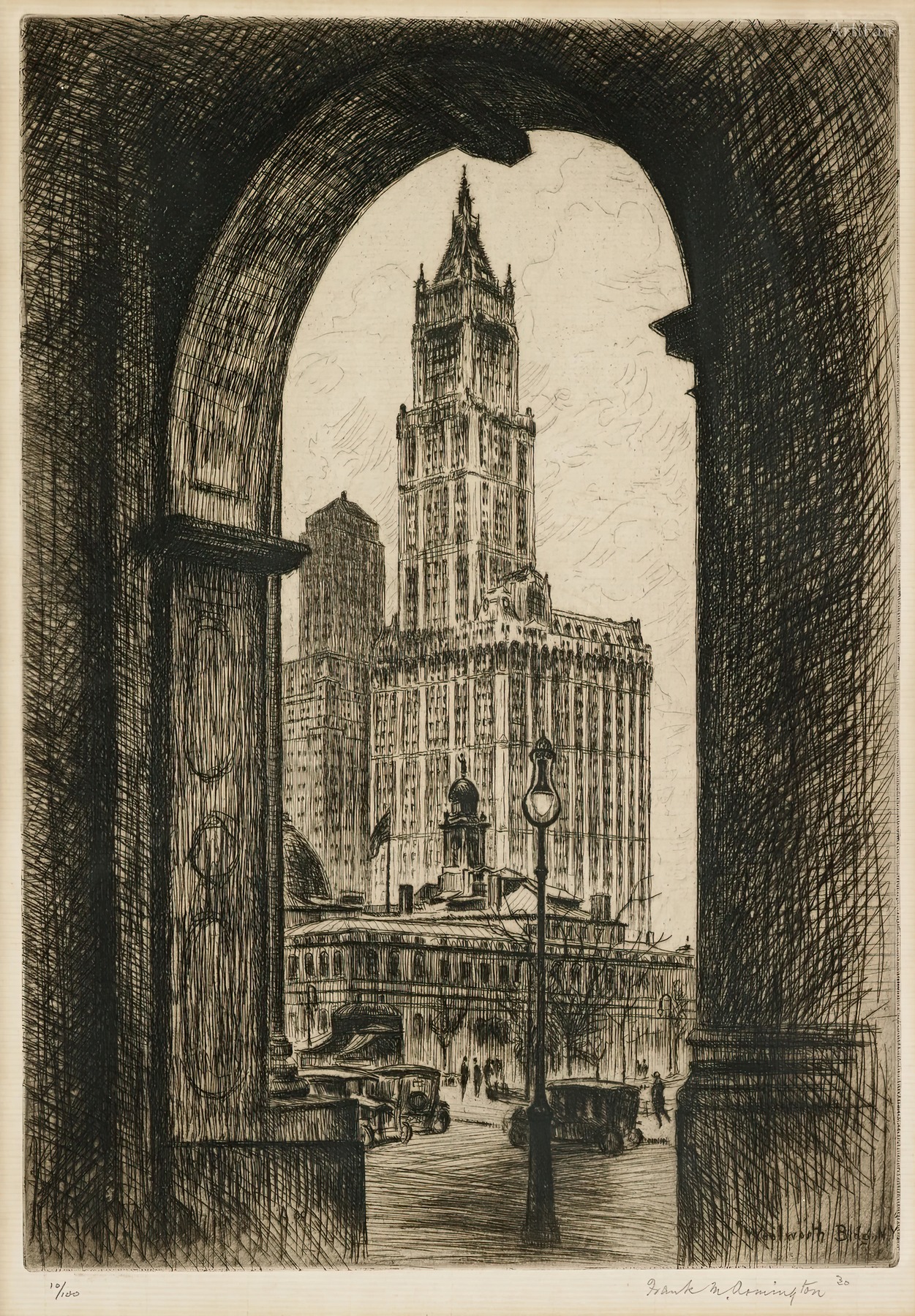
Woolworth Building is an etching by the Canadian-born printmaker Frank Armington, dated 1930 by Loch Gallery, which lists an impression measuring 12.12 × 8.5 inches; it shows Cass Gilbert's skyscraper in Lower Manhattan framed by a massive stone arch.
Armington was born in Fordwich, Ontario, in 1876 and studied with J. W. L. Forster in Toronto, where he met his wife, the etcher Caroline Wilkinson. After studying at the Académie Julian he lived in Paris from 1905 until 1939, and the couple became established figures in the city's expatriate art community during the etching revival of the early twentieth century. Over his career he made 221 etchings as well as lithographs, many of them views of European towns and monuments, but he also took up subjects in modern North America. The Armingtons moved to New York in 1939, and Frank died there in 1941.
The Woolworth Building, designed by Cass Gilbert for the retailer Frank W. Woolworth and opened in 1913, rises 792 feet on Broadway and was the tallest building in the world until 1929. Its neo-Gothic ornament earned it the nickname 'The Cathedral of Commerce', and it attracted many etchers: Joseph Pennell drew it in 1915 and again in 1921, looking through the arch of the Municipal Building. Armington uses a similar device. The dark, densely cross-hatched arch fills the foreground and edges of the sheet, while the pale, finely drawn tower soars in the bright opening, with a street lamp, motor cars, pedestrians and a low domed building at its foot. The contrast makes the building appear even taller.
This impression is signed in pencil at lower right and numbered at lower left as one of an edition of 100; the artist's name also appears in the plate at lower right. Prints by the Armingtons are held by the Victoria and Albert Museum, the British Museum and the New York Public Library, among other collections.