
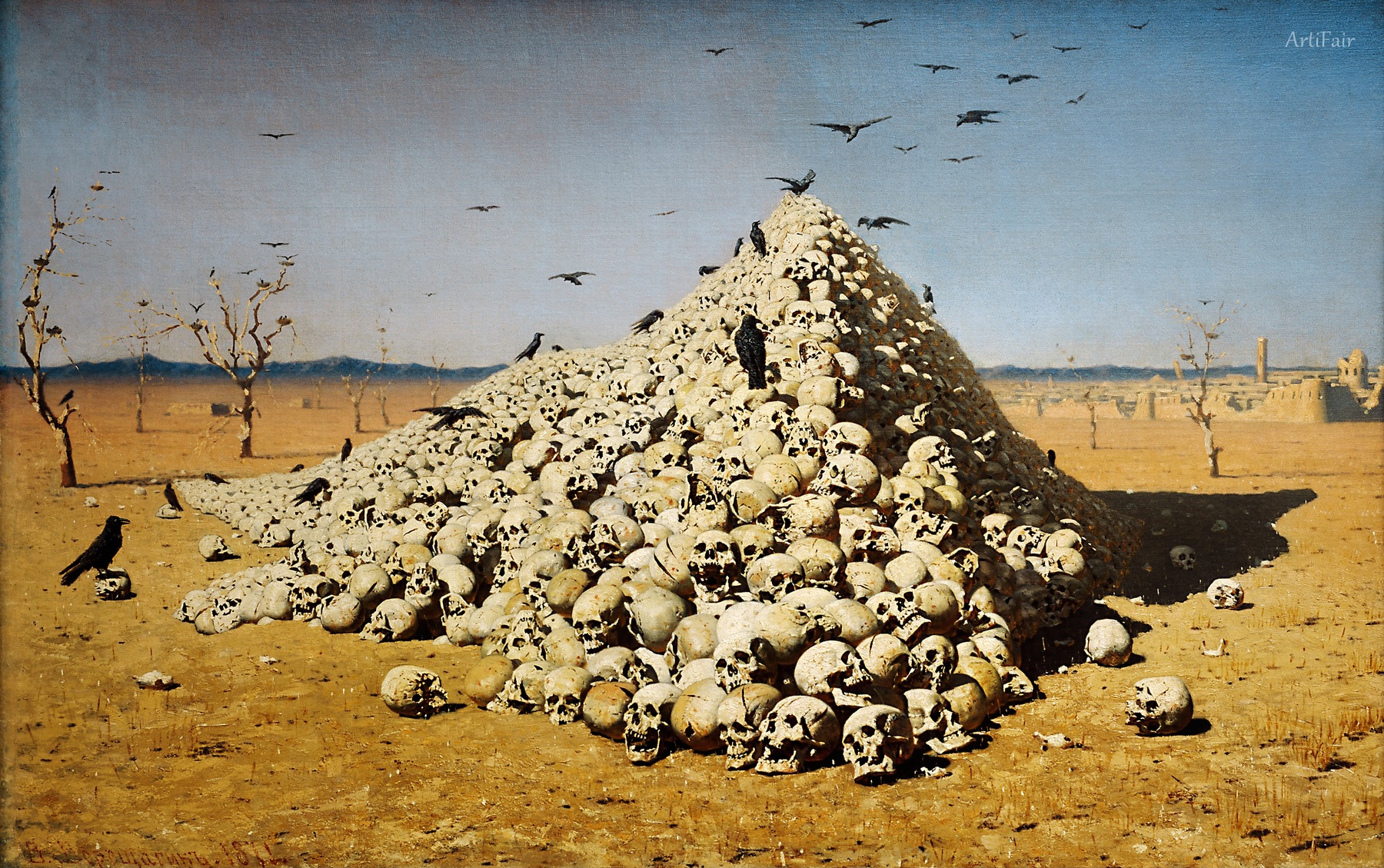
The Apotheosis of War
Category:
Created:
1871
Likes:
0
Dimensions:
Download:
New users get 4 free credits. 2K costs 1 credit; 4K and Ultra HD are priced by resolution. Public domain artworks can be used commercially.
Dominant colors
Public domain download summary
This artwork is provided as a public domain image resource. The 2K file costs 1 credit for everyday creative work, while 4K and Ultra HD files are priced by resolution.
Art Appreciation
The Apotheosis of War is an oil painting on canvas by the Russian war painter Vasily Vereshchagin, made in Munich in 1871 and held by the State Tretyakov Gallery in Moscow. It measures 127 × 197 cm and belongs to his Turkestan Series.
Vereshchagin went to Turkestan in 1867 as an ensign attached to Governor-General Konstantin von Kaufmann, while the Russian Empire was conquering Central Asia, and saw fighting there. After a second journey in 1869–70 he settled in Munich and painted the series from his sketches and memories. He first meant to call this canvas the Apotheosis of Tamerlane, after the fourteenth-century conqueror whose armies left pyramids of enemy skulls behind them, and in the catalogue of his 1876 Moscow exhibition he recalled that such pyramids were still built in recent times: the head of the German traveller Adolf Schlagintweit, executed in Kashgar in 1857, was placed in one. He then widened the meaning, writing the title at the top of the frame and, below, a dedication to all great conquerors, past, present and to come. The Tretyakov describes it as the epilogue of his cycle The Barbarians, about a Russian detachment destroyed by Bukharan troops.
A mound of skulls rises from a scorched yellow steppe under a clear blue sky; crows circle it or perch on the bones, charred trees stand around, and the ruins of a walled town lie in the distance. Sword cuts and arrow holes can be seen on some skulls. The critic Vladimir Stasov saw in it the feeling of a historian and judge of humanity rather than mere skill with paint.
The picture was read as an anti-war statement, and the Russian authorities kept it and Left Behind out of Vereshchagin's exhibitions in Russia. In Germany, Field Marshal Helmuth von Moltke is reported to have barred soldiers from seeing it. Pavel Tretyakov bought it from the artist in 1874.