
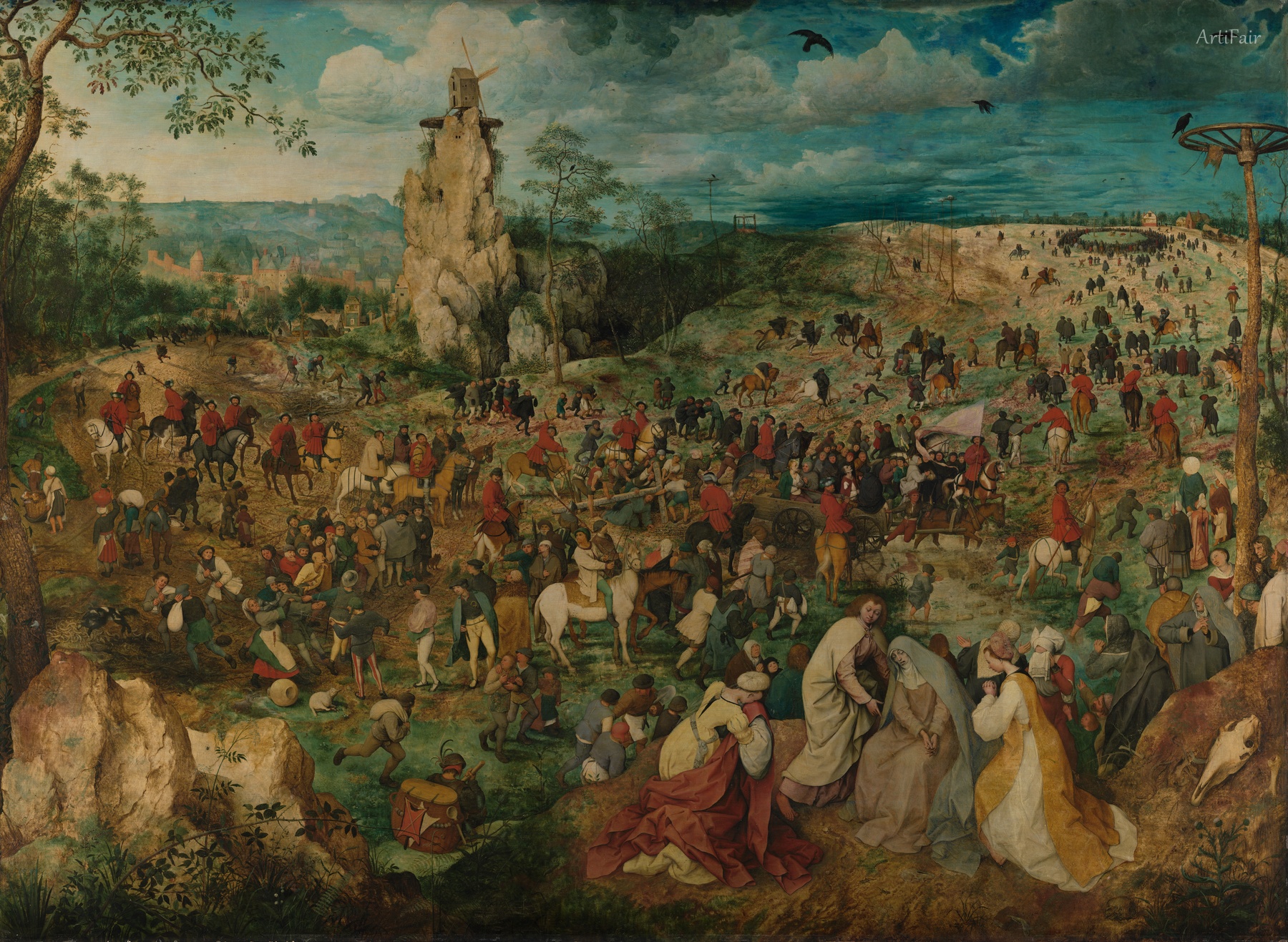
The Procession to Calvary
Category:
Created:
1564
Likes:
0
Dimensions:
Download:
New users get 4 free credits. 2K costs 1 credit; 4K and Ultra HD are priced by resolution. Public domain artworks can be used commercially.
Dominant colors
Public domain download summary
This artwork is provided as a public domain image resource. The 2K file costs 1 credit for everyday creative work, while 4K and Ultra HD files are priced by resolution.
Art Appreciation
The Procession to Calvary is an oil painting on oak panel by Pieter Bruegel the Elder, signed and dated 1564, in the Kunsthistorisches Museum in Vienna. At 124 by 170 cm it is the second-largest painting by Bruegel that is known.
It is one of sixteen Bruegels listed in 1566 in the inventory of the Antwerp merchant Nicolaes Jonghelinck, who commissioned the painter's series of the months and may have ordered this picture too. Jonghelinck's Bruegels passed to the city of Antwerp that same year. The panel went to Archduke Ernst in 1595 and later to Emperor Rudolf II, in whose Prague collection it was recorded in 1604. It has been in the Vienna picture gallery since 1783, apart from 1809 to 1815, when Napoleon's forces took it to Paris.
Bruegel recast the Gospel story as a contemporary Flemish execution. A colourful crowd, many in sixteenth-century dress, streams from a walled city towards a ring of spectators on Golgotha, where a hole is being dug for the cross. Christ, fallen under the cross at the exact centre, is tiny and easy to miss amid the red-coated horsemen. Ahead of him a cart carries the two thieves, clutching crucifixes and confessing to monks, while Simon of Cyrene is being pulled from the crowd to help with the cross. A windmill stands on an impossibly sheer rock, a type of outcrop that belongs to the Antwerp landscape tradition of Joachim Patinir, and the sky darkens from left to right towards the place of execution.
In the right foreground, raised on a rocky ledge and dressed in older flowing robes, the fainting Virgin is supported by Saint John among the holy women, a scene set apart from the indifferent crowd behind them. The painting inspired Michael Francis Gibson's book The Mill and the Cross and Lech Majewski's 2011 film of the same name.