
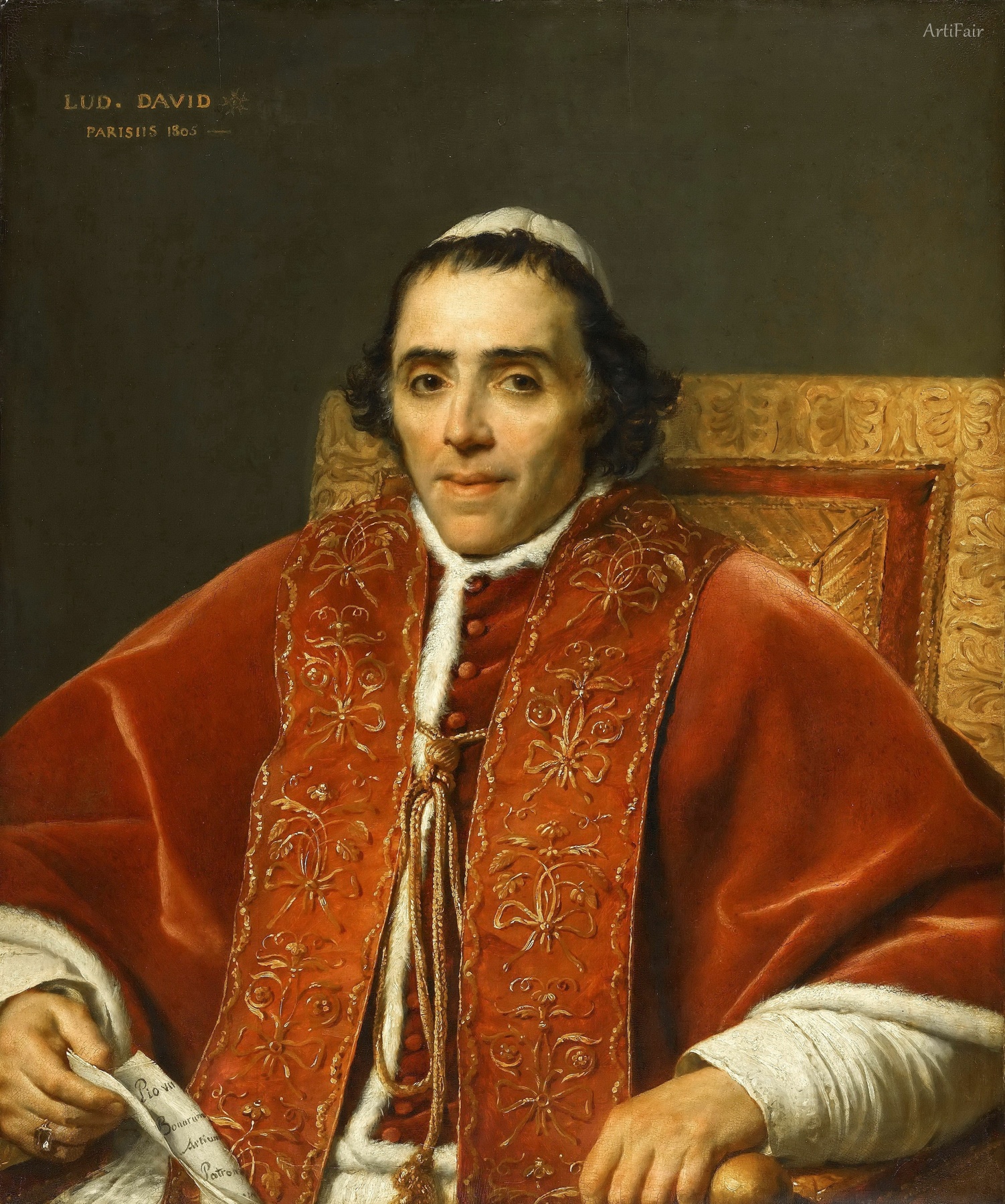
Portrait of Pope Pius VII
Category:
Created:
1800
Likes:
0
Dimensions:
Download:
New users get 4 free credits. 2K costs 1 credit; 4K and Ultra HD are priced by resolution. Public domain artworks can be used commercially.
Dominant colors
Public domain download summary
This artwork is provided as a public domain image resource. The 2K file costs 1 credit for everyday creative work, while 4K and Ultra HD files are priced by resolution.
Art Appreciation
Portrait of Pope Pius VII is an oil-on-panel portrait by Jacques-Louis David, signed LUD. DAVID PARISIIS 1805 at upper left and measuring 86.5 × 71.5 cm; it is in the Louvre, Paris (INV 3701).
Pius VII had come to Paris for the coronation of Napoleon, a ceremony David was to record in The Coronation of Napoleon, and David painted him from life at the Tuileries Palace in February and March 1805. The commission came through the Intendant General of the Emperor's Household, and the portrait was probably meant as a gift to the sitter. Finished on 15 March 1805, it was shown for eight days from 25 March at the gallery of the Senate in the Luxembourg Palace. David was paid 10,000 francs in September 1806, but instead of going to the pope the panel entered the Musée Napoléon; after a spell at the Musée du Luxembourg it came to the Louvre in January 1826.
The pope is seen at half length, seated in a gilt chair upholstered in red velvet against a plain dark brown background. He wears a white skullcap, a white rochet visible at the sleeves, a red velvet mozzetta lined with ermine and a red stole embroidered in gold. His arms rest on the chair, and in his right hand he holds a sheet inscribed Pio VII Bonarum Artium Patron, Pius VII, patron of the fine arts. Rather than the mightiest prelate in Christendom, David chose to show a calm, direct and inward-looking man, apparently impressed by his simplicity. Some contemporaries found the tight framing cramped. Until about 1816 the signature was preceded by words naming David First Painter to the Emperor Napoleon; those words were later erased.
With the help of a pupil, probably Georges Rouget, David made replicas: two ordered for Napoleon and Josephine, each paid 6,000 francs and now at Versailles and Fontainebleau, and a third that he kept and took with him into exile.