
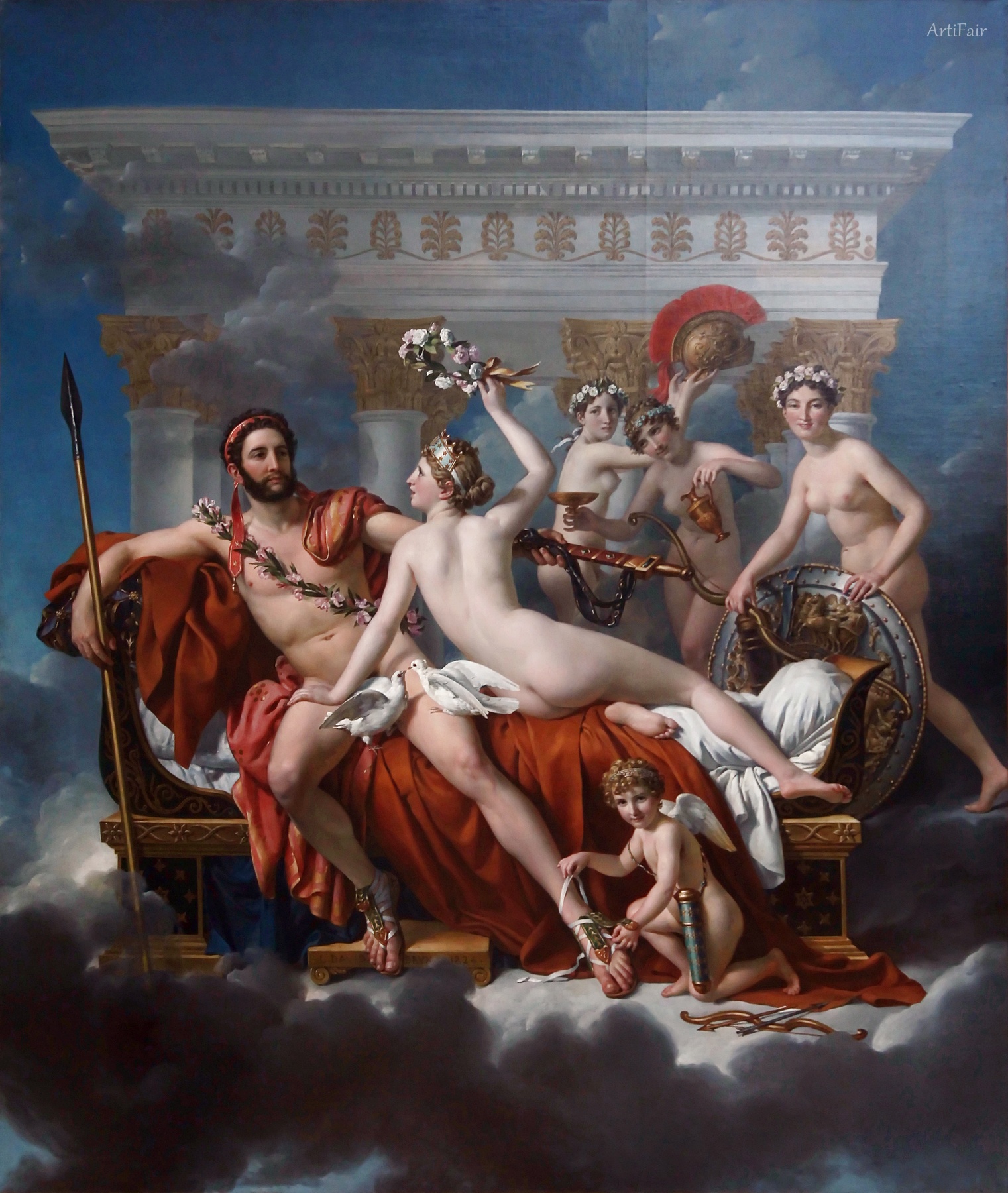
Mars Being Disarmed by Venus
Category:
Created:
1824
Likes:
0
Dimensions:
Download:
New users get 4 free credits. 2K costs 1 credit; 4K and Ultra HD are priced by resolution. Public domain artworks can be used commercially.
Dominant colors
Public domain download summary
This artwork is provided as a public domain image resource. The 2K file costs 1 credit for everyday creative work, while 4K and Ultra HD files are priced by resolution.
Art Appreciation
Mars Being Disarmed by Venus (Mars désarmé par Vénus et les Grâces) is the last large painting by Jacques-Louis David, an oil on canvas measuring 308 × 265 cm, signed L. DAVID BRUX 1824, and held by the Royal Museums of Fine Arts of Belgium in Brussels (inv. 3261).
David painted it in exile in Brussels, where he had settled after the fall of Napoleon; he was in his seventies when he began it and worked on it for about three years. He sent the finished canvas to Paris for the Salon of 1824, at a moment when Romanticism was gaining ground there. Critics said relatively little about it at first, and those who did dwelt on technique rather than on the painter's political exile; its standing has risen since. Like Marat assassiné, it was bequeathed by Jules David-Chassagnol in 1886 and entered the museum in 1893.
In a temple floating on clouds, Venus, seen from behind, leans towards Mars and holds out a wreath of flowers, while the three Graces carry off his helmet and shield and pour nectar into a cup, and Cupid unlaces his sandal. Mars hands over his sword without looking at it but still holds his spear upright; two doves beside the couple stand for love. Most of the models came from the Théâtre de la Monnaie in Brussels: the actress Marie Lesueur posed for Venus, Lucien Petipa for Cupid, a subscriber to the theatre for Mars, and one of the Graces was the mistress of the Prince of Orange.
The picture mixes the idealised forms of mythological painting with close, almost realist attention to bodies and objects, a combination already tried in David's Love and Psyche. Art historians have read the triumph of love over war as a turn away from the stern masculine heroism of works such as the Oath of the Horatii, and Philippe Bordes and Satish Padiyar have discussed it as David reworking, even disarming, his own earlier Neoclassical language.