
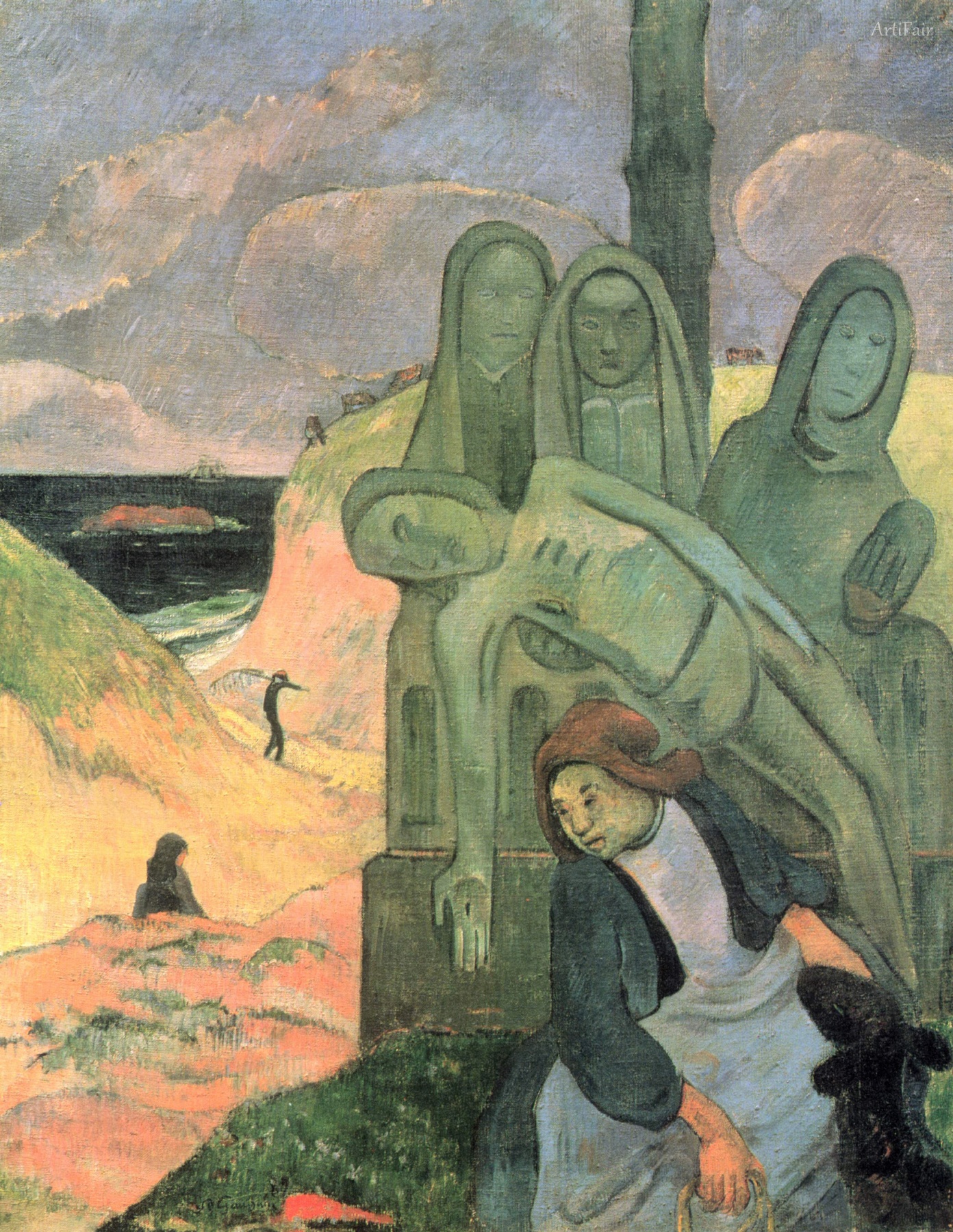
The Green Christ
Category:
Created:
1889
Likes:
0
Dimensions:
Download:
New users get 4 free credits. 2K costs 1 credit; 4K and Ultra HD are priced by resolution. Public domain artworks can be used commercially.
Dominant colors
Public domain download summary
This artwork is provided as a public domain image resource. The 2K file costs 1 credit for everyday creative work, while 4K and Ultra HD files are priced by resolution.
Art Appreciation
The Green Christ (Le Christ vert), catalogued by its owner as Le calvaire breton (The Breton Calvary), is an oil on canvas painted by Paul Gauguin in Brittany in 1889; it measures 92 × 73.5 cm and belongs to the Royal Museums of Fine Arts of Belgium in Brussels (inv. 4416).
Gauguin made the picture while based at Pont-Aven, shortly before The Yellow Christ. It belongs to a small group of religious canvases from that year, including The Yellow Christ and the Self-Portrait with the Yellow Christ, which the critic Manuel Jover has called the original core of Symbolism in painting. Like its companion, it uses the region's carved stone calvaries, emblems of the deep Catholic faith of the Breton people, to give a religious subject a local, present-day setting.
The monument shown is not a crucifixion but a pietà: the Virgin holds the dead Christ, taken down from the cross, his right arm hanging straight with the palm open, while two other holy women stand on either side and the base of the calvary's shaft rises behind them. The whole group is weathered to a mossy green. French sources identify the pietà with the calvary beside the church at Nizon near Pont-Aven, while other accounts describe the monument as an amalgam of several calvaries. Gauguin moved it to the coast, setting it before the high yellow dunes of Le Pouldu, which open onto a dark green sea where two small figures walk. In the foreground a tired-looking Breton woman in traditional dress sits at the foot of the sculpture, with a black sheep beside her. Rather than aiming at realism, Gauguin used unnatural colour and simplified forms to convey suffering.
The canvas is signed and dated '89 / P.Gauguin' near the lower left. By 1922 it belonged to the Brussels dealer Joseph Breckpot, from whom the Belgian museums acquired it that year.