
Cupid and Psyche (preparatory drawing)
Category:
Created:
1813
Likes:
0
Dimensions:
Download:
New users get 4 free credits. 2K costs 1 credit; 4K and Ultra HD are priced by resolution. Public domain artworks can be used commercially.
Dominant colors
Public domain download summary
This artwork is provided as a public domain image resource. The 2K file costs 1 credit for everyday creative work, while 4K and Ultra HD files are priced by resolution.
Art Appreciation
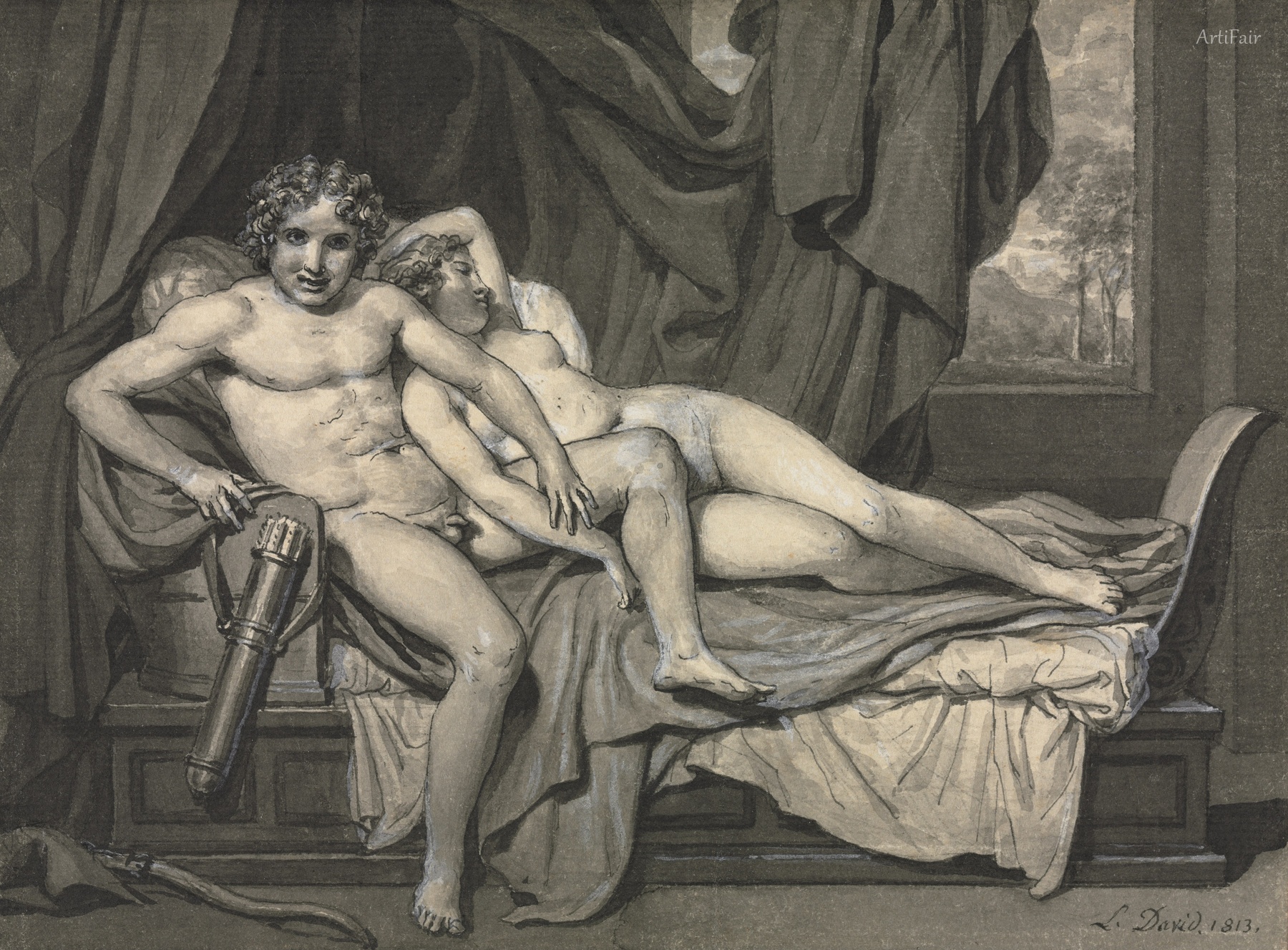
This Cupid and Psyche is a drawing by Jacques-Louis David in grey wash and pen and black ink with white paint and traces of black chalk, signed and dated L. David 1813 at lower right; the sheet measures 16.7 × 22.4 cm and belongs to the Cleveland Museum of Art (2002.91), which also owns the painting it prepares.
David began planning Cupid and Psyche in Paris in 1813, while Napoleon was still in power, and completed the canvas in 1817 in exile in Brussels for the collector Gian Battista Sommariva; it was the first painting he finished in exile. According to Cleveland, this sheet belongs to a group of preparatory studies in which David worked the looser charcoal sketches up into a finished design. The composition is already fully fixed here, and only minor details, such as Cupid's facial expression, changed in the 184.2 × 241.6 cm painting. Using only diluted grey wash and black outlines, David anticipated the exact appearance of the final canvas.
The subject comes from the Metamorphoses of Apuleius. Cupid visits the mortal Psyche every night on condition that she never learns who he is, and leaves before dawn. David shows the morning: Psyche still sleeps on the bed while Cupid sits up, about to slip away, his quiver in hand and his bow on the floor and a window opening on a landscape behind. In place of the graceful adolescent of tradition, David's Cupid is an awkward, knowing teenager, a choice that led many critics in 1817 to see the painting as a sign of his decline, though art historians now read it as a deliberate break with idealised mythology.
The artist gave the drawing to the comte de Forbin (1777–1841). It passed through a Paris sale in 1973, where artist and date were misidentified, and several dealers and collectors before Cleveland acquired it.