
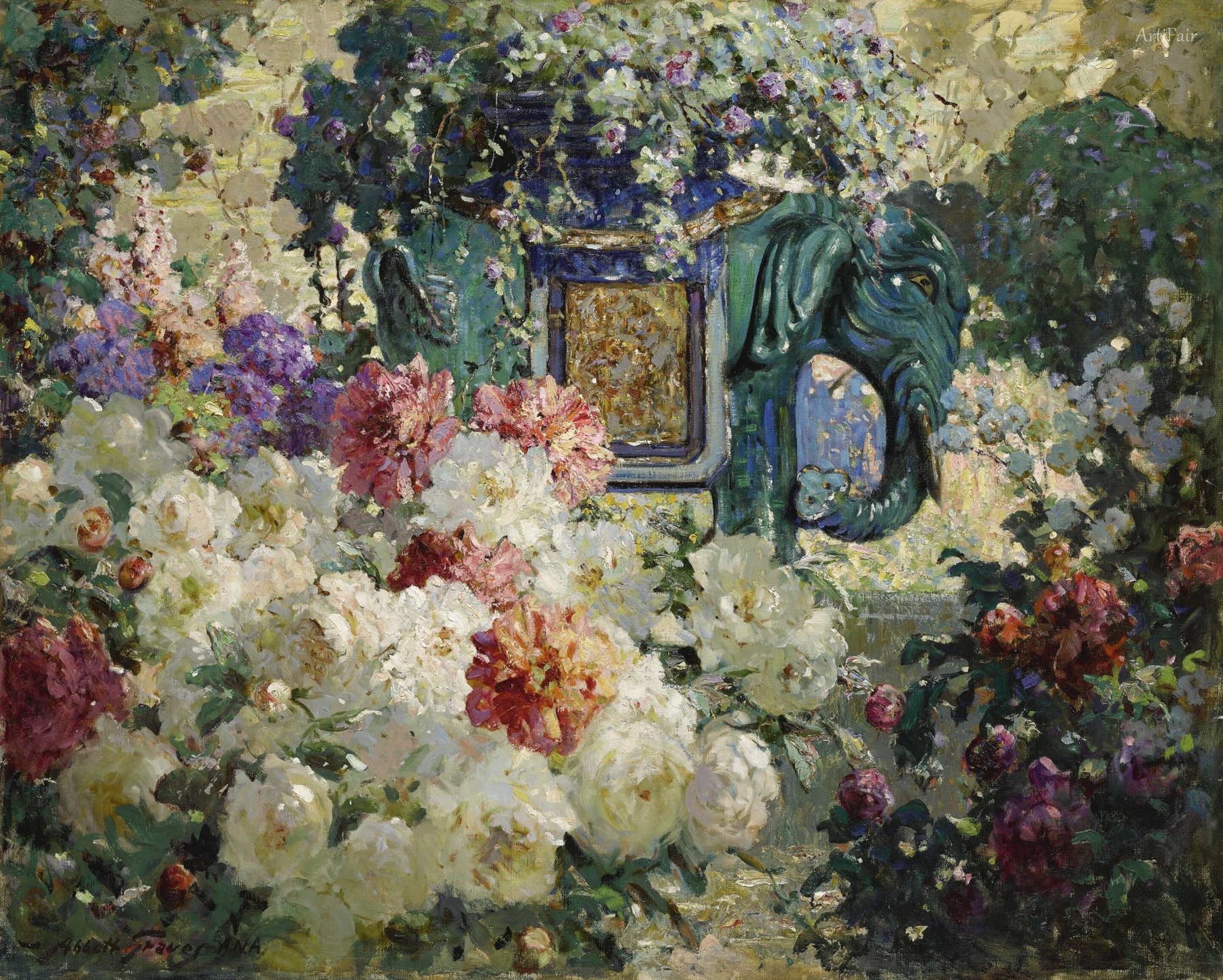
In My Wife's Garden
Category:
Created:
1930
Likes:
0
Dimensions:
Download:
New users get 4 free credits. 2K costs 1 credit; 4K and Ultra HD are priced by resolution. Public domain artworks can be used commercially.
Dominant colors
Public domain download summary
This artwork is provided as a public domain image resource. The 2K file costs 1 credit for everyday creative work, while 4K and Ultra HD files are priced by resolution.
Art Appreciation
In My Wife's Garden is an oil on canvas by the American painter Abbott Fuller Graves, painted around 1930 and signed 'Abbott Graves A.N.A.' at lower left; it was last offered at Sotheby's New York in 2018.
Graves (1859–1936) trained in Boston and Paris, where he studied figure painting at the Académie Julian, and after 1891 devoted most of his output to gardens and flower pieces, the field in which he was widely known by the time of his death. He summered in Kennebunkport, Maine, from 1891 and in 1905 built a year-round house there to his own Prairie-style design, which remained his home until he died. After 1922 he spent his winters in New York City, where he belonged to the National Academy of Design, the National Arts Club and the Salmagundi Club.
The large canvas, 101.6 by 127 cm (40 by 50 inches), shows a sunlit border crowded with white, pink and crimson peonies, with tall spikes of blue and pink flowers at left. Behind them stands a green glazed ceramic garden seat in the form of an elephant, carrying a blue-and-gold planter that spills over with small violet blossoms. The thick, broken brushwork and bright outdoor light are typical of the impressionist manner Graves adopted for his garden scenes.
The painting was probably owned first by Warren Cochrane of Kennebunk, Maine, then by Mrs. Homer Strong of Rochester, New York, who bequeathed it to the Strong National Museum of Play. The museum sold it at Christie's New York on 4 March 2010 to benefit its collections fund, and it was offered again at Sotheby's New York on 28 March 2018. Both catalogues cite an illustration in the Ladies' Home Journal of September 1925, in an article titled 'An Artist's Restoration Magic with Old Dwellings'.