Back to gallery
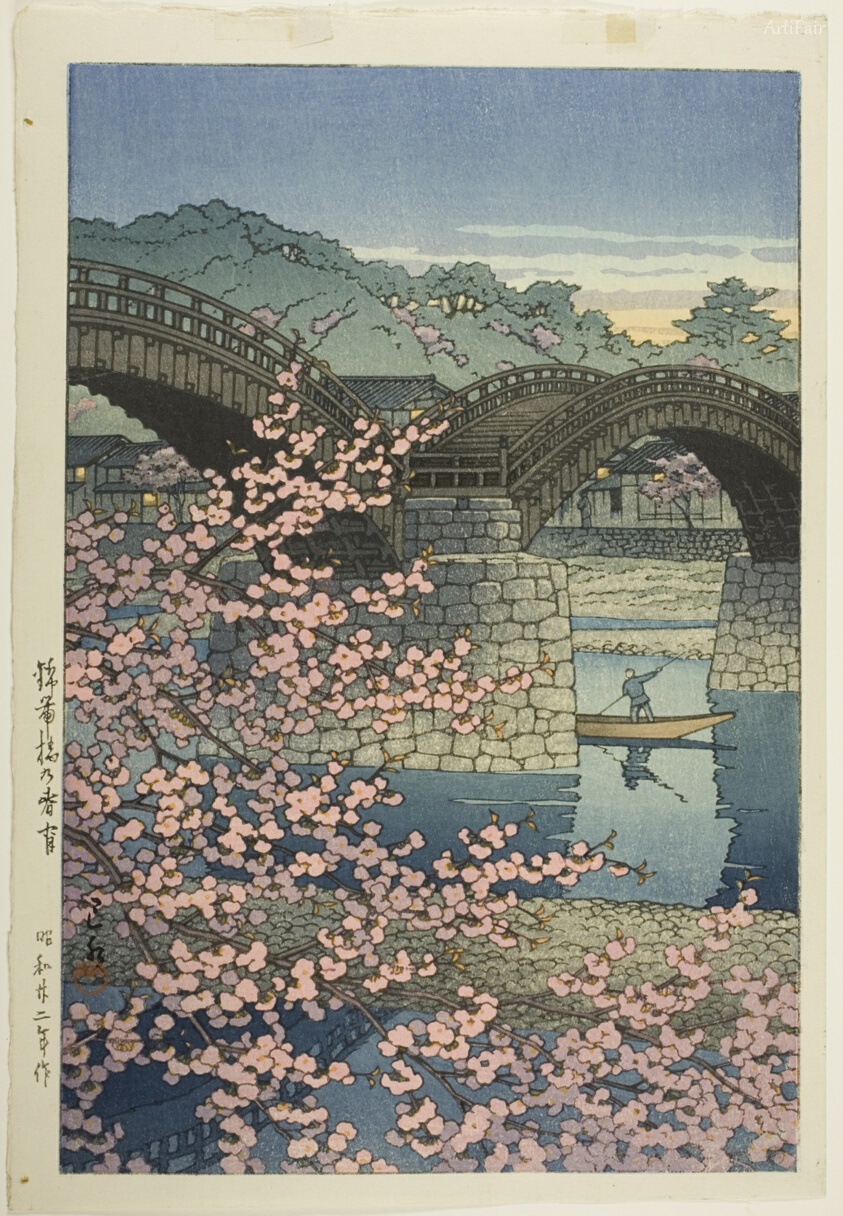
Spring Evening at the Kintai Bridge

Art Appreciation

This evocative woodblock print captures a serene spring evening at the iconic Kintai Bridge, where the delicate blossoms of cherry trees frame a gently flowing river beneath gracefully arched wooden spans. The artist’s razor-sharp attention to detail—the textured stone pillars and soft ripples on the water—transports the viewer into a peaceful reverie, where the muted blues and pinks of twilight merge in harmonious contrast. The quiet silhouette of a boatman propels his vessel beneath the bridge, suggesting a tranquil yet fleeting moment of life quietly unfolding.

The composition masterfully balances foreground and background, with the curving bridge creating rhythm and movement across the scene, leading the eye from foreground cherry blossoms through the middle watery expanse and onto distant tree-lined banks beneath a softening sky. The gentle gradation of color and delicate line work characteristic of the shin-hanga tradition breathe subtle life into the print, evoking not only the beauty of nature but also a nostalgic emotional resonance—a wistful pause in the rhythm of modernity. Its historical significance lies in capturing a traditional icon during the early 20th century, bridging eras and artistic styles with the refined elegance typical of this period.

Spring Evening at the Kintai Bridge

Hasui Kawase

Category:

Created:

1927

Likes:

0

Dimensions:

843 × 1216 px

Download:

Related artworks

Akasaka Benkei Bridge
Travel Notes I (First Collection of Travel Souvenirs) Kanazawa Asanogawa 1920
Scenery Collection of Japan: Hizen Kanie Beach 1923
Travel Notes II (Travel Souvenirs, Second Collection) Koshu Somagawa 1921
View of Unzen Mountain from Amakusa
Travel Notes I (Miyage Izu Islands, Matsushima) 1919
Snow on the Shinkyo Bridge, Nikko
Nikko Futatsudo 1928
Twenty Views of Tokyo: Asakusa Kannon After Snow
Twelve Scenes of Tokyo: Snow at Terajima Village
Moon over Miyagi Prefecture
Morning at Okayama Castle
Travel Notes III (Osaka Kōzu, 1924)