
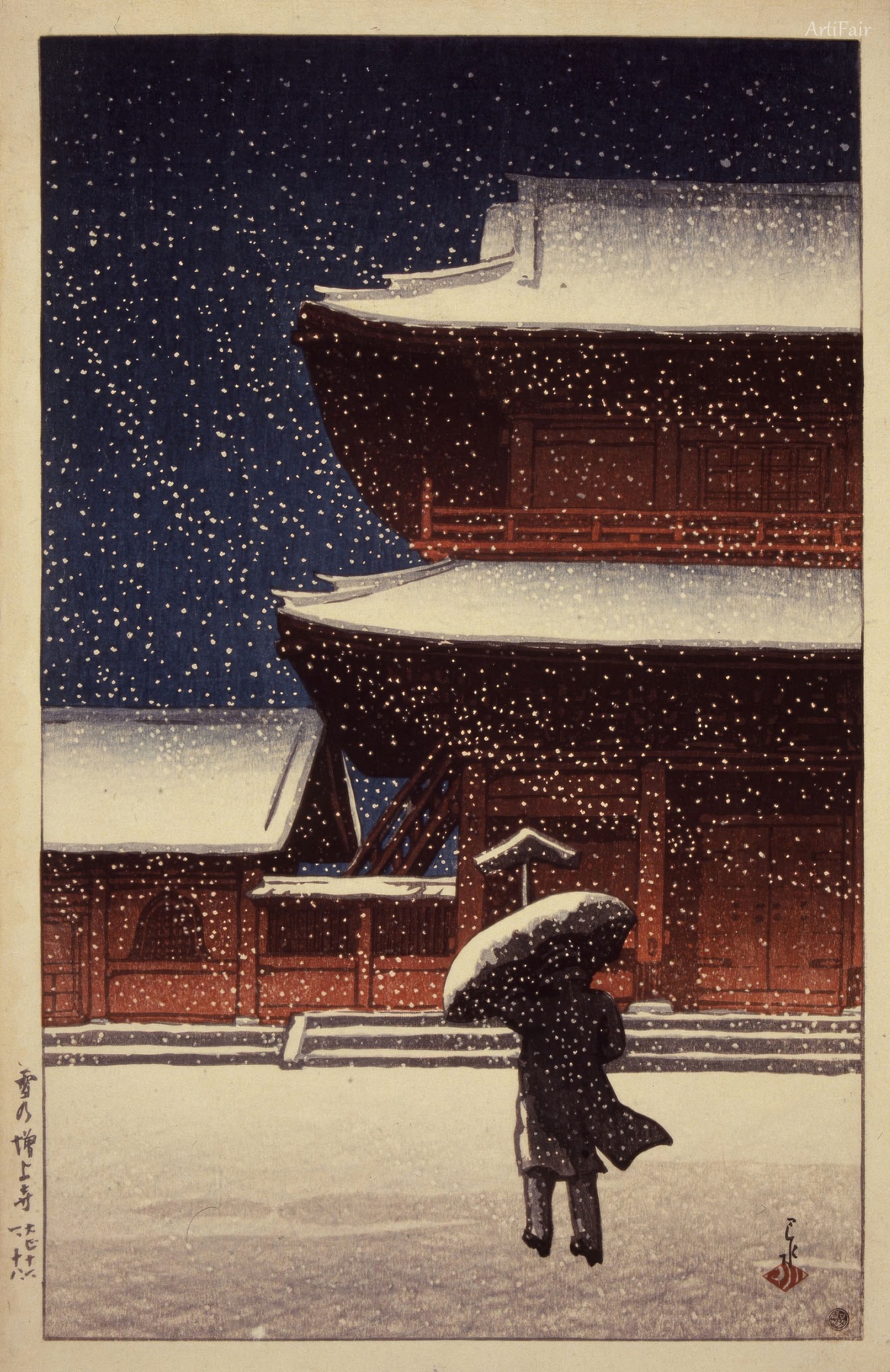
Snow at Zojoji Temple
Category:
Created:
1922
Likes:
1
Dimensions:
Download:
New users get 4 free credits. 2K costs 1 credit; 4K and Ultra HD are priced by resolution. Public domain artworks can be used commercially.
Dominant colors
Public domain download summary
This artwork is provided as a public domain image resource. The 2K file costs 1 credit for everyday creative work, while 4K and Ultra HD files are priced by resolution.
Art Appreciation
Snow at Zōjō-ji (Yuki no Zōjōji) is a woodblock print by the Japanese printmaker Kawase Hasui, issued in 1922 as part of the series Tabi Miyage dai nishū (Souvenirs of Travel, second series) and published by Watanabe Shōzaburō.
Hasui was the leading landscape designer of the shin-hanga ('new prints') movement, and this vertical ōban print, about 30.8 by 22.5 cm, is among his earliest and most sought-after snow scenes. According to the scholar Narazaki it was produced in an edition of about 100 impressions, and it is counted among the finest of all pre-earthquake Hasui prints — the Great Kantō earthquake of September 1923 destroyed Watanabe's workshop, woodblocks and stock, closing the first phase of Hasui's career.
The print shows the gate of Zōjō-ji, the Buddhist temple in the Shiba district of Tokyo, in a heavy snowstorm. A man in Western-style dress walks toward the temple through the blizzard, an umbrella on his back — one of the first appearances of modern western clothing in Hasui's prints. Snowbound temple views became a signature subject for him: the Japanese government commissioned another Zōjō-ji snow design in 1953, and Hasui was designated a Living National Treasure in 1956.
Impressions of the print are held by the Honolulu Museum of Art and the Los Angeles County Museum of Art, among other collections. Because Hasui returned to Zōjō-ji in snow several times — most famously in a different, larger 1953 design — this small 1922 print should not be confused with the later versions.