
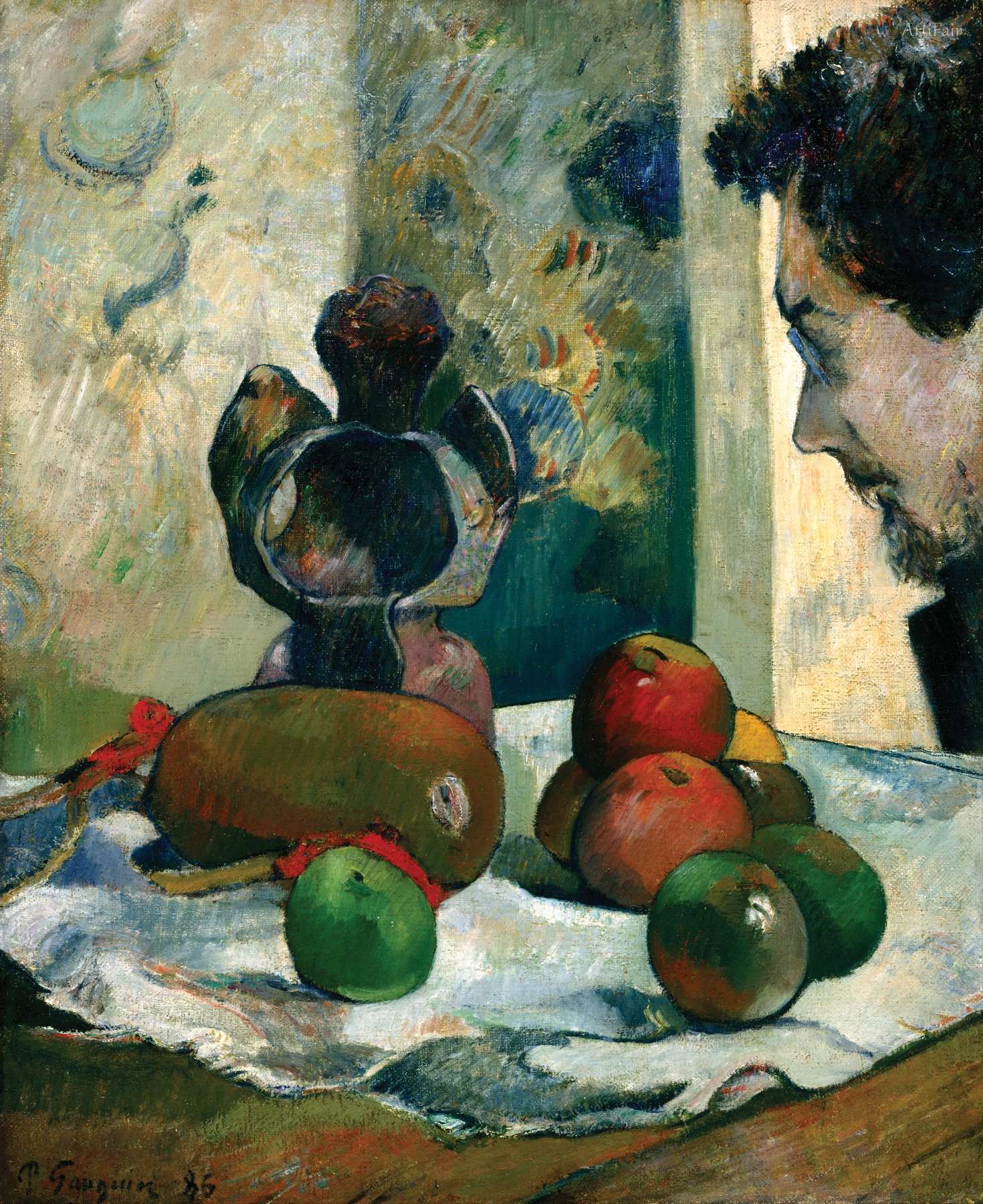
Still Life with Profile of Laval
Category:
Created:
1886
Likes:
0
Dimensions:
Download:
New users get 4 free credits. 2K costs 1 credit; 4K and Ultra HD are priced by resolution. Public domain artworks can be used commercially.
Dominant colors
Public domain download summary
This artwork is provided as a public domain image resource. The 2K file costs 1 credit for everyday creative work, while 4K and Ultra HD files are priced by resolution.
Art Appreciation
Still Life with Profile of Laval is an oil on canvas painted by Paul Gauguin in Paris in late 1886; measuring 46 × 38.1 cm, it belongs to the Indianapolis Museum of Art at Newfields (1998.167).
Gauguin met the younger painter Charles Laval during his first stay at Pont-Aven in Brittany in the summer of 1886, and Laval soon became his pupil. Back in Paris that autumn Gauguin took up ceramics, which he valued both as art and as a source of income, and the tall, strange stoneware vessel at the centre of the picture is one of his own pieces. Because it cannot have been made before October, it dates the canvas to the very end of 1886. Gauguin told his wife Mette that the pot was worth 100 francs; its present whereabouts are unknown.
The picture combines portrait and still life and openly borrows from two artists Gauguin admired. Laval's head, abruptly cut off by the right edge, recalls the off-centre cropping of Edgar Degas, while the arrangement of fruit on a rumpled cloth and its parallel, outlined brushstrokes point to Paul Cézanne. Between them sits Gauguin's own ceramic, which Laval studies intently. The work has been read as the first in a series of paintings about the difficulties of creation, with Laval standing in for the viewer trying to guess the artist's next move.
Gauguin gave the painting to Laval in 1887. It later passed through Émile Schuffenecker and the Galerie Miethke in Vienna, was lent by Baron Mór Lipót Herzog of Budapest to the Cologne Sonderbund exhibition of 1912, and in 1944 was seized from the Herzog family's storage by the Hungarian State Security Police. Taken to Bavaria in 1945, it was recovered by the Monuments Man Thomas Carr Howe and restituted in 1948. The Swiss collector Samuel Josefowitz bought it at Christie's New York in 1980, and it came to Indianapolis in 1998 with his collection of the School of Pont-Aven.