
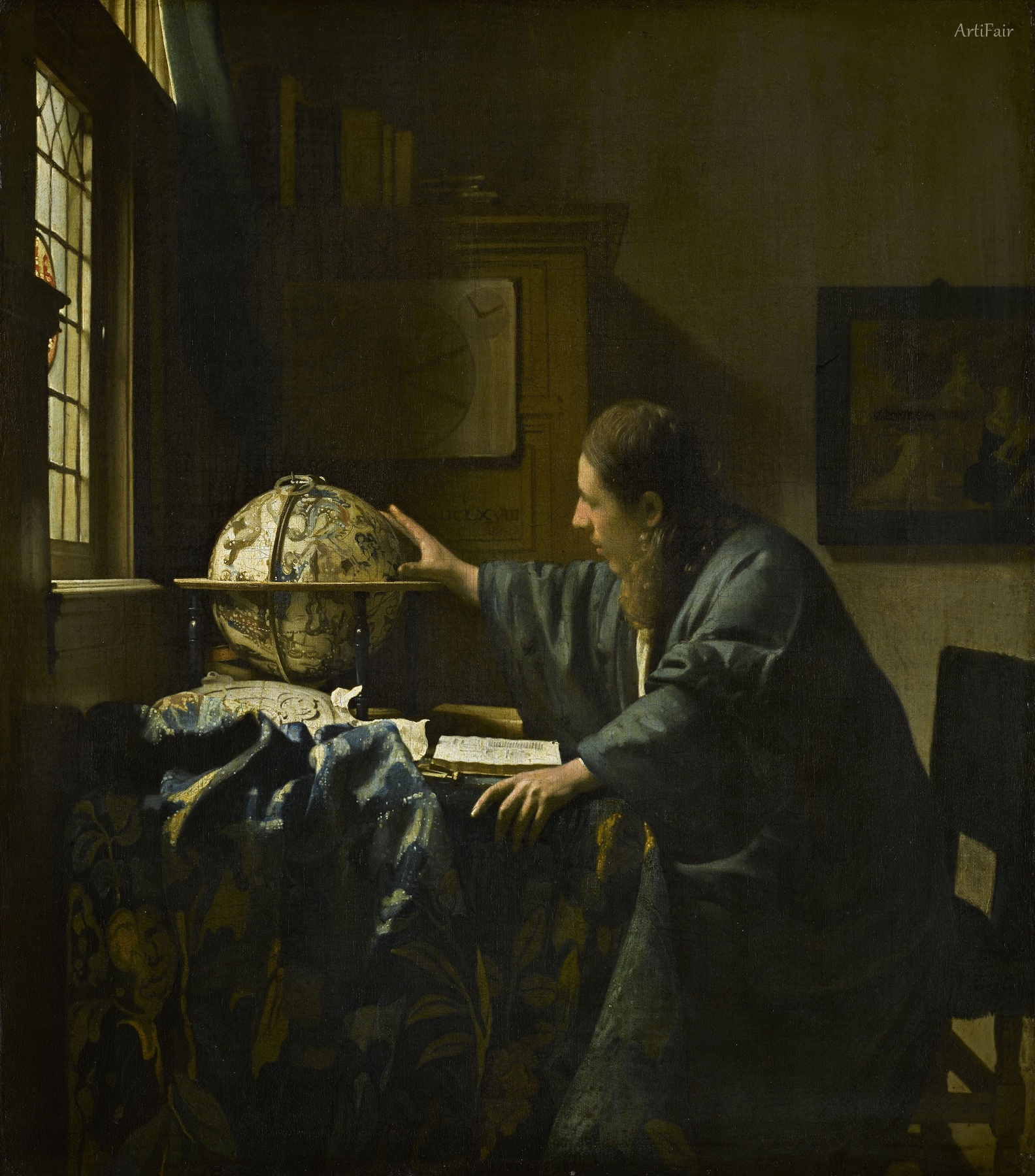
The Astronomer
Category:
Created:
1668
Likes:
0
Dimensions:
Download:
New users get 4 free credits. 2K costs 1 credit; 4K and Ultra HD are priced by resolution. Public domain artworks can be used commercially.
Dominant colors
Public domain download summary
This artwork is provided as a public domain image resource. The 2K file costs 1 credit for everyday creative work, while 4K and Ultra HD files are priced by resolution.
Art Appreciation
The Astronomer (L'Astronome, also called The Astrologer) is an oil on canvas, 51 × 45 cm, by Johannes Vermeer, signed and dated 1668; it is in the Musée du Louvre, Paris (RF 1983-28).
Scholars at work were a favourite subject in Dutch painting, and Vermeer treated it twice, here and in The Geographer of 1669, now in the Städel Museum, Frankfurt. The two show the same room and furniture, apparently the same model, and a 2017 study found that their canvases came from the same bolt of cloth. The Louvre notes that they are less strict pendants than close variations on one theme, and that the sitter's identification with the scientist Antonie van Leeuwenhoek is unproven. The signature and date, 'IVMeer' with the year in Roman numerals, are slightly retouched and have sometimes been read as 1673.
The man leans from his chair to touch a celestial globe by Jodocus Hondius of 1600. On the table lies Adriaan Metius's astronomy manual in its 1621 edition, open at the section on the stars, beside an astrolabe and compasses. On the wall behind hangs a Finding of Moses, which the Louvre attributes to Peter Lely's Dutch period and reads as an allusion to divine providence set against the astronomer's search for knowledge. Light from the window falls across the globe, the man's face and the heavy patterned cloth on the table.
The two paintings were sold together in Rotterdam in 1713 and in Amsterdam in 1720, where The Astronomer was called 'top-notch', and stayed together until 1797. The Astronomer later belonged to Alphonse de Rothschild and his heirs in Paris. In 1940 it was seized by the Nazi looting agency ERR, stamped with a swastika on the back and earmarked for Hitler's planned museum in Linz. Returned to the family after the war, it was accepted by the French state in lieu of inheritance tax by personal decision of Guy de Rothschild and entered the Louvre in 1983, joining The Lacemaker as the only other Vermeer in the French national collections.