
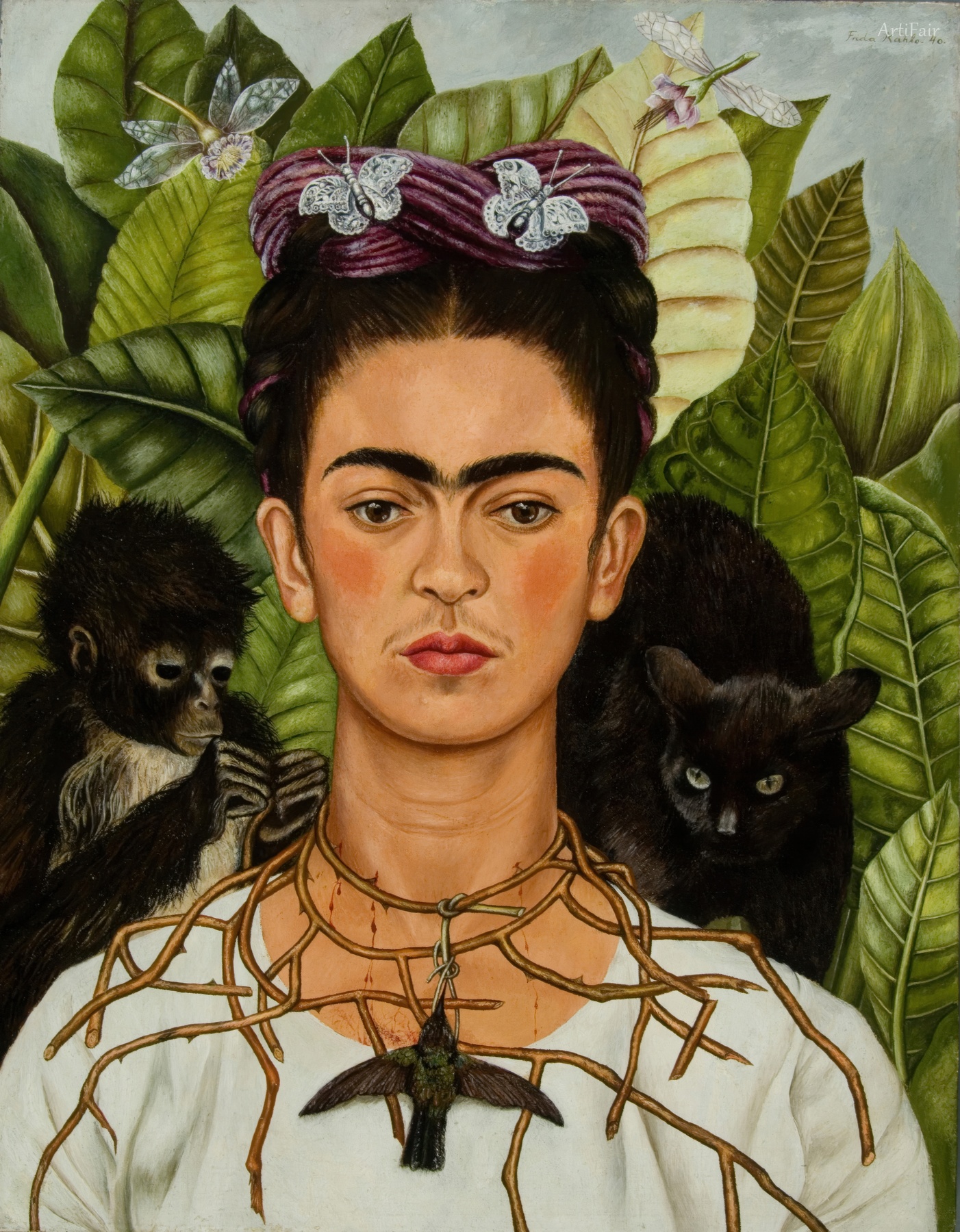
Self-Portrait with Thorn Necklace and Hummingbird
Category:
Created:
1940
Likes:
0
Dimensions:
Download:
New users get 4 free credits. 2K costs 1 credit; 4K and Ultra HD are priced by resolution. Public domain artworks can be used commercially.
Dominant colors
Public domain download summary
This artwork is provided as a public domain image resource. The 2K file costs 1 credit for everyday creative work, while 4K and Ultra HD files are priced by resolution.
Art Appreciation
Self-Portrait with Thorn Necklace and Hummingbird (Autorretrato con collar de espinas y colibrí) is a 1940 oil painting by the Mexican artist Frida Kahlo, held by the Harry Ransom Center at the University of Texas at Austin as part of the Nickolas Muray Collection of Mexican Art.
Kahlo painted it shortly after her divorce from Diego Rivera and the end of her affair with the photographer Nickolas Muray; Muray bought the portrait soon after it was finished, and the university acquired it with his collection in 1966. The small canvas mounted to board — about 61 by 47 cm — shows her head and shoulders before a wall of dense leaves, a format typical of her mature portraiture.
A necklace of thorns bites into her throat, drawing small wounds, and from it hangs a dead black hummingbird with outstretched wings like a pendant: in Mexican folklore a hummingbird is a charm for luck in love, though it has also been read as an allusion to Huitzilopochtli, the Aztec god of war, or to Christ's crown of thorns. Behind her right shoulder a spider monkey — her pet, a gift from Rivera — tugs at the necklace, while a black cat with ice-blue eyes peers from the foliage at the left; dragonflies and butterfly clips hover in her elaborate hair, read by some writers as signs of resurrection amid symbols of ill omen.
The Ransom Center calls the work a principal example of Kahlo's mature-style self-portraiture and her direct, confrontational gaze one of its defining features. In recent decades it has traveled widely, appearing in exhibitions in Philadelphia, Los Angeles, Quebec City, Mexico City, Rome, New York and Boston.