
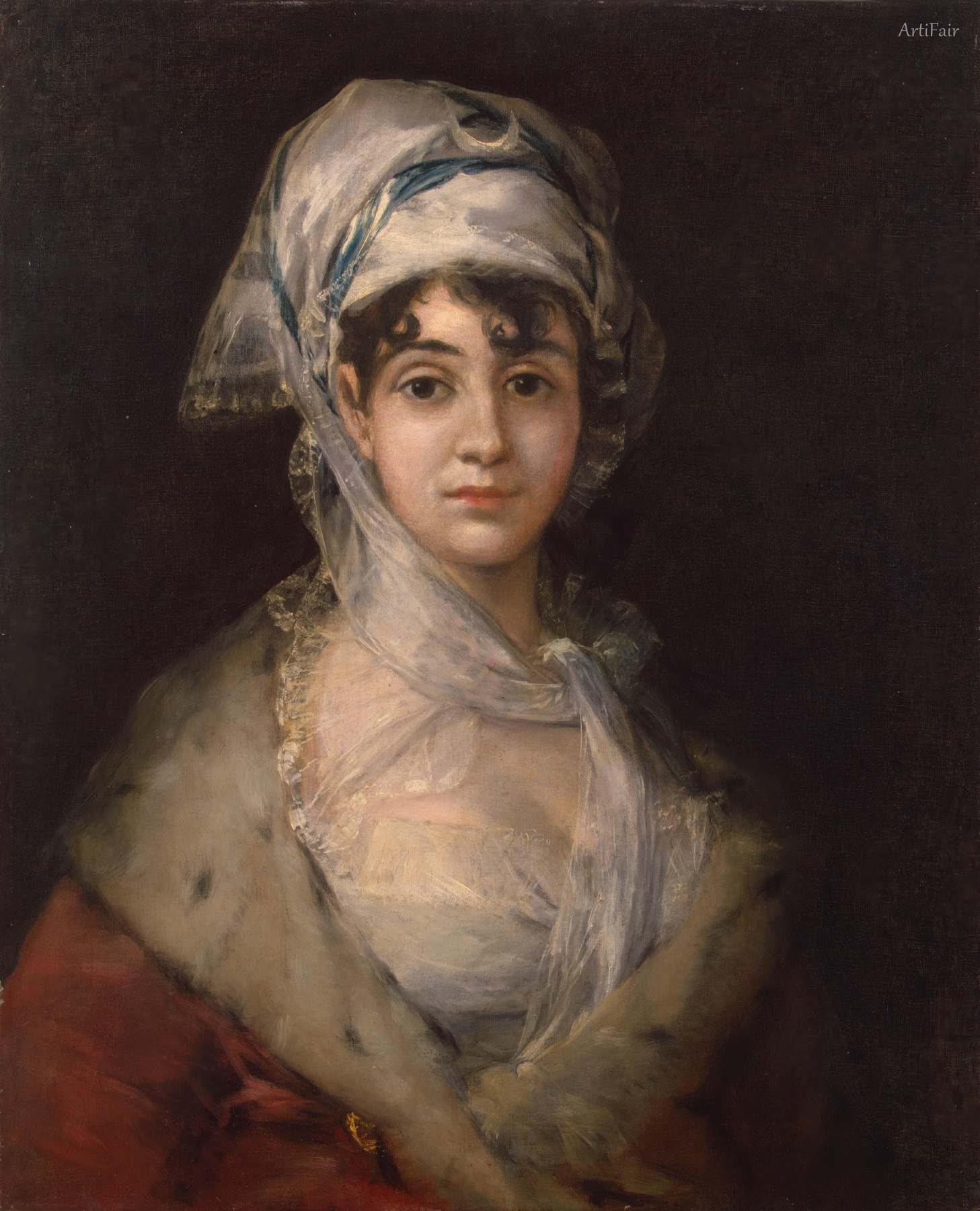
Portrait of the Actress Antonia Zárate
Category:
Created:
1810
Likes:
0
Dimensions:
Download:
New users get 4 free credits. 2K costs 1 credit; 4K and Ultra HD are priced by resolution. Public domain artworks can be used commercially.
Dominant colors
Public domain download summary
This artwork is provided as a public domain image resource. The 2K file costs 1 credit for everyday creative work, while 4K and Ultra HD files are priced by resolution.
Art Appreciation
Portrait of the Actress Antonia Zárate is an oil-on-canvas half-length portrait by Francisco Goya, dated 1810–1811, in the State Hermitage Museum, St Petersburg (inventory ГЭ-10198); it measures 71 × 58 cm.
Antonia Zárate (1775–1811) was born in Barcelona, the daughter of an actor and theatre manager, and became a well-known actress and singer on the Madrid stage. Her husband Bernardo Gil was a comic actor and tenor, and their son Antonio Gil y Zárate became a poet and dramatist. She belonged to the circle of the playwright Leandro Fernández de Moratín, a close friend of Goya. Goya painted her twice: the other portrait, a more formal seated figure in a black dress and mantilla on a yellow sofa, is in the National Gallery of Ireland, Dublin, and is usually placed earlier. According to Francisco Calvo Serraller, the Hermitage picture may have been commissioned by her son after her death in 1811, with Goya reusing the earlier likeness, which would explain the near-identical nose, mouth and the two curls falling on her forehead.
She is shown against a flat dark ground, probably in stage costume: a white headscarf with a crescent ornament, a translucent band knotted at the throat, and a reddish cloak with a wide fur collar fastened by a gold button. The role it belongs to has not been identified. The fabrics are painted with quick, energetic strokes, and the Goya scholar José Gudiol observed that the plain background, with no effects of light or depth, works as a contrast that gives the figure its intensity.
The portrait stayed with the sitter's son and other Spanish owners before passing through Gimpel et Wildenstein in Paris and the New York collector Howard B. George. Armand Hammer acquired it and gave it to the Hermitage in 1972. Some writers have described it as by Goya or his studio; if it is autograph, it is the only painting by Goya in a Russian collection. In 1985 the Soviet post issued a souvenir sheet with two stamps reproducing it.