
The North-West Passage
Category:
Created:
1874
Likes:
0
Dimensions:
Download:
New users get 4 free credits. 2K costs 1 credit; 4K and Ultra HD are priced by resolution. Public domain artworks can be used commercially.
Dominant colors
Public domain download summary
This artwork is provided as a public domain image resource. The 2K file costs 1 credit for everyday creative work, while 4K and Ultra HD files are priced by resolution.
Art Appreciation
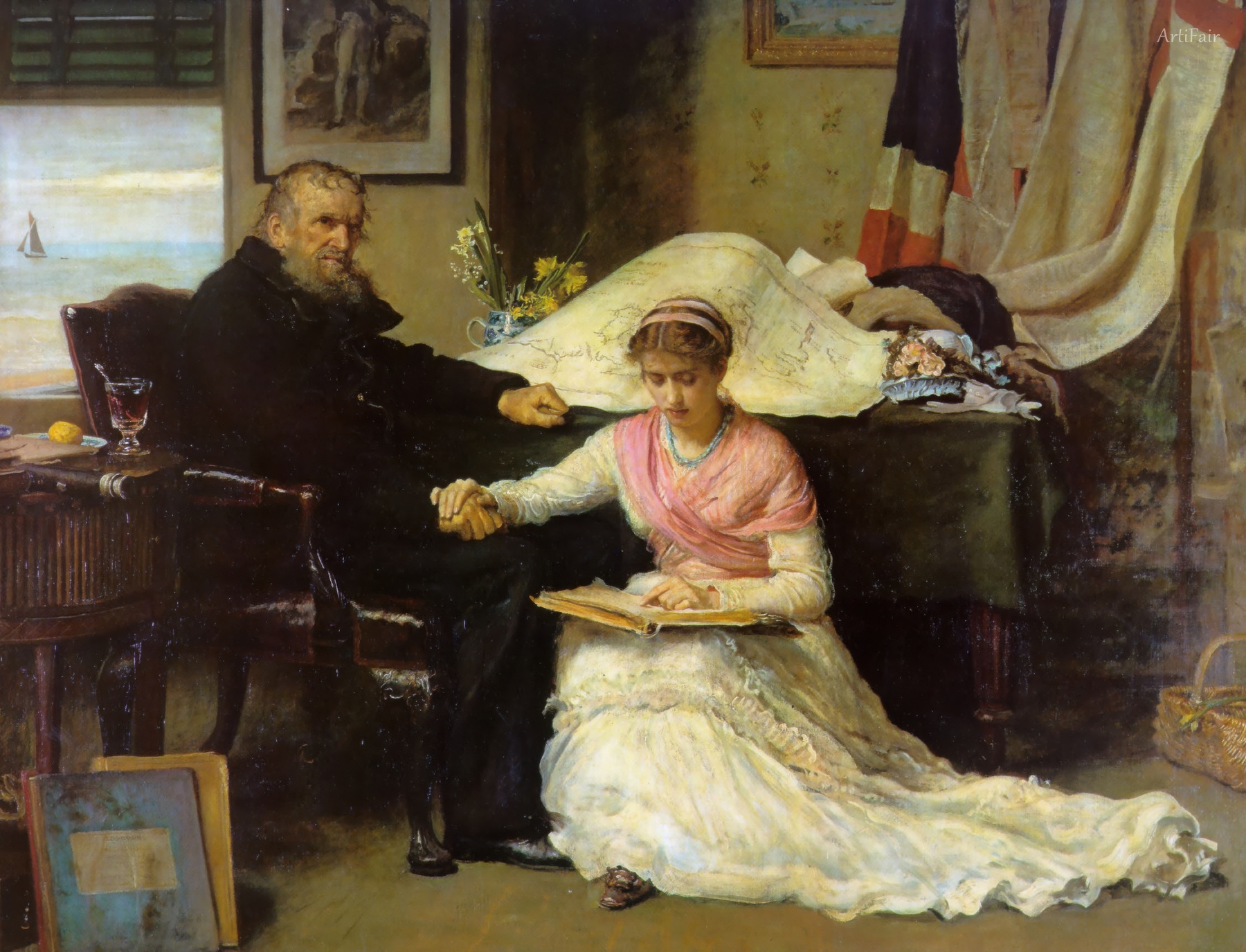
The North-West Passage is an oil painting on canvas by John Everett Millais, shown at the Royal Academy in 1874 and presented to the nation by Sir Henry Tate; it belongs to Tate in London.
The North-West Passage, a sea route around the top of North America through the Canadian Arctic, had been sought by European explorers since the voyages of Henry Hudson in the early seventeenth century. The quest became bound up with failure and death, above all after John Franklin's expedition of 1845 vanished in the ice. Millais conceived the picture while a new attempt, the British Arctic Expedition of 1875–76 under George Nares, was being prepared, and exhibited it with the subtitle 'It might be done and England should do it', words imagined as spoken by the old sailor.
The seaman was modelled by the adventurer Edward John Trelawny, whom Millais had met at the funeral of their friend John Leech; Effie Millais persuaded him to sit by agreeing to try a Turkish bath he was promoting. The daughter reading from the log book was a professional model, Mrs Ellis. On the table lies a printed chart of the northern coast of Canada as surveyed on Robert McClure's expeditions of 1848–53, and a picture of an ice-bound ship on the wall resembles McClure's HMS Investigator, abandoned in 1853. Millais first painted two grandchildren with a globe at the right, posed by his own children John and Alice, but he cut that section out and replaced it with a screen hung with naval flags. Trelawny, a teetotaller, was furious to find himself shown with a glass of grog and a lemon.
The picture was praised at the Academy, shown at the Paris International Exhibition in 1876 and bought by the industrialist Henry Bolckow. Tate purchased it from Bolckow's estate in 1888 for 4,000 guineas. Widely reproduced, it was parodied by John Tenniel in Punch in October 1874, with Disraeli as the sailor, and later helped inspire George Bernard Shaw's Heartbreak House. The canvas measures 176.5 by 222.2 cm.